Anti-Fascist Writers, Fascist Family Legacies: Reading Nicholas Mosley in 2026
Tobias Carroll on the Shockingly Mixed Legacy of England’s Mosley Family
There’s a long tradition of artists and activists using their platforms to take issue with the reactionary politics of their parents. We’ve seen that this year with Vivian Wilson vocally pushing back against the far-right and anti-trans positions of her father, Elon Musk. Earlier this century, poet and musician David Berman publicly wrestled with the conservative lobbying work done by his father, the lawyer Richard Berman. And then there’s the case of Nicholas Mosley (1923-2017), author of dozens of works of fiction and nonfiction, a man whose bibliography includes everything from tales of near-future espionage to 1965’s Experience & Religion: A Lay Essay in Theology.
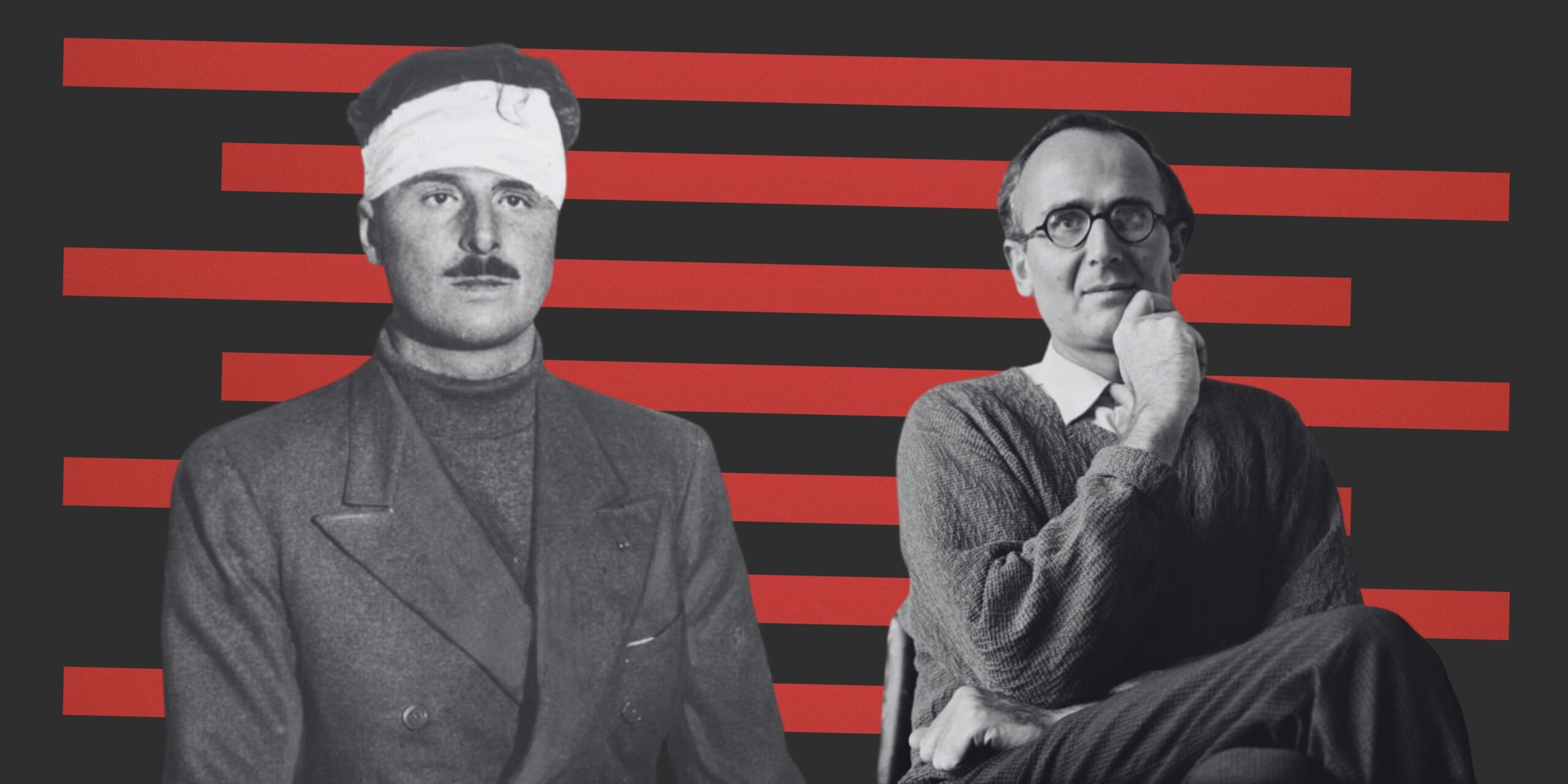
Even if you haven’t read one of his books, Mosley’s surname may sound familiar. That’s likely due to the infamy of his father, Oswald Mosley—a politician and aristocrat best known for founding the British Union of Fascists in the 1930s. (Through his father’s second marriage, Nicholas is also connected to another well-known British family: his stepmother was Diana Mitford.) To say that Nicholas did not share his father’s politics is an understatement, but much of his bibliography can be seen as a reckoning with his father’s unsettling career in politics and disquieting legacy.
In some cases, that reckoning is overt: 2006’s Time At War is a memoir of Nicholas’s time fighting in World War II, a conflict he joined in part to balance out his father’s pro-Nazi beliefs. In Rules of the Game and Beyond the Pale (published in 1982 and 1983, and revised a decade later), subtitled “Memoirs of Sir Oswald Mosley and Family,” Nicholas traces his father’s erratic political trajectory in his pre-fascist days and meticulously describes a harrowing experience: what happens when one of the people you’re closest to in life turns out to hold political beliefs that you utterly despise?
*
His father’s infamy has cast an ominous shadow over Nicholas Mosley’s career. In her 2009 book Nicholas Mosley’s Life and Art: A Biography in Six Interviews, Shiva Rahbaran writes that Oswald Moslsey’s fascism “has also prevented a large readership from access to and appreciation of [Nicholas] Mosley’s literary oeuvre.” The six interviews that comprise this book are often candid, in the manner of some late-career reflections. Nicholas Mosley died eight years after the book’s publication, and his responses to Rahbaran’s questions are open, whether he’s discussing his books or his romantic relationships.
The first interview addresses the Mosley family, and finds Nicholas discussing his father’s political evolution. He says of his father, “He had been a Conservative and then a socialist and only thought of becoming a fascist when he saw that the old parties were carrying out none of their undertakings.” This is a very compact description of the elder Mosley’s political evolution, which can come off as dizzying to modern readers: while history abounds with thinkers who moved from right to left or vice versa, Oswald Mosley’s move from right to left to far right plays out a bit like the personal embodiment of horseshoe theory.
Reading Nicholas Mosley’s nonfiction reveals a writer concerned with the sins of the past, with political maneuvering at the highest levels of government, and of personal and ideological betrayals.
One of the running themes of Time at War, Rules of the Game, and Beyond the Pale is the challenge that Nicholas Mosley faced in terms of breaking with his father decisively. In Time at War, Nicholas writes about going to fight in World War II in part to break with his father’s beliefs, but he writes that there was still a lingering influence there: “My being under the influence of my father in thinking the war was a bit of an irrelevance and dreaming of being taken prisoner.”
And in Beyond the Pale, Nicholas writes of himself at sixteen, wrestling with both his rebellion with and admiration for his father.
“I had developed a sort of patter by which I could defend my father’s points of view: I had also developed an arrogance which was at least in part, I suppose, a mechanism by which to protect myself and show sympathy with my father.”
That sense of both protectiveness and distancing will be familiar to most readers who have been sixteen; the difference, though, is that the parental figure that provoked these conflicting impulses was almost certainly not the founder of a fascist organization. And much of the story of Beyond the Pale is Nicholas’s ultimate break with his father, which came when the elder Mosley ran for office in 1959 and Nicholas witnessed his father making horrifically racist appeals to the electorate. Nicholas describes an argument between father and son where he argued that “what he was doing was not only wrong it was squalid; he had done this before, he was doing it again, was he so crazy as not to know what he was doing?”
More succinctly, in Time at War, Nicholas Mosley describes “the calamitous failures and destruction of [Oswald Mosley’s] politics.” Throughout these works of nonfiction, Nicholas also seems to be attempting to understand the impulses that led his father to adopt such reprehensible politics—and to grapple with decisions he seems to regret in retrospect, such as contributing to a journal published by his father and stepmother in the 1950s, The European. In Beyond the Pale, Nicholas recalls being warned by friends against contributing to it: “did I not realize that if one wrote anti-fascist articles for a fascist magazine this made one a fascist?”
And yet reading through Mosley’s writing, one can find another paradoxical philosophical strain as well: one of optimism that the pseudo-intellectual fascism that seduced his father was no longer possible after World War II. Consider this passage from Experience & Religion:
The articulate seem to be being driven just by knowledge towards more tolerance: it is almost impossible for instance to imagine nowadays a really intelligent and self-conscious anti-semite or anti-negro; impossible to imagine a good fascist work of art.
*
Reading Nicholas Mosley’s nonfiction reveals a writer concerned with the sins of the past, with political maneuvering at the highest levels of government, and of personal and ideological betrayals. Those same concerns come to the forefront in his fiction as well. Mosley’s 1966 novel Assassins involves a kidnapping and its aftermath, and the growing implications it has for a tense moment in the Cold War. But there’s also an element of the novel that contrasts these big conceptual concerns with familial relationships; for all of the international intrigue contained in its pages, Mosley chooses to end the book on the image of “a father and daughter in an English summer.”
Thirty years later, Mosley’s Children of Darkness and Light used a similarly globetrotting plot to very different ends, telling the story of a jaded journalist investigating the possibility of a miraculous series of events. But here, the presence of war undercuts the possibility of transcendence: the novel’s antihero witnessed wartime violence in Bosnia, and—as James Wood noted in his review of the novel—Mosley also establishes a parallel between the actions of the novel and events in Portugal during World War I. These novels play out like inversions of some of the concepts found in Mosley’s nonfiction: the unpredictable juxtapositions of history and philosophy, and the stubbornness of events to hew to a clean ideological line.
Ultimately, that messiness strikes me as being at the core of much of Nicholas Mosley’s bibliography. In witnessing his father’s ideological journey, he was able to see the seductive power of fascism and authoritarianism. But in attempting to reckon with the fact that it was his own father who espoused those beliefs, Nicholas Mosley also experienced the difficulty of extricating oneself from them—even when he couldn’t be further removed from fascism.
In Experience & Religion, Nicholas Mosley lamented “the lack of an intelligent language in which to discuss important things.” Instead, he called for a holistic way of evaluating the world as it is, not in terms of absolutes but instead in all of its painful complexity.
“What is required is a way of thinking which will take account of both the hope and hopelessness, responsibility and helplessness, the good not in spite of but together with the evil. And this, at the moment, we have not got.”
Decades later, in Time at War, he approached the same question from a more personal perspective.
“All that I have learnt of men is that they are composed of such a mix of perfidy and nobility as I cannot hope to unravel; and all I have learnt of life is that there is nothing more to be known about it save that which is observable at the end of one’s nose.”
And yet, one could describe that process of unraveling as being at the heart of Mosley’s own literary project. It is it an easy thing? It is not; still, that doesn’t mean it isn’t an endeavor worth pursuing, even if it lasts for a lifetime.

Tobias Carroll
Tobias Carroll is a writer and essayist, and the managing editor of Vol. 1 Brooklyn. He is the author of three books: Political Sign (Bloomsbury), part of the Object Lessons series; the story collection Transitory (Civil Coping Mechanisms) and the novel Reel (Rare Bird).