Anjali Enjeti on Ballots and How Trump Wants to Steal Them
In Conversation with Whitney Terrell and Jennifer Maritza McCauley on Fiction/Non/Fiction
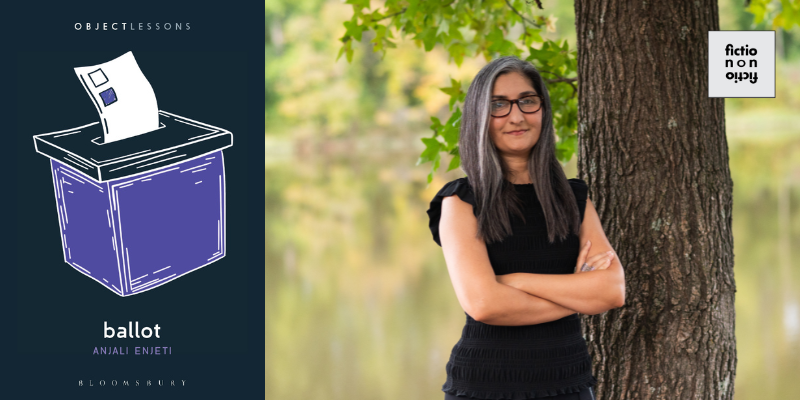
Award-winning journalist, activist, poll worker, and former attorney Anjali Enjeti discusses her new book, Ballot, which considers the real and metaphorical role that ballots play in our democracy. Co-hosts Whitney Terrell and Jennifer Maritza McCauley (in her first episode joining the co-host rotation) talk to Enjeti about her childhood encounters with ballots, the history of ballots in America, and the problems she encountered with Republican-installed Dominion voting machines in Fulton County, Georgia, where she was an election worker during the 2020 presidential race. She debunks the false claims of election fraud in Fulton County during that election and discusses the Trump Administration’s recent seizure of 700 boxes of 2020 ballots from Fulton County, what those ballots represent, and whether or not the administration might try to alter them. She reads from Ballot.
To hear the full episode, subscribe through iTunes, Google Play, Stitcher, Spotify, or your favorite podcast app (include the forward slashes when searching). You can also listen by streaming from the player below. Check out video versions of our interviews on the Fiction/Non/Fiction Instagram account, the Fiction/Non/Fiction YouTube Channel, and our show website: https://www.fnfpodcast.net/ This podcast is produced by V.V. Ganeshananthan and Whitney Terrell.
Ballot • The Parted Earth • Southbound: Essays on Identity, Inheritance, and Social Change
Others
Fiction/Non/Fiction Season 2, Episode 8: Lacy Johnson and Anjali Enjeti on the State of Reproductive Rights • FBI raid in Georgia has little legal basis – but serves Trump’s goal to weaken trust in election results | The Guardian • FBI’s Search of Fulton County, Georgia, Election Center Is Unprecedented, Experts Say | ProPublica • Trump is trying to change how the midterm elections are conducted | The Washington Post • Move to Seize Ballots Thrusts F.B.I. Into Trump’s Election Conspiracy Claim | The New York Times • Trump’s Mug Shot Is Released After Booking at Fulton County Jail | The New York Times • Nickel and Dimed: On (Not) Getting By in America by Barbara Ehrenreich
EXCERPT FROM A CONVERSATION WITH ANJALI ENJETI
Jennifer Maritza McCauley: I was reflecting on my first time voting, and I felt so nervous. I don’t know why I felt so nervous. I’m just like, I think the weight of what I could do kind of hit me. So I think, you know, I just remember being really scared that I was going to mess it up or vote for the wrong person or something like that.
Anjali Enjeti: But I think that’s a great feeling to have, because it meant you felt so responsible for yourself and your community and everyone’s health and safety and welfare, and you knew what it meant. You weren’t taking it for granted. And that’s so important. We can’t take it for granted. This is something that Congressman John Lewis said his entire life, “You can’t take it for granted. If you do, you might lose it.” It’s very true. It’s something that we should hold sacred. I’m not religious or spiritual, but to me, voting is holy.
JMM: That’s so beautifully said. I love your sections on John Lewis in the book too.
AE: I had to pay homage to him, being from Georgia. I don’t live in Atlanta, but I live very close by, and I’ve had the pleasure of hearing him speak in person at various protests and rallies. An incredible human being. It’s sad that we were not able to have Congress pass a more robust version of the Voting Rights Act before he passed away. We really did owe that to him.
JMM: There’s a lot of heaviness there but I think you give us hope, because you’re working on this and you’re writing the wonderful book that you did. Thank you for that.
AE: I give a lot of credit to the people who fought for the right to vote, but also the people that are out there day after day, trying to get people to the polls and fighting the good fight, and the candidates, who really are wonderful candidates, who run in elections that they know they have no chance of winning but they’re still going to run and be an alternative so that people can vote for them on their ballots.
Whitney Terrell: Also though in that passage is the complication and the power of getting caught up in wanting to be on the winning side. That’s pleasurable and you describe this heady joy, that fun even when we’re voting for Democratic candidates. You talk later about how excited you were to vote for Clinton and that you could taste it, his victory. Then it turns out that vote didn’t work out the way that you wanted given the 1994 Crime Bill that Clinton passed, and the Don’t Ask, Don’t Tell policy in the military. I look back with a lot of regret at things that happened during the Clinton administration. So how often does that desire to win seduce us away from voting for things that we care about?
AE: That is a great question, because when I’m in the middle of trying to get out the vote for a candidate, I am a fan girl. I am just falling over myself for this candidate. I am in that hero worship place. But it’s something that I’m able to turn on and turn off pretty easily. I was protesting Clinton pretty soon after I voted for him. I was very much against his “welfare reform,” Temporary Assistance for Needy Families. I was against Don’t Ask, Don’t Tell, the Crime Bill, his warmongering and willingness to work with Republicans on really punishing policies.
WT: So I still teach a section from Barbara Ehrenreich’s “Nickel and Dimed” which is a response to kicking everybody off the welfare roles that Clinton made in his presidency.
AE: One of the most horrifying policies, honestly, that we’ve ever had. It’s got to rank really high up there. It was cruel. I knew it was cruel before it passed, and I was lobbying people and protesting, and it still passed. There’s nothing the U.S. loves more, whether you’re Democratic or Republican, than punishing poor people. It’s like a sport in this country.
WT: I know. And then I always tell my students, the idea of the bill was that it would be honorable to work and you’d feel better about yourself. But Ehrenreich’s trying to prove is it really possible for someone to live on minimum wage at this time? Then I, with the students, read it, and I’m like, “Guess what. The minimum wage has not changed since this book was written. It’s exactly the same.”
AE: It really hasn’t, and that’s the thing, right? But we have to hold them accountable. I was totally madly in love with Zohran Mamdani’s campaign. I am not a New Yorker. I have never lived in New York, but I was donating money from Georgia. I was liking all the posts on social media of my friends who were canvassing for that campaign. I was totally in love with this candidate, but once they got into office, I’m like, “What are you going to do now? What’s going to happen?”
Even with Biden, Biden was not in my top, several choices in the presidential primary for the 2020 election. I was a Sanders Warren Castro person, an anybody-but Biden-person practically. But he won the primary presidential election and so I thought, “Okay, I don’t want Trump to win. Let me do this.” But Biden was a disappointment from the start as well, which is not to say he didn’t do some good things, but we were in the midst of Covid, and Biden essentially ignored it. I expected after Trump some serious attention to especially long Covid. We were in the middle of a surge when Biden said that covid was over. We were in a surge that was almost as serious as the initial surges of covid. So, we’ve gotta find a way to turn it on and turn it off.
If you are excited about your candidate because you believe that they stand for issues that are going to improve the lives of members of your community, I say, go have a blast. Go out there, knock doors, do what you need to do. It’s a very empowering feeling. For me, it is the biggest high to gather with people who come together to try to elect a candidate. I flipped seats blue. I had a red congressional district, a red state senate district, and a red state House of Representative district here in Georgia. So I was in three red states, right in 2017, and then in 2018, I was in three blue states. And it’s because I was one of the people on the ground knocking hundreds and hundreds of doors to get out the vote. So it is a high. I was walking on air after that. That was the year that Stacey Abrams lost. So I was incredibly disappointed about that, because we were wanting her to win as well. But still, I went from being one day in a total Red State zone to being in a blue zone, and that was a great feeling.
But we have to hold everybody accountable. We have to pay attention to the legislation that comes up, and if we want our elected officials, that we helped elect especially, to vote a certain way on bills and policies, we gotta tell them, we’ve gotta say “This is what we want.” We gotta show up to town halls. We gotta do all of this work. Election day is a few days a year, right? You got your primary, you got your main elections. Sometimes you have a runoff, sometimes you have other special elections, but it’s only a couple times a year for most people. But the process of voting really is every day of the year, because on the days you’re not going to the polls, you gotta be doing something else to hold your elected officials accountable.
Transcribed by Otter.ai. Condensed and edited by Rebecca Kilroy.

Fiction Non Fiction
Hosted by Whitney Terrell and V.V. Ganeshananthan, Fiction/Non/Fiction interprets current events through the lens of literature, and features conversations with writers of all stripes, from novelists and poets to journalists and essayists.