This first appeared in Lit Hub’s Craft of Writing newsletter—sign up here.
At some point in the last few years, my students became convinced that the worst sin a fiction writer can commit is an “info dump.” Admittedly, when you put it that way, it does sound like something you’d want to avoid. I don’t want to hear the word “dump” unless you’re singing “The Thong Song” by Sisqo, in which case: that’s cool. When I first started hearing students warn against the info dump, I thought that maybe if I just nudged us to call it an “information download” or something, its repulsive power would be lost. But the problem, I’ve come to realize, runs deeper than the wording.
What fear of the dump translates to in practice is a broader resistance to the work of exposition in a story or novel. I’m not talking about a philosophical objection to backstory, the way Joy or Diane Williams reasonably might in work that is disorienting by design. Rather, it seems to be about something more fundamental—an anxiety that providing too much concentrated information about a character or situation is, on its face, artless, or worse, boring.
Like a lot of workshop-based neuroses, this is rooted in the experience of seeing something done badly, or doing it badly oneself, and hearing a teacher explain wearily why it should be otherwise. We all have our familiar writing hobbyhorses—me, I’m a stakes guy, sorry. There is of course a thing as too much backstory, and when a writer frontloads information before giving the reader a sense of why it has some kind of emotional or psychological value, it’s hard to expect them to keep reading. Historical fiction, fantasy, and science-fiction are particularly vulnerable to this problem, as the process of explaining a time period or world different from ours can stretch to nearly infinite dimensions if not checked. There’s also the dreaded shadow of “show don’t tell” hanging over all of this—boy do I wish I could talk to the guy who came up with that. You don’t show someone a story, dammit, you tell it.
Information needs to be managed, it’s true, but it needn’t be feared. Getting the balance right is a process, part of the endless work of revision, as is everything important in writing.
More frequently than excessive exposition, I’ve seen writers trying to work their way around this imagined stricture by jamming exposition into dialogue, laundering it implausibly into free indirect discourse (“She looked up at the statue of the town’s first mayor who, she remembered suddenly, had been famous for his fear of bees”), or simply omitting it entirely until we reach a crucial moment in the plot that necessitates further explanation, by which point it’s too late. In these cases, the cure is worse than the disease. They draw more attention to the artificiality of exposition than if it were simply stated plainly at a logical juncture.
As with finding a title for a novel or story, if no great option presents itself, the goal with exposition should be to do as little damage as possible. Tell us what we need to know, don’t go on for too long, get out of there. The better course of action, if at all possible, is to be stylish and elegant with your exposition, as one strives to be in all things. Mary Gaitskill is particularly good at this ideal combination of straightforwardness and pithiness. She’s not afraid to tell the reader things, but she maintains her poise while doing so. Her very recent New Yorker story “Something Familiar” contains a good example. The protagonist is recalling the very Gaitskillian jobs of her youth:
“Nude art model (poorly paid), waitress (she got fired), hostess (she wasn’t charming enough), whore (bingo.) That was another threshold she’d crossed with Carly; they had both started at the same place, a “house,” rather than outcall, which they’d agreed was too dangerous. They did it on an emergency basis, off and on for maybe five years. Neither took it seriously; it seemed of a piece with the pleasing artifice of clubs and magazines, an almost comical piece, more real and more absurd than dating. And safer, actually, on an emotional level; none of the men she met there could really hurt her.”
There’s a jaunty Nabokovian compression to the first sentence that draws us in, and the comparison of sex work to the “pleasing artifice” of clubs and magazines is a surprising turn that holds our interest. But the rest is simply informative, neither coy nor overly blunt. We’re learning important things about this character, filtered mildly through her consciousness. Gaitskill has the confidence to know that backstory is action, is story, if it’s done right.
In my new novel Down Time, I spent more time than usual figuring out how to manage exposition. Since there are four point-of-view characters, each one needed to be introduced with enough backstory that the reader will be able to easily join their portion of the story, but not so much that their bogged down in unnecessary detail. Furthermore, each chapter picks up a month or more after the last one, requiring information to be filled in with every character switch. It was important to remember the principle that exposition shouldn’t feel any more rote than action or dialogue. Every sentence in a novel carries weight, provides an opportunity for the writer to display their sensibility.
Information needs to be managed, it’s true, but it needn’t be feared. Getting the balance right is a process, part of the endless work of revision, as is everything important in writing. You might find yourself with too much in your early drafts. In which case, you can always dump it.
_____________________________________
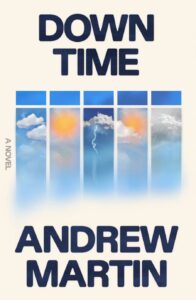
Down Time by Andrew Martin is available via Farrar, Straus and Giroux.

Andrew Martin
Andrew Martin is the author of the novel Early Work, the story collection Cool for America, and the forthcoming novel Down Time.