Andrea Mara on Building Suspense
In Conversation with Mitzi Rapkin on the First Draft Podcast
First Draft: A Dialogue of Writing is a weekly show featuring in-depth interviews with fiction, nonfiction, essay writers, and poets, highlighting the voices of writers as they discuss their work, their craft, and the literary arts. Hosted by Mitzi Rapkin, First Draft celebrates creative writing and the individuals who are dedicated to bringing their carefully chosen words to print as well as the impact writers have on the world we live in.
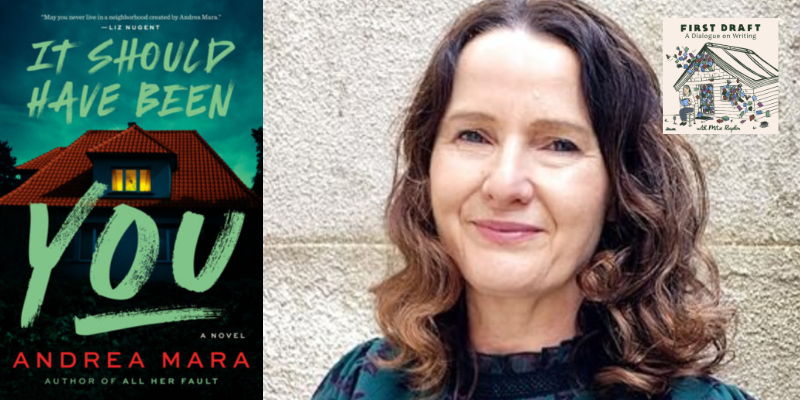
In this episode, Mitzi talks to Andrea Mara about her new thriller, It Should Have Been You.
Subscribe and download the episode, wherever you get your podcasts!
From the episode:
Mitzi Rapkin: I’m curious about your thoughts about suspense and surprise and spoilers. You start your book towards the end. You have an initial chapter that is later in the story timeline and then you go back to the beginning and you’re asking the reader to then follow you to this one point where you started and then beyond. I’m curious about this technique, and then just your general thoughts about these things, spoilers and surprises and suspense.
Andrea Mara: I think that’s a really good question because it’s something that comes up for me when I’m thinking about every new book as I start it. So, for example, three of my books are about a child that goes missing. And that’s very straightforward because the child goes missing immediately. So, any reader who is on page two already knows, okay, where’s the child gone? I want to keep reading to find out where the child has gone. But as is the case with the other five books, it’s not about a missing child, you have to somehow find a way to draw the reader in from the start. In the first few chapters, after that opening in It Should Have Been You, yes, you’re seeing about the text message, but you don’t have a sense that there’s going to be any jeopardy, so there’s no real tension. You just know that this woman sent a text message. And some readers might be curious to see where it goes, but other readers, especially the big crime fans, are going to be like, I don’t know. I don’t care, why this person sent their text and what’s going to happen. So, the ending at the beginning is a way of showing the reader, very simply, look, actually, there’s going to be a really big repercussion from this. So, it opens with Susan saying, I have to kill my sister. And so, we know that Susan is in a situation where she is now going to kill her sister. And then we go back, I think it’s nine days or something, to see what led to this point. So, it is a trick, a way to try to get the action in from the start. And I’m very conscious too, as a reader, when I read kind of a prologue and it’s anonymous characters, and sometimes it is in italics, I don’t always invest in that prologue, so I’m always trying to find ways to pull the reader in in that opening, even if it does look a bit like an anonymous prologue in italics. So, partly by not calling it a prologue and not putting it in italics. Those are two ways to try to avoid that, but it is tricky. In the genre I write, my editor, and I, we’ve worked together on the last five books, and he’s very clear with me about the brand for the readers and hooking the reader from the opening and having the action, whatever that might be, the murder, the kidnap, having that from the very first few pages of the book. So that’s always a challenge to try to do that.
***
Andrea Mara is a number one international bestselling Irish author. Several of her books have been shortlisted for Irish Crime Novel of the Year awards. Someone in the Attic was her U.S. debut and her novel All Her Fault was adapted into a television series on Peacock. Her new novel It Should Have Been You is her newest novel.
First Draft: A Dialogue on Writing
First Draft: A Dialogue on Writing is a literary podcast produced and hosted by Mitzi Rapkin. Each episode features an in-depth interview with a fiction, non-fiction, essay, or poetry writer. The show is equal parts investigation into the craft of writing and conversation about the topics of an author’s work.