Ana Gavrilovska on Pynchon’s Prescient Technofascism
In Conversation with Whitney Terrell and V.V. Ganeshananthan on Fiction/Non/Fiction
Writer Ana Gavrilovska joins co-hosts V.V. Ganeshananthan and Whitney Terrell to talk about her recent article for Current Affairs, “Thomas Pynchon Saw American Fascism Coming.” Gavrilovska reflects on Pynchon’s long career and his interest in writing about systems, how his time as a technical writer at Boeing informs his work, his classic novels Gravity’s Rainbow and The Crying of Lot 49, and his new novel, Shadow Ticket. She explains why Shadow Ticket’s fictional Airmont family seems like stand-ins for the Trumps and considers the significance of a food-stuffed film that cheese mogul Bruno Airmont watches with his daughter Daphne as many ordinary people go hungry. The three also discuss Paul Thomas Anderson’s Oscar-winning movie One Battle After Another, which takes inspiration from Pynchon’s novel Vineland. Gavrilovska reads from Shadow Ticket.
To hear the full episode, subscribe through iTunes, Google Play, Stitcher, Spotify, or your favorite podcast app (include the forward slashes when searching). You can also listen by streaming from the player below. Check out video versions of our interviews on the Fiction/Non/Fiction Instagram account, the Fiction/Non/Fiction YouTube Channel, and our show website: https://www.fnfpodcast.net/ This podcast is produced by V.V. Ganeshananthan and Whitney Terrell.
“Thomas Pynchon Saw American Fascism Coming” | Current Affairs
Thomas Pynchon
Shadow Ticket • Vineland • Gravity’s Rainbow • The Crying of Lot 49 • Inherent Vice • V. • Mason & Dixon • Bleeding Edge • Against the Day
Others
One Battle After Another (2025)
EXCERPT FROM A CONVERSATION WITH ANA GAVRILOVSKA
Whitney Terrell: Rereading Vineland made me think of so many things that are happening right now. DOGE, for instance, or all this talk about AI agents who are going to take over people’s jobs, the purging of voter rolls from Fulton County, Georgia by the DOJ, surveillance through social media. I wondered if you could talk a little bit about Pynchon’s conception of—he does the same thing in Gravity’s Rainbow but he starts using computers in this novel—this idea of what you call techno fascism, and how that prefigures and anticipates our present day.
Ana Gavrilovska: One of the things that I was thinking about when I wrote the piece that I didn’t get to delve into too much, is the idea of how we understand fascism, and how the modern imagination is a bit limited when it comes to what we think is fascist. That relates to this because I think that what he’s getting at, and what is happening now, is these forms of coercion are already happening, and have been happening. They’ve been intruding on our everyday lives through these AI agents, or we’re surveilling ourselves on social media. We put our information out there constantly.. We’re doing the work of the Panopticon for them. We’re putting it all out there. So when I talk about techno fascism in the piece, that’s the kind of stuff that I’m talking about. I think Pynchon, back to the 70s when he’s working at Boeing, had an early look at the way that computers and technology were going to change everything. That couldn’t help but show up in his work.
V.V. Ganeshananthan: So when I was thinking about Vineland and also watching One Battle After Another, I was thinking about—I wrote my journalism school thesis on literature of the Weather Underground, which was on my mind. Obviously Paul Thomas Anderson also thought that Vineland was relevant to the present day, because he used it as the source material for One Battle After Another in an interesting way where, maybe if you didn’t know that, you would have a hard time figuring out how the two relate to each other. How did you feel about PTA’s adaptation?
AG: I think Pynchon uses families to write about politics in Vineland and in his other work, and PTA uses politics to tell stories about families. PTA is much much less interested in systems.
WT: I was going to say, the whole computer techno part that we were talking about and the way that pre-figures self surveillance is going on, we have an old, dated version of fascism. We think of it as the Stasi, or police that are informing on people, but you’re saying, “No, this is happening with the system, the technology that we’re using,” which is what Pynchon is writing about. That’s not really in the One Battle After Another at all.
AG: Not at all. If you were to do a one-to-one comparison, you could say he replaced that with white supremacy because he’s much more interested in that aspect of modern fascism, or just our modern world. I think that he was more interested in that, but I also think that for him, it was more set dressing than commentary on society. That might be a hot take.
WT: I didn’t think the movie was nearly as interesting to me as the book was when I went back to read it. The differences are, it’s important the Zoyd character is similar to whatever in the hell the guy’s—
AG: Bob, and then Pat. Everyone has multiple names.
WT: And then the the wife, the Frenesi character, is—
VVG: Perfidia Beverly Hills.
WT: Perfidia Beverly Hills. So she gets a Pynchon-esque name. The character in Vineland, Frenesi, is white and she likes being fascist. There’s a passage where she talks about her attraction to the simplicity of what she’s doing, as opposed to the drug culture she’d been involved with. She’s really a convert. You don’t get that sense from Perfidia Beverly Hills, who is being basically blackmailed because she wants to protect her daughter. Am I reading that correctly?
AG: I agree with you about Perfidia. I don’t know about Frenesi, she’s a very interesting character. I see her as more of a symbol of an attraction to fascism, rather than her character’s actions being literal. In the movie, the characters are much more human. In Pynchon’s work, he’s more interested in critiquing society at large, rather than telling a story about what’s going on through this one woman’s head when she’s sleeping with a cop.
WT: I was thinking of this from page 72 on Vineland, where she’s talking about switching over, and she says, “Here was a world of simplicity and certainty. No acid head, no revolutionary anarchist, would ever find a world based on the one and zero of life and death, minimal, beautiful, the patterns of deaths and lives.” That’s her thinking about her informant world, and it seems a lot like that passage that you read earlier, too. She has an attraction to that kind of minimalist, what I would call fascist, live or die kind lack of messiness.
VVG: I think books are much better at critiquing systems than films are, broadly. This is a dangerous thing to say, perhaps, but what you’re saying also makes me wish that Boots Riley had adapted this book.
AG: Maybe we’ll get more adaptations from other people, because there’s just so much there. There’s so many different ways the story could have been taken. I also think Paul Thomas Anderson’s own life—he’s married to Maya Rudolph, a Black woman, he has children with her—that element of it is obviously autobiographical. And to jump ahead, the endings are completely different. The ending. Vineland is dark, and it is Prairie who—in the film, her character is named Willa— is basically yearning for Brock Vond to show up again. He’s about to abduct her, and then the funding for his program gets pulled—which is also funny in a different way, because even the fascist is going to lose his funding at the end of Vineland—but then he disappears, and she’s hoping that he comes back. There’s that attraction that comes through from her mom, the idea of the American pull to this authoritarianism. Whereas in the movie, she’s sweet, fun, “Oh, the kids are gonna save us. Sorry we left you a screwed-up world, but at least you know you’re going to the protest.” It’s just not at all what is going on in Vineland.
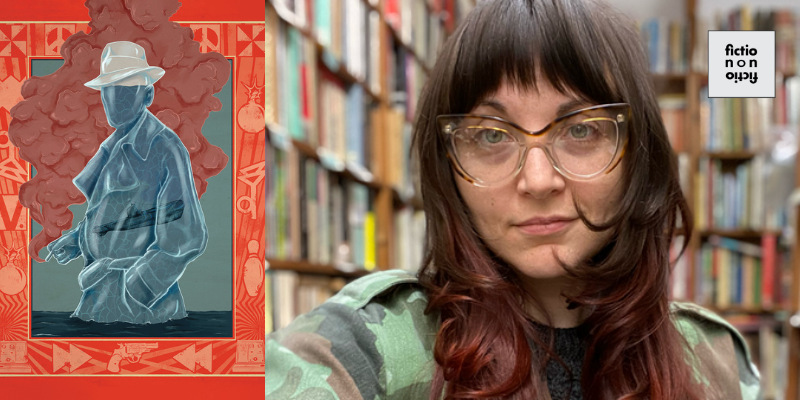
Transcribed by Otter.ai. Condensed and edited by Rebecca Kilroy. Art by John Biggs for Current Affairs.

Fiction Non Fiction
Hosted by Whitney Terrell and V.V. Ganeshananthan, Fiction/Non/Fiction interprets current events through the lens of literature, and features conversations with writers of all stripes, from novelists and poets to journalists and essayists.