An Open Letter to the Jewish Book Council From a Concerned Group of Jewish Writers
“We are Jewish authors who believe in Jewish books, and for whom Palestinian liberation is a moral imperative.”
Below is an open letter from a group of Jewish authors to the Jewish Book Council (JBC). A group of us—consisting of writers with books eligible for the 2025 National Jewish Book Awards and those who have written for their magazine, had our books reviewed in their pages, or had some connection to the JBC—came together because we felt that the JBC, the pre-eminent US organization for Jewish writers and literature, did not represent or value us, as non- and anti-Zionist Jewish writers. Further, we were—and remain—concerned that the institution’s apparent bias toward centering Israeli and Zionist voices is not only exclusionary but harmful, contributing to the dehumanization of Palestinians and advancing a system of cultural apartheid.
To name a few practical examples of this bias: Since October 7, 2023, JBC leadership has spoken to national press about anti-Semitism and violence against Jews while remaining silent about the loss of life to Palestinians; has taken special care to highlight Israeli narratives and Zionist voices in the announcement of—and choice of recipients of—their 2025 National Jewish Book Awards; has launched an anti-Semitism reporting tool that did not offer any definition of anti-Semitism (thus rendering anti-Zionist voices vulnerable); and has posted a round-up on social media of Jewish AWP panels that only included ones with a Zionist bent and excluded those with a non- or anti-Zionist lens.
We sent this letter directly to the JBC first because the JBC is a historically social justice-oriented institution, and we wanted to have a good faith conversation about how they might expand their awards, programming, and institutional vision to support non- and anti-Zionist voices. They agreed to a conversation, and we met with their leadership in a moderated Zoom conversation, where representatives from our informal coalition asked questions about the JBC’s actions—including the use of the data from their anti-Semitism reporting tool and their role in curating and publicizing panels of Jewish interest at AWP 2025—and proposed a number of specific ideas for more inclusive programming and messaging. The JBC’s leadership listened and promised to follow up.
We are Jewish authors who believe in Jewish books, and for whom Palestinian liberation is a moral imperative.
Unfortunately, no follow-up has been forthcoming and none of our proposed action steps have been implemented, even after several additional attempts to reach out for status updates. We felt disappointed that no action steps were taken. We have now decided to publish our original letter as an open letter to the literary and cultural community in the hopes that even more Jewish authors will sign in support and that the JBC will finally take meaningful action.
We are Jewish authors who believe in Jewish books, and for whom Palestinian liberation is a moral imperative. While we are eager for our work to find Jewish audiences, we have not been inclined to participate in the JBC’s’s initiatives because of their vocal support for the Israeli state, and disproportionate highlighting of Zionist stories and voices.
Because the JBC is our most visible and longstanding Jewish literary institution, its focus on Zionist authors and books gives both Jewish and non-Jewish readers the false impression that Jewish books are inherently Zionist. We refuse this conflation and call on the JBC to respond in good faith and in a manner that addresses the urgency of this moment.
__________________________________________
Dear Jewish Book Council Leadership,
We reach out to you as Jewish authors whose books have been eligible for National Jewish Book Awards; who have collaborated with the council’s blog or magazine, participated in the JBC touring authors network, been honored by the Jewish Book Awards, had our books reviewed or chosen as “Editor’s Picks” on the Jewish Book Council’s website, or are just in a wider network of Jewish writers in the JBC’s orbit. The Jewish Book Council, as an institution, has been crucial in promoting and furthering many of our works. It’s provided a home to our writing and has connected us to other authors in our communities.
The Jewish Book Council has a long history of being committed to the concerns and cultural experiences of all American Jews. Its 1925 origin story of being born inside the Boston Public Library suggests a commitment to universal access and populism and its work throughout the mid twentieth century reflects the influence of many different Jewish traditions spanning the diaspora and political spectrum including Yiddishkeit, Bundism, Jewish Socialism, and Zionism. When the Anti-Defamation League and other Jewish organizations were criticizing Philip Roth’s novel Goodbye, Columbus for its “negative” portrayal of Jewish people, the JBC recognized Roth’s vision and right to creative expression and awarded him its highest honor.
Yet in the months since October 7, 2023, from launching the “reporting antisemitism tool,” to comments by Jewish Book Council leadership in two separate New York Times articles, to the announcement of the winners of the 74th annual National Jewish Book Awards, we feel the JBC has betrayed its mission by narrowing its vision to a Zionist approach to Jewish culture. As writers who care about Palestine, we don’t currently feel represented by the work, programming, or values of the JBC. Given this narrowing, many of us refrained from submitting our books for consideration to your awards or declined to engage with your programs.
Our concerns and requests are as follows:
The JBC has been disproportionately vocal about anti-Semitism while neglecting other issues of cultural concern to Jews, and has also left the phrase “anti-Semitism” open to dangerous misinterpretation: When Israel’s war on Gaza began, many of us hoped the JBC’s social justice history would lead the organization to speak out against the atrocities committed there. Instead, the only public response we saw was the launch of an antisemitism reporting tool. However, the tool did not clearly define the phrase “antisemitism,” and we saw no transparent communication on what would be done with these reports.
Anti-Semitism is, of course, to be taken seriously. But we are also living in a time when this term has been co-opted as a tool to shut down any critical discussion of the Israeli government and its violence. It has been used as a tool to justify the dehumanization of Palestinians, and to justify Islamophobia more broadly. In a moment where many, including Jews, are losing jobs and livelihoods for expressing support for Palestine, care and clarity in these terms really matters.
We ask that the JBC make it clear that criticism of Israel, or support of Palestine, is not inherently anti-Semitic and that the JBC make transparent what is being done with the reports that come through this tool.
Further, the JBC has remained silent on the violence committed by Israel in Gaza while concentrating on messaging, programming, and authors with a non-critical perspective on Israel and its actions. This year’s National Jewish Book Awards announcement included the following: “While our National Jewish Book Award winners always reflect an important cross section of Jewish life, it’s especially meaningful that this year’s awards are going to a number of Israeli authors and books on Israel.”
This statement rang false to many of us. It assumes that uplifting Israeli narratives is “especially meaningful” to all Jews and that all Jews, regardless of citizenship, feel inherently aligned with the modern nation state of Israel. It also assumes that uplifting Israeli narratives is an act of rebellion against the suppression of Israeli voices where we have found that the opposite is true: Israeli voices are being amplified in the current political landscape where Palestinian voices and Jewish voices that support the Palestinian cause are unlikely to find mainstream representation. Regretfully, the JBC has been one of the platforms where we have encountered that lack of representation. Many Jews are engaged in the critical work of imagining the ways in which liberation for all—Palestinians, Israelis, and those of us in the US and all over the world—is the only way forward.
We ask that the JBC step into its responsibility as the preeminent Jewish literary organization in the United States and create programs and content in the coming year that reflect a more genuine diversity of Jewish views on Israel/Palestine and create spaces for Jews and cultural workers engaged with Judaism to have these difficult conversations.
We have always been taught that it is a Jewish value to hold the organizations we care about to rigorous ethical standards, and we are hopeful that this letter can express our dissatisfaction and open a conversation about how to shift the JBC’s practices, priorities, and programming. We write to you today not in the interest of retreating from the JBC, but rather in the hopes that the JBC can once again broaden its umbrella to be meaningful to, and inclusive of, the next generation of Jewish writers.
We request that the leadership and staff of the JBC take our concerns to heart and take actions to address them, so that we can find a home in the JBC once more.
Signed,
Antonia Angress
Jami Attenberg
Bethany Ball
Mattilda Bernstein Sycamore
Sol Brager
Sam Cohen
Rachel Edelman
Philip Eil
Emma Copley Eisenberg
Amy Feltman
Elisheva Fox
Leora Fridman
Temim Fruchter
Mónica Gomery
Danny Goodman
Jennifer Gilmore
Maris Kreizman
Danya Kukafka
Sacha Lamb
Joy Ladin
Michael David Lukas
T Kira Madden
Moshe Zvi Marvit
Ilana Masad
Rachel Mennies
GennaRose Nethercott
Emet North
Rebecca Podos
Amelia Possanza
Eden Robins
Rabbi Jessica Rosenberg
Moriel Rothman-Zecher
Sam Sax
Shelly Jay Shore
Emma Specter
Claire Stanford
Eli Valley
Adelle Waldman
Yael van der Wouden
Qian Julie Wang
Courtney Zoffness
Rachel Zucker
__________________________________________
Add your name here and see a full list of signatories here.
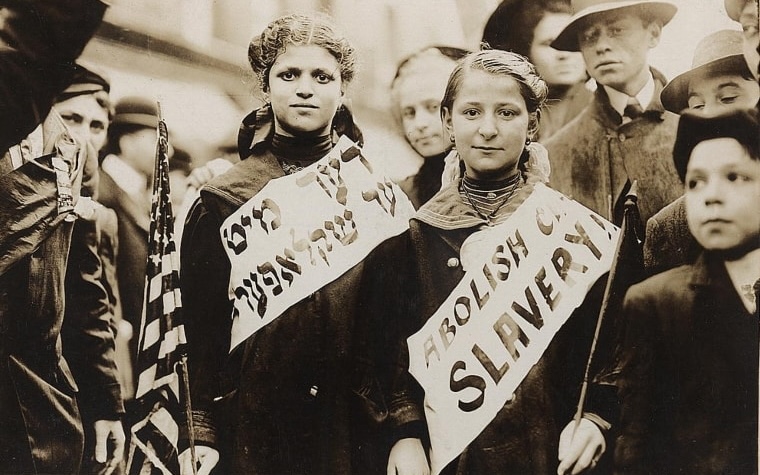
Featured image: A protest against child slavery in New York in 1909 with slogans in Yiddish and English (Courtesy Library of Congress)