







An Ode to the Lost Generation: Adam Gopnik on The Sun Also Rises at 100
"We reread [it] for streets and tastes and trout and wine bottles and for the unprettified truth of what war wounds are."
To encounter Ernest Hemingway’s novel The Sun Also Rises as a first-time reader now is to wander into surprising areas of sometimes dubious prejudice and often dated bigotries. The first sentences, about the writer Robert Cohn, have a tang of anti-Semitism, one that only becomes stronger later on as the narrator draws the reader into a shared understanding that there is something absurd and overcompensating about a Jewish Ivy League boxer. Nor are many subsequent pages—with their slighting references to gay men, and with the normal sexual appetite of the heroine regarded as a slightly undignified affliction—entirely to contemporary taste. Against that other mighty pillar of 1920s literature, The Great Gatsby—though doubtless we have at times romanticized there what is in fact a brutal American parable of self-making and violence and gangsterism—The Sun Also Rises offers some barbed wire and thorns in the perimeter of its effects, ones that must be leapt past and over.
What is it in this book, then, that has kept it alive for a century and that, as much as any other, has compelled writers to mine it in the making of so much subsequent American fiction? A charmingly direct new reader—in a more Hemingwayesque cadence than he may be aware—announces on Reddit that it “Just felt like a boring travel vlog….Just people going to a place and doing a thing.” This is not entirely wrong—indeed, in an unintended or not fully realized way so entirely right—that it is worth glossing. The book is about going to a place and doing a thing, and the clarity of purpose it took for Hemingway to strip writing of obvious weighted allegory or neatly labeled social “comment” and make it about the particulars of going to places and doing things is perhaps the secret to the book’s still-evergreen originality.
As with all such things, some forensic work helps. The story is simple and not even quite a story: a group of expatriate Americans—and, significantly, some Brits— who are living and working in Paris at the height of the American “occupation” of the 1920s, decide to go to Pamplona for the annual “running of the bulls” and the bullfights that surround it. This takes place during the weeklong San Fermín “fiesta,” to use the British title chosen for the novel by Hemingway’s London publisher, at a time when the festival was not yet the commercialized global event it is today (at a time, too, when Hemingway was not yet successful enough to dictate his own titles). While there, the heroine, Lady Brett Ashley, begins an affair with the most romantic of the young Spanish bullfighters, rejecting Cohn, the Jewish writer whom she had briefly favored before—and all in lieu of actually connecting with the narrator, Jake, who we are to understand is the real love of her life but has been emasculated, or at least left impotent (the mechanics are somewhat unclear) by a wound in the Great War.
Hemingway brought the stoical code back to life exactly by not articulating it as a self-conscious code. He gave it new life as a series of sensual experiences.
It is by general reputation, as one of the epigraphs of the book suggests, the testament and witness of the “lost generation.” The meaning of this term—put by Hemingway into the mouth of his mentor and teacher Gertrude Stein, rather unpoetically, at a gas station in provincial France—is disputed. The original French speaker (the patron of the gas station) may not have meant “lost” in the sense of unmoored and searching for meaning but merely “missing.” Millions of young Frenchmen had been killed in the war; an entire generation was lost. Yet the meaning of the term has settled on a second, more romantic sense—a generation “lost,” free to wander where they would.
Hemingway surely intends it to reference the second meaning, but it is done in consciousness of the first. These otherwise lucky and fortunate people, free to drink and wander in a Europe where the American dollar goes far, are lost—the war that annihilated millions also annihilated the surviving generation’s confidence in the old order that got the millions annihilated. The once formidable prewar taboos against “promiscuity” and a more unheeded and unapologetic hedonism are broken, while the standards supposedly supporting the taboos, the whole structure of bourgeois self-sacrifice, duty, and obligation, are overturned as well. We end up with people who can only…go to a place and do a thing and then go and do another…until the Depression follows the war and everyone goes home to get ready for the next one. The symbolism of the book, including the emasculation of the hero, which leaves him capable of hedonistic rumination of all kinds but impotent in decisive action, is meant to diagnose a time. The Great War unmoored the Western world; the surviving bees race across the flowers in search of what nectar they can find before the next bad wind blows.
As the ample annotations of this edition reveal—and as Lesley M. M. Blume detailed in her fine recent study of the real-world origins of the novel, Everyone Behaves Badly—the basic lineaments of the book come directly from Hemingway’s experience. Robert Cohn was taken almost without a transformative gesture from the figure of the editor and writer Harold Loeb, Brett Ashley (wonderful movie star’s name! Hemingway was good on them) was really the British aristocrat Duff Twysden, and Bill a blending of the writer Donald Ogden Stewart and Hemingway’s childhood friend Bill Smith. How “close” or distant the portraits are from the real people is the kind of question that scholars sniffily dismiss and real readers are interested in—and the real readers are right, since how far or close the composer strays from the home key, so to speak, is central to the expressive effect of the music.
The search has interesting results. The real Brett Ashley slept with the real Robert Cohn but not it seems with Hemingway himself—nor was her attachment to Hemingway anything like as piercing and defining as Brett’s is to the unobtainable Jake, this being one of many consolatory fantasies Hemingway steadily dreamt up. (Similarly, the real Catherine of A Farewell to Arms did not die in childbirth, like the fictional one carrying his child, but absented herself after having written the younger Hemingway a “Dear John” letter and went off to nurse flu patients with a more favored lover.) Nor did the “real” Cohn have the kind of pugilistic pretensions that Hemingway finds contemptible in his doppelganger.
And yet for all of that—despite all of that—the book lives on the page, still, as few American books do. It couldn’t have been read by any reader then—or now, for that matter—as a portrait of a “wasteland” of deadened feelings, as that other Midwestern American’s poem suggested the postwar world had been reduced to. Hemingway’s Europe sounds like a lot of fun. The bathetic image of the 1920s American in Paris—at its best in Gershwin’s An American in Paris—which lingered on into Woody Allen’s Midnight in Paris, is first alive here.
The revolt against abstraction…would remain the leitmotif of all acts of courage throughout the twentieth century.
Part of the book’s perpetual fascination is due to the intensity of the code, the instructions on the way to live and eat and love, that Hemingway dramatizes. For the truth is that Hemingway, instinctively, did not really replace one social code with another but translated exactly the code that had existed and been honored before the war into a new language that could become credible and useful after. Jake’s stoicism, which strikes the novel’s tonic note, is, essentially, the stoical code of the prewar British upper classes: Never complain about misfortune; retreat under stress to the recesses of one’s own mind; eat well and drink plentifully; always value simple sensual pleasure, particularly of the rural kind, hunting and fishing, before verbal discourse. It is the code of the bullfighter as well, of course, or at least of Hemingway’s version of it, and in another way the projected code of the bull: Life is indubitably fatal; you fight off the matador as long as you can; uncomplaining elegance in loss, grace under pressure—the pressure of death—is everything. (Hemingway thought that the code of the bullfighter and the code of the bull were the same, though the bulls of course did not get to vote on this.) That it is a new articulation of the very code of the class destroyed by the war—or left bereft and tipsy, like Lady Brett—and unavailable to outsiders like the Cohns of this world is one of the odder and more touching inner vibrations of the text.
But Hemingway brought the stoical code back to life exactly by not articulating it as a self-conscious code. He gave it new life as a series of sensual experiences. We reread the book now for the almost too vivid physical detail—and we reread particular passages even as we reread the whole, exactly because the “how” of the magic trick that brings the sensual experience to the page is so mysteriously, and yet so expertly, achieved.
The secret to the trick lies in excision: How tiny the touches are that convey so much voluptuous evocation! I read the book for the first time at twelve or thirteen, when I was only vaguely aware of what Jake’s problem was—though I was, I recall, turned on by Lady Brett’s balcon in her sweater. Yet, opening it again after all this time, I could still recall the trout in the fishing stream being laid one on top of another, and the innkeeper counting the bottles of wine drunk—and, yes, there it still is, ridiculously simple! “We did not lose money on the wine, and the girl was shy but nice about bringing it. The old woman looked in once and counted the empty bottles.” That’s it! (But I had forgotten that a few lines before, the narrator makes a deal with the innkeeper, the old woman, that they can drink as much as they like, so the point is set and paid off as neatly as a one-liner.)
And, I had forgotten, the trout are laid out on ferns—I thought it was dill, it looked like dill in my memory. (Now I realize that the only fern I had ever seen was dill: Of such projections onto amputations, we make our memories of books.) But read it again and see how simply the means by which the sensation is summoned up: “I took the trout ashore, washed them in the cold, smoothly heavy water above the dam, and then picked some ferns, and packed them all in the bag, three trout on a layer of ferns, then another layer of ferns then three more trout, and then covered them with ferns. They looked nice in the ferns, and now the bag was bulky, and I put it in the shade of the tree.” Decades may pass between a first reading of those lines and a second, and the trout still look nice, and the bag is still heavy with its new bulk, and the shade of the tree is still welcomingly cool.
Many “influences” press on this accomplishment: Flaubert’s exquisite example, Stein’s own ABC style, the “newspaper” manner Hemingway had become familiar with, and also Cézanne, whom Hemingway always credited as the key begetter, and whose monosyllabic unvarying crosshatched touches, building a world, really are doubtless foundational to the grammar of Hemingway’s apprehensions. Yet one should never miss the moral force that is at the back of these sensual simplifications.
The key passage—the Rosetta Stone to all of Hemingway’s work—surely lies in a passage he wrote later, in A Farewell to Arms, reflecting on the experience of the Great War, which shadows both novels:
. . . I had seen nothing sacred, and the things that were glorious had no glory and the sacrifices were like the stockyards at Chicago if nothing was done with the meat except to bury it. There were many words that you could not stand to hear and finally only the names of places had dignity. Certain numbers were the same way and certain dates and these with the names of places were all you could say and have them mean anything. Abstract words such as glory, honor, courage, or hallow were obscene beside the concrete names of villages, the numbers of roads, the names of rivers, the numbers of regiments and the dates.
When we read the great nineteenth-century novelists whom Hemingway studied, the hum of confident generalization still seduces and delights us. (Someone once counted three per page in Tolstoy.) To create complexity, those great novelists turned to contradiction, which is the leitmotif of their work, as in the blazing first lines of Dickens’s A Tale of Two Cities—or in all of Hugo’s novels. But in Hemingway, self-conscious contradiction and confident generalization are gone and what is left are…things and places, the concrete names of rivers and the numbers of roads. Lev Grossman—a great admirer of The Sun Also Rises—not long ago made a list of things he loved in it made entirely of “the interstitial, throwaway moments” of life, disregarding everything else in the novel:
…you’d still be left with one of the most overwhelmingly human books ever written. You’d be left with the pretty prostitute who smiles, showing her unexpectedly bad teeth; and the Spanish peasant who takes a little more than his fair share of the wine…and Jake promising to be there at five in the morning for the start of a bicycle race, then waking up the next morning after the cyclists have already been on the road for three hours.
The revolt against abstraction —even in the benign form of confident generalization that had made the nineteenth-century novel great—would remain the leitmotif of all acts of courage throughout the twentieth century. It is what motivates things as different as Saint-Exupéry’s The Little Prince and Simenon’s Inspector Maigret stories—the certainty that, in a world gone mad through abstract principles and inhuman ideology, only faces and voices matter.
The particulars in this book, however peculiar, are as redemptive as any an American writer has pursued. We reread The Sun Also Rises for streets and tastes and trout and wine bottles and for the unprettified truth of what war wounds are— still in wonder, just as when we look at Cézanne, at how such simple strokes can conjure up a world so compellingly real, so permanently present, so alive on the page. We come back from rereading it not to judge the author and his prejudices but determined to find particulars, names and numbers, of our own, specific experiences and nameable things, as worth our being faithful to as he was to his.
______________________________
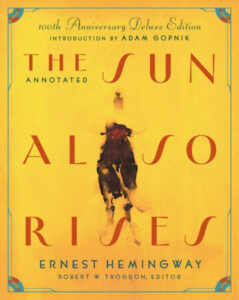
Introduction by Adam Gopnik, from The Annotated Sun Also Rises: 100th Anniversary Deluxe Edition. Publication date, October 13, 2026, by Library of America. Copyright © Library of America. Used by permission.

Adam Gopnik
A staff writer at The New Yorker, Adam Gopnik has been contributing to the magazine since 1986. His books, ranging from essay collections about Paris and food to children’s novels, include Paris to the Moon, Through the Children’s Gate: A Home in New York, Angels and Ages: A Short Book About Darwin, Lincoln, and Modern Life, The Table Comes First: Family, France, and the Meaning of Food, and Winter: Five Windows on the Season. Gopnik has three National Magazine awards, for essays and for criticism, and also the George Polk Award for Magazine Reporting. In March of 2013, he was awarded the medal of Chevalier of the Order of Arts and Letters.