Among the Fascists and the Nazis: How Two Women Journalists Survived the Chaos of 1930s Europe
Julia Cooke on Martha Gellhorn and Virginia Cowles
Standing in front of the Gran Vía shop window, both women coveted the silver fox furs they could not afford, understood the craftsmanship of the leather gloves and shoes, knew how Schiaparelli perfume smelled in its tiny, torso-shaped glass bottles: musky, floral. Around them, yellow tramcars rattled down the streets, drowning out the chatter of the people who milled outside movie theaters. Marquees announced Greta Garbo as Anna Karenina and the latest Marx Brothers comedy.
As the women walked along the broad boulevard, they sidestepped notches in sidewalks where shells had fallen and examined the clean edges of bullet holes in sedate stone buildings. Madrid was under siege, and Virginia Cowles and Martha Gellhorn had come to report on war. Martha had arrived at the end of March 1937, and Ginny came in a week or two later. It was month five of the city’s bombardment by Francisco Franco’s army. The fascists surrounded Madrid on three sides.
But the Republican forces defending the city had recently won two key battles. Ominous mentions of “the fall of Madrid” barely popped into conversations anymore. The arrival of a wave of glamorous day-tripping journalists who hopped in from France seemed, to the Spanish press censor, to herald a shift in the feeling of the war. The aristocratic writer-aviator Antoine de Saint-Exupéry, on assignment for Paris-Soir, the biggest paper in Paris, and the actor Errol Flynn—why he had arrived was unclear—came through. So did dozens of journalists hoping only to file a story with a Madrid dateline and thereby prove their access and daring via this war of fascism against democracy, pitting the great powers of the world against one another in shadowy combat.
Appearances aside, the war had not stopped. Food was scarce. Women queued for hours, sometimes midnight to noon, outside near-empty grocery stores, scattering only when bombs fell around lunchtime. Sometimes the women did not move even then. The front line sat two miles from Madrid’s main shopping area; foreign journalists used Baedekers to navigate their way from the tram line’s ends to the trenches. During her first bombing, Ginny had run for shelter into a perfume shop, where the proprietress methodically moved each bottle from the streetfront vitrine into a neat line on the floor as the dust from the percussive bombs blotted out the sun. When she emerged, Ginny saw the pavement spattered with blood. Two dead.
For the first few days Madrid felt to Ginny like a “strange carnival.” But you got used to it, she realized.
Hours after she and Martha had stared at those silver fox furs, “desperately greedy wanting them,” Martha wrote in her journal, a shell ricocheted off the thirteen-story steel-and-concrete Telefónica Tower and killed five women right on the Gran Vía. The building was the tallest in Europe, some said, where the press dispatched their reports on one of two lines to London and Paris after passing it through the press censor, who checked the copy for strategy giveaways or mention of illicit Soviet arms that the International Brigades used in contravention of global treaties.
Tens of millions of American readers avidly followed this war: Franco, using Hitler’s planes and pilots and Mussolini’s tanks and men, fought against the Communist-allied, democratically elected Spanish Republic. Forty thousand men and quite a few women had come to fight from fifty countries, including the United States, Poland, France, the USSR, and Germany.
For the first few days Madrid felt to Ginny like a “strange carnival.” But you got used to it, she realized. “With the passing of danger it disappeared so completely it was difficult even to recall the sensation,” she wrote. Rubble made its way into neat piles within two hours of a bombing. At an exhibit of graphic war posters, alongside a small hole in the ceiling from a shell, a sign read, art as practiced by general franco. Spaniards thronged two fashionable bars every afternoon: guns jostled at the soldiers’ hips and the women wore two-tone hair, blond at the shoulders and black at the roots. Hospitals had confiscated the peroxide. Martha felt a creeping boredom in the long hours when nothing at all happened. Days after she arrived, Martha walked to the park. “Forgot the war and the vague strange restlessness which is mixed up boredom and a kind of personal footlingness, not knowing who I am, or what I love, or why I live.”
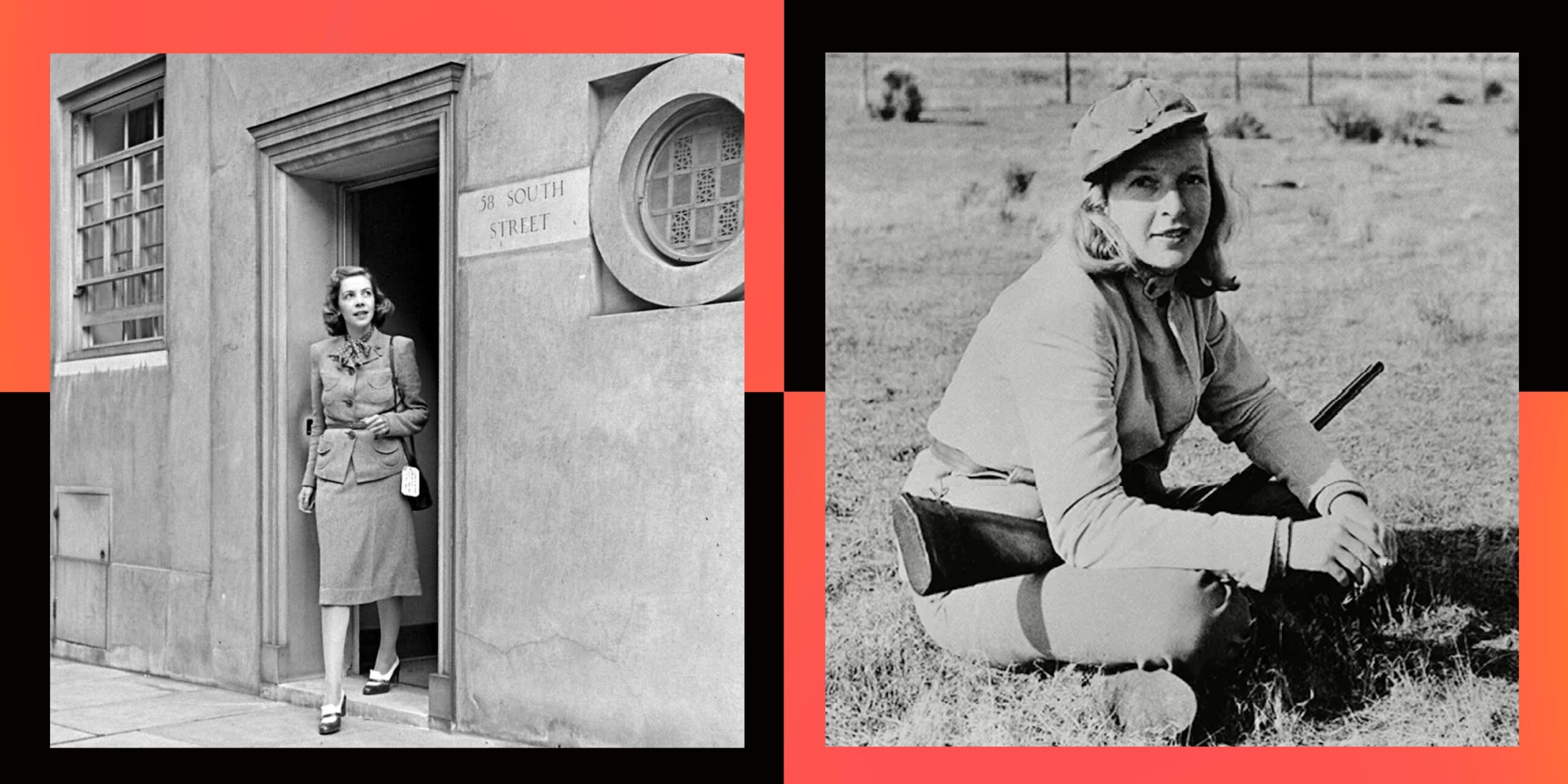
Martha did seem to know how to get where she wanted to go. She had crossed the Pyrenees alone, hitched rides on trains with Republican soldiers, dozed through a bombardment on her first night in a Spanish hotel. She had an athletic, leggy build; a face that, even as she approached thirty, kept an appealing softness around the chin; a recent literary hit; friendships and connections with prominent intellectuals and politicians on both sides of the Atlantic.
Gossip wound its way around both Martha and Ginny. The correspondents in Madrid “studied each other like crows,” Ginny noted. Martha possessed a keen sense of glamour, though she also seemed a hair too political, too open for the fashion set. She had spent time in Paris in the early 1930s, eating free meals with “the Haves” even as she was angrily aware of the “frantic half-starved unemployed.” She had acquired an odd if extravagant wardrobe—nubby tweed Schiaparelli suits with leather clips and samples bought cheap from the previous season’s collections—until she made enough money to buy herself “ordinary clothes” rather than couture seconds.
To Spain, Martha had worn a windbreaker and wrapped her blond hair in a green chiffon scarf. Women who traveled knew the importance of clothes; they calibrated clothing to deflect judgment and ensure safety. A veiled hat blocked eye contact. Simple, modest clothes made of coarse fabric implied virtue and necessity—a journey to a distant factory or a domestic job, caring for a sick relative. A calculated air of vulnerability could invite decent and gallant men to a woman’s aid. Yet these women rarely went unprepared. Martha chose her clothing and packed a duffel bag full of canned foods.
Confident of bearing, with warm eyes and a wide smile that cracked her face in two, Ginny had arrived in Madrid carrying a suitcase with a typewriter, three wool dresses, and a fur jacket. She wore three-inch heels and gold bangle bracelets in a war zone. She accidentally carried a suitcase with red and yellow bands, Franco’s colors, which appeared to mark her as a wealthy Franco supporter, she realized as she deflected evil glances on her first day in Spain.
The only people who crossed the front, really, were spies. If she succeeded, she would be the first journalist to publish reports from both sides.
Ginny, a former society reporter, would cover the war for the conservative Hearst magazines. She had recently interviewed Mussolini and Marshal Italo Balbo, the new Italian governor of Libya. Some admired her journalistic mettle; others, including Martha at first, could not take her seriously (those tinkling bracelets). But Ginny had arrived determined to cover both Nationalist and fascist Spain. Evenhanded reporting, seeing both sides of a war, might ensure her full departure from the confines of society writing. Filing stories from the front hadn’t done it yet. In Morata de Tajuña, she had been one of only six journalists permitted to the front and had filed a detailed report on the military action. “Half of 300 U.S. Youths Fighting at Front in Spain Killed, N.Y. Socialite Discovers,” the headline read.
In Spain, amid factionalism and undercover alliances—few knew who, on the left, reported to the Stalinists and helped draw up lists for execution, or who on either side actually directed the action—Ginny’s goal seemed dangerous, even crazy. The only people who crossed the front, really, were spies. If she succeeded, she would be the first journalist to publish reports from both sides. To Ginny’s editor, her success or failure did not matter. A woman making the attempt to cross the border alone would interest readers. He funded her passage.
No magazine had paid for Martha’s tickets. She bought her boat fare by writing an article titled “Beauty Problems of the Middle-Aged Woman” for Vogue, testing a new chemical peel that fried her skin but took her across the ocean. Martha had no interest in Franco’s aristocratic, fascist Nationalists. Like most of the foreign intelligentsia, such as Ernest Hemingway, John Dos Passos, and the New York Times correspondent Herbert Matthews, all of whom had come to Madrid to cover the war, Martha arrived in Spain a passionate partisan.
As Rebecca West wrote in her contribution to Authors Take Sides on the Spanish War, a pamphlet Nancy Cunard published collecting 126 state-ments on the war from the intelligentsia, “Spain herself, at a properly conducted election, chose [the Republican] Government and rejected the party which now supports Franco.” The pamphlet published five pro-Franco missives; sixteen authors declared neutrality. Martha agreed with Rebecca. She saw no two sides. The fight for Madrid represented a battle for the future of democracy, with Franco and Hitler and Mussolini lined up like mustached dominoes ready to sweep fascism up from the coast into Europe. She knew the Soviets and the leftist volun-teers supported the Republicans, and that the Germans and Italians tested their munitions and men by helping Franco’s forces.
Yet Martha had absolutely no war experience. Her most recent book, The Trouble I’ve Seen, culled from the year she’d spent reporting for FDR’s Federal Emergency Relief Administration on the poverty of the post-Depression era, had established Martha as “a good reporter with an eye for the small, significant, heartbreaking detail,” but the book was fiction, regardless of how accurate its stories felt to American readers.
“I am going to Spain with the boys,” she had written to a family friend in St. Louis before departure. The only American reporters Martha knew would be there were men, though women reported from the war, too—180 of them, from various countries, would file stories from Spain by the war’s end. When she met Ginny in Madrid, Martha was cold, hungry, and confused. She had no assignment, only a vague letter of interest from Collier’s. Her relationship with “the boys” had grown complicated, and her rapport with other women, too. Some of the women journalists disdained Martha for starting to sleep with Hemingway after two weeks in Spain, or for how she “sailed in and out in her beautiful Saks Fifth Avenue pants.”
At the very least, one could not help but notice her linen dress, her “perfectly even suntan,” how she swung her long legs while sitting on a table. Most reporters struggled to cadge a ride to the more distant fronts with the dirty soldiers who kept Franco’s forces at bay. Martha had scarcely arrived when Hemingway loaded her into his jeep. They had become friendly months earlier in Key West. She could consider herself “spoiled” in the hard circumstances of Madrid under siege, one woman had suggested wearily.
Ginny was too practical to dwell on “personal footlingness” or who slept with whom. “Philosophic or metaphysical ideas” bored her. Unlike Martha, she had grown up in financial precarity but with a society name; her mother’s well-to-do family had disowned her when she married a nobody doctor, who proved to be impulsive and promiscuous. She had raised Ginny and a sister on her own. Ginny had made use of her father’s eventual success to launch her own writing career via zingy pieces on society events. She parlayed that work into more serious writing by traveling around the world on the life insurance money her mother left her when she died, mailing dispatches back to editors.
Ginny was patient and clever. While she earned the contacts and orientation in Madrid to write the rounded, analytical articles to which she aspired, she would have fun alongside her reporting. She and Martha went window-shopping and had their hair washed at a salon and drank afternoon cocktails. Then they plotted their research: which general they could convince to take them to what front, which civilian facility they might visit in the meantime. Hospital, prison, restaurant.
By 1936 she was the first woman on the paper’s editorial board; in 1937 she became the first woman to win a Pulitzer Prize in reporting, for her foreign correspondence.
These were the places where a woman reporter could make her name while the more conventional armies of the world refused to let them to the front. Forty-odd women, a significant number among the on-the-ground press, had covered the First World War for American papers. The American and British armies had not permitted them near the most consequential battles. “The big story of a war is never at the front, but in the hospitals and homes. War is largely a woman’s affair,” noted the editor of The Saturday Evening Post, who sent four women to cover civilian issues in World War I.
Still, Europe offered opportunity for someone bold, willing to subvert the usual expectations of women. Dorothy Thompson, who had become astronomically famous after Hitler kicked her out of Germany for her impolite coverage—“he is the very prototype of the Little Man,” she wrote—landed her first exclusive in 1921 by dressing as a Red Cross nurse to sneak into the castle of the deposed Hapsburg king and claim an interview. That same year, Anne O’Hare McCormick had written directly to the managing editor of The New York Times to offer articles during her stays on the Continent with her businessman husband.
By 1936 she was the first woman on the paper’s editorial board; in 1937 she became the first woman to win a Pulitzer Prize in reporting, for her foreign correspondence. The Times itself downplayed her win. Where male winners for the paper saw their names rendered in the subhead of an article announcing the year’s Pulitzers, McCormick’s was not, nor did the article mention her prize until the story’s fifth paragraph.
Ginny had more grit to her than the gold bangles suggested, Martha understood as they walked through Madrid. During these first weeks on the ground, Martha acquired routines and reams of notes from hospitals and prisons, assiduously compiling them every night back at the Hotel Florida, and a single friend, but no bolt of inspiration. She wrote down sounds, smells, and gestures and didn’t try to gather them together for Collier’s yet. She drank whiskey at night in the hotel rooms where the foreign press gathered. And she waited.
__________________________________
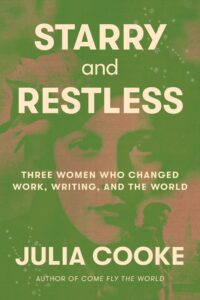
Excerpted from Starry and Restless: Three Women Who Changed Work, Writing, and the World by Julia Cooke. Published by Farrar, Straus and Giroux. Copyright © 2026 by Julia Cooke. All rights reserved.

Julia Cooke
Julia Cooke is the author of The Other Side of Paradise: Life in the New Cuba; Come Fly the World: The Jet-Age Story of the Women of Pan Am; and the forthcoming Restless Women: The Writers Who Made A Place for Women in the World, narrative nonfiction about the intersecting lives of Rebecca West, Martha Gellhorn, and Emily Hahn. Her essays and reporting have appeared in Tin House, the New York Times, A Public Space, and the Virginia Quarterly Review, where she is a contributing editor.