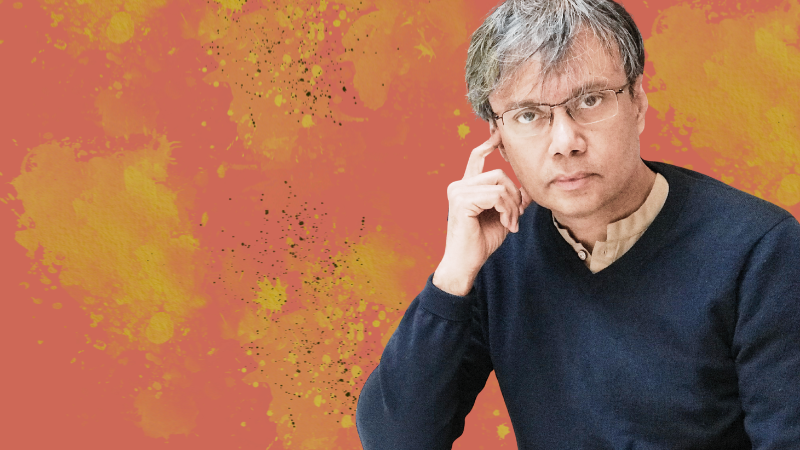
Amit Chaudhuri Still Writes His Novels Longhand
The Author of A New World Takes the Lit Hub Questionnaire
Amit Chaudhuri’s novel, A New World, is available now from New York Review Books, so we asked him a few questions about writing routines, writers block, rereading, and more.
*
What time of day do you write (and why)?
I write in the morning, starting late on days when I practice music, which is every other day. (Besides being a writer of books, I’m a singer in the Hindustani classical tradition, whose complexities require constant honing. This honing is called riyaaz. Some people say to me that writing, which is to a large extent revising, is also riyaaz.) I will continue to write in the afternoon, but not necessarily what I was writing in the morning. If I was writing a novel then, in the afternoon it might well be an essay. As every writer is aware, writing is commonly a return to work you have already been engaged in; it is only occasionally the beginning of something new. In other words, writing means stopping to consider what you have written—a dispiriting task that requires greater strategies for procrastination than writing itself—and then finding a way of getting back in. I have chronic insomnia, and try to keep my overactive brain in check by staying away from writing after 6 PM.
*
How do you tackle writers block?
Part of the answer to this lies in my answer to the previous question. I think writer’s block occurs when your entire consciousness is focussed on the work. Practicing music helps me write not because of music’s palliative qualities—it is as difficult to pursue it as it is to pursue any other art—but because, when I’m singing, I have no memory of being a writer. Writing essays, in the same way, lubricates my writing of fiction and vice versa—by distracting me and taking my thoughts elsewhere. Not that you move between genres or forms to relieve yourself of the tortuous fidelity to one thing. But dispersal of attention is essential.
Watching thrillers or murders on TV (and now on OTT platforms) and turning into an uncritical enthusiast of plot in the evenings is similarly indispensable to openness to plotlessness during the day. I think that seeming abeyance of intelligence must, in some mysterious way, be part of the creative process. The other thing to remember in order to avoid writer’s block is the fact that money is unimportant. The one time I was blocked was when I was paid what seemed to me a needlessly substantial advance after writing the first 20,000 words of my third novel, Freedom Song. I had to escape that debilitating sense of obligation by writing my fourth novel, A New World, before finishing my third one.
*
What part of your writing routine do you think would surprise your readers?
I don’t know. The fact that I still write my novels and poems longhand, and that, for this purpose, I rely on outstation material: biros or cheap ballpoints from the UK, and a spiral-bound student notebook with a red cover that I can only get from a newsagent’s on Holywell Street, Oxford? The notebook gives me a vaguely accurate sense of how many words I’m getting on a page. Also, maybe the fact that I often stand when I write, moving from one location in the flat to another.
*
Which book(s) do you reread?
In the last fifteen years, I have been rereading two books that I first read as a teenager in English translation and then forgot about: the Bhagavad Gita and the Upanishads. I read them not as religious texts but as the earliest examples of creative-critical writing in which thought and poetry come together, and as key works for modernism. I also go back sometimes to the Irish poet-critic Tom Paulin’s collection of critical essays, Minotaur: Poetry and the Nation State, for its extraordinarily shrewd and enlivening readings of poets like John Clare and Elizabeth Bishop.
And I find myself returning to Paulin’s translations—more akin to Lowell’s “imitations” than to conventional translations—of mainly European poets in The Road to Inver, especially the poem “Bournemouth” by Paul Verlaine, which, in Paulin’s version, speaks to me on many levels. Tagore’s songs—so exquisite in the original Bengali—I reread each time I sing them from the Gitabitan or Collected Songs. Some of Woolf’s essays in their entirety; paragraphs from Naipaul’s A House for Mr Biswas and The Enigma of Arrival—these reward repeated reading.
*
Which non-literary piece of culture—film, tv show, painting, song—could you not imagine your life without?
I can’t imagine being a writer through literature alone. I see all forms as being indispensable to the literary: for instance, the 20th-century khayal in Hindustani classical music; the so-called art-house cinema from the middle of the 20th century right up to Abbas Kiarostami; Barry Lyndon, A Clockwork Orange, and Visconti’s The Leopard; The Simpsons and Seinfeld; Kangra miniatures and the paintings of Matisse and Benode Behari Mukherjee—life as a writer would be poorer if our stimuli came only from books and not from these and other artifacts.
__________________________________
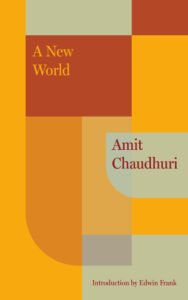
A New World by Amit Chaudhuri is available from New York Review Books.