American Psycho:
How Donald Trump Brought the “Bateman Doctrine” to the World
Aron Solomon on the Devastating Consequences
of Narcissism Elevated to Policy
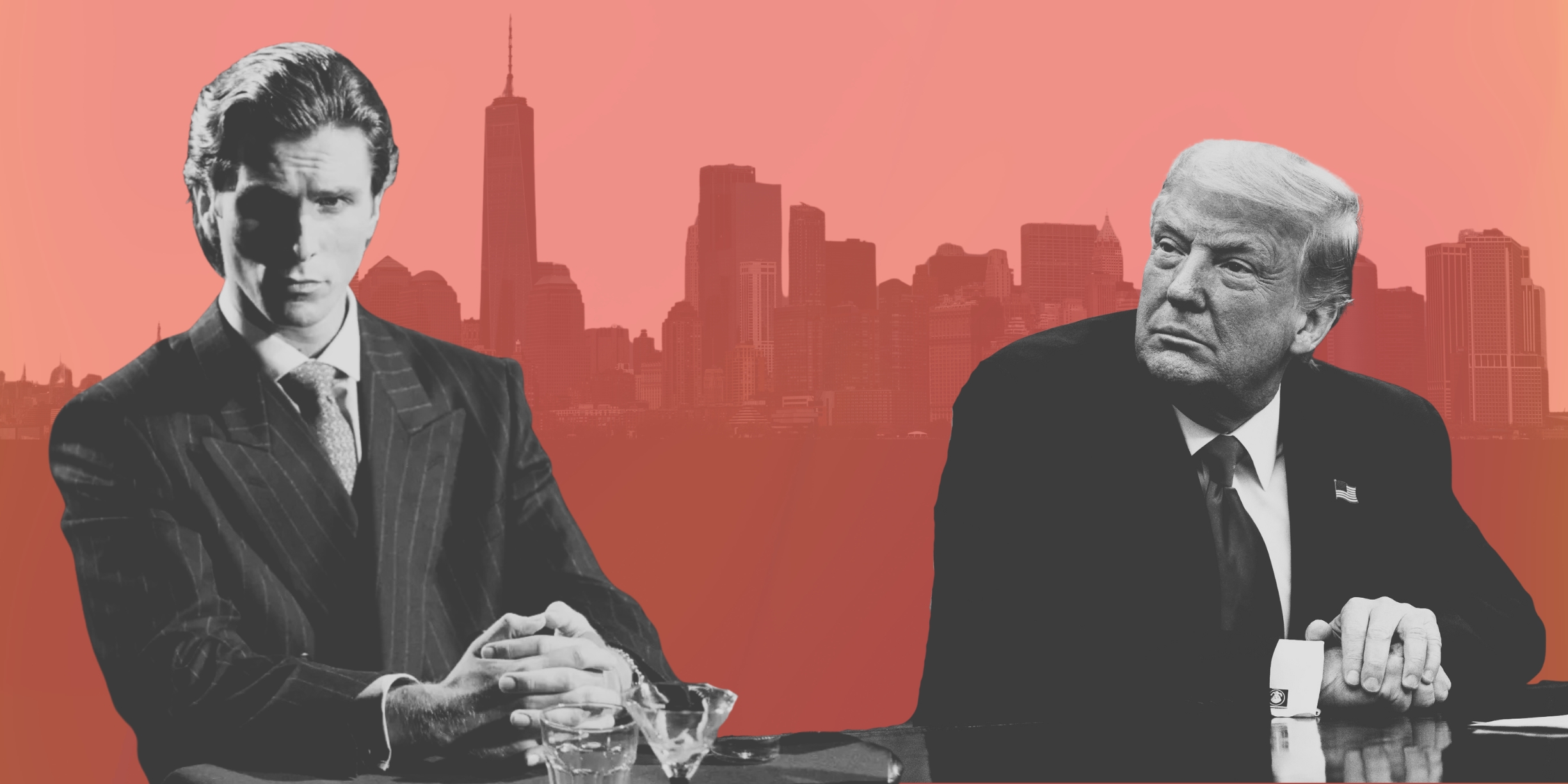
There is a moment in American Psycho when Patrick Bateman realizes that the rules do not apply to him. Not because he has outsmarted the system, and not because the system has collapsed, but because it never truly existed for someone like him. Status insulates. Presentation protects. Violence dissolves into noise so long as it is delivered with confidence and good tailoring.
That realization was meant to horrify. Instead, it prepared us.
What Donald Trump has done to the Rule of Law, and to international relations more broadly, cannot be explained by ideology or even corruption alone. It makes more sense when viewed as narcissism elevated to doctrine. Not strategy. Not realism. Performance. Validation. Domination for its own sake. The self as the organizing principle of the state.
This is where Patrick Bateman stops being a literary monster and becomes a governing metaphor.
Bateman does not believe in rules. He believes in surfaces. Business cards. Reservations. Who is winning the room. The law exists only as background noise, something that applies to other people, lesser people, invisible people. When consequences appear, they evaporate under scrutiny. No one wants to see. No one wants to know. The system itself collaborates in his impunity because acknowledging the truth would implicate everyone.
Trump governs from the same interior logic.
The rule of law depends on a shared fiction. That power submits to constraint. That leaders accept loss. That institutions matter more than ego. Narcissism rejects every one of these premises. It replaces them with a single question. Does this affirm me?
Narcissism collapses time into the present moment. What matters is today’s headline, today’s crowd, today’s assertion of dominance.
Courts that rule against Trump are corrupt, not because their reasoning is flawed, but because their existence contradicts his self image. Journalists are enemies, not because they lie, but because they observe. Allies are useful only until they assert independence. Treaties are insults. Norms are weaknesses. Accountability is persecution.
This is not chaos. It is coherence of a different kind.
Bateman’s violence is not driven by rage. It is driven by boredom and entitlement. He hurts people because he can, and because doing so confirms his reality. Trump’s dismantling of legal and diplomatic norms follows the same pattern. He breaks because breaking proves power. He lies because lying demonstrates that truth no longer restrains him. He humiliates allies because humiliation clarifies hierarchy.
Foreign policy, under this logic, becomes an extension of the mirror.
International law assumes actors who at least pretend to believe in restraint. It assumes shame. It assumes reputation matters over time. Narcissism collapses time into the present moment. What matters is today’s headline, today’s crowd, today’s assertion of dominance. Long term consequences are abstract and abstraction is intolerable to a personality organized around constant validation.
Patrick Bateman does not plan futures. He performs scenes.
Trump’s approach to NATO, to trade, to diplomatic norms follows the same script. Loyalty is personal, not institutional. Agreements are revocable on impulse. Threats are theatrical. Praise is currency. Policy becomes indistinguishable from mood.
This is why attempts to explain Trumpism through conventional political analysis often feel inadequate. They assume motivation where there is impulse. They assume strategy where there is appetite. They assume belief where there is only self regard.
Bateman’s most chilling trait is not his violence. It is his emptiness. He does not experience others as fully real. They exist as props, obstacles, or reflections. Trump’s rhetoric treats institutions the same way. Courts, agencies, alliances, even voters are meaningful only insofar as they validate him. When they do not, they become illegitimate by definition.
The danger here is not merely authoritarianism. It is solipsism with power.
Ellis wrote American Psycho as a satire of excess, a grotesque exaggeration of Reagan era moral vacancy. The assumption was that exaggeration would repel. Instead, it anesthetized. We learned to laugh. We learned to quote. We learned to admire the sharpness without sitting with the horror. Over time, the warning dissolved into aesthetic.
Reality learned the wrong lesson.
When narcissism occupies the state, cruelty becomes policy without ever being named as such. There are no death camps. There is simply neglect. There is no formal abolition of law. There is simply selective enforcement. There is no declared hostility to democracy. There is simply constant erosion of trust until participation feels futile.
An international order that relies on norms without enforcement will discover that some actors never believed in the game.
Bateman gets away with murder not because the police are incompetent, but because the culture refuses to see him clearly. Trump’s attacks on the rule of law function the same way. Each violation is framed as outrageous but isolated. Each norm break is excused as style. Each lie is rationalized as politics. Over time, the accumulation becomes the system.
This is the real parallel. Not the body count. The impunity.
International relations suffer most under this doctrine because they rely so heavily on shared illusion. Mutual recognition. Good faith. Continuity across administrations. A narcissistic actor treats all of that as optional theater. Agreements are not commitments. They are performances to be renegotiated or discarded the moment applause fades.
The Bateman Doctrine teaches that power is proven by violating expectations and surviving. Every unchecked transgression becomes precedent. Every unpunished lie becomes permission. Every alliance strained but not broken confirms that the rules are weaker than the ego.
Patrick Bateman famously confesses near the end of the novel, only to realize that confession itself changes nothing. There is no catharsis. No reckoning. The system absorbs the truth and moves on.
That is the final warning.
A society that cannot confront narcissism at the level of power will normalize it as character. A legal system that treats bad faith as noise will slowly surrender meaning. An international order that relies on norms without enforcement will discover that some actors never believed in the game.
Trump did not invent this condition. He revealed it.
American Psycho was never about murder. It was about what happens when surface replaces substance, when accountability becomes optional, when cruelty is indistinguishable from confidence. We were supposed to recognize the monster before he learned how to govern.
Instead, we taught him the language of applause and handed him the microphone.

Aron Solomon
A Pulitzer Prize-nominated writer, Aron Solomon, JD, is the chief strategy officer for Amplify. He has taught entrepreneurship at McGill University and the University of Pennsylvania, and was elected to Fastcase 50, recognizing the top 50 legal innovators in the world. Aron has been featured in Newsweek, Fast Company, Fortune, Forbes, CBS News, CNBC, USA Today, ESPN, Abogados, Today’s Esquire, TechCrunch, The Hill, BuzzFeed, Venture Beat, The Independent, Fortune China, Yahoo!, ABA Journal, Law.com, The Boston Globe, and many other leading publications across the globe.