Am I a Better Ceramicist Than Novelist?
Brendan Mac Evilly on Figuring Out How To Be an Artist
In literature, the execution of a work of art happens on the page, at the desk. In my debut novel, Deep Burn, the characters are artists and curators—people working in photography, film, painting, public installation. Their art gets them out of the house. Their artworks and ideas are concrete.
But a strange sort of transformation took place during the writing of the book. It’s only accelerated since publication. I’ve begun to try out other forms of art. To copy-cat and inhabit the lives and work of my fictional characters, and bring their work to life.
In Deep Burn, the main character Martha Knox moves to a seaside village in South Kerry and begins an unlikely career burning emotionally charged objects for clients and photographing the results. She provides a kind of unburdening service, incinerating the fraught objects against a beautiful rural backdrop and replacing them with a printed photograph.
An urn elicits feedback in seconds; a book, maybe never.
Now I, too, am setting fires in long abandoned houses and photographing the results. I want to become her. Steal her practice, at least. I asked friends for precious objects and burn them in unusual places in the Kerry townland where the novel is set. I fill a rucksack with dried turf, lighter fluid and camera. The desolate, stunning landscapes I traverse are privately owned, and so the break-and-enter factor makes the work feel transgressive from the outset.


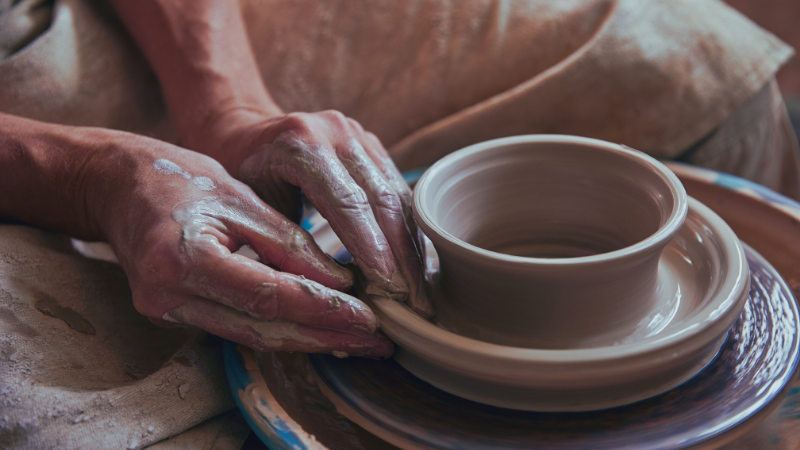
Now, I’m making ceramic versions of key objects from the book—an urn, an oil can, a lobster trap—bringing the world of the novel to life. A series of hand grenades. A series of pint glasses.
It’s a fun project, until I began to think, a little sheepishly: did I pick the wrong art form?
I’ve wanted to write a novel for longer than I haven’t. Yet I’ve always suspected I might have been happier—or more satisfied—working in another medium. I’ve always been jealous of visual artists. There is something intoxicating about the immediacy of showing a piece of ceramic work to a friend. Made in a day, held in the hand, admired instantly. Whereas a novel takes five years and may never have a single reader. An urn elicits feedback in seconds; a book, maybe never.
Last weekend, at the birthday of friend and writer Thomas Morris, I made him the gift of a small pot. It is wonky but beautifully glazed (glaze, for the most part, makes everything beautiful!) I could have given him my novel, of course, but what writer wants an eight-hour reading assignment for their fortieth?
In another medium, might I have been better? A dangerous fantasy because it’s so attractive, for the simple reason that, for want of a time machine, it can’t be disproven.
I’ve become a studio member at a new community studio in Dublin’s city centre, Throwing Shapes. It’s situated on the ground floor retail space of a hastily built apartment block—what Dubliner’s would consider ‘a high rise’ (about eight storeys). The shopfront wall is all glass, so the building feels as much like a gallery as it does a workspace, with member’s work on display for passersby and to inspire each other. The ‘community’ aspect means that anyone can join. Many are beginners like me. People are chatty, and the more experienced makers are generous with tips and hacks. Many are non-professionals, making objects for personal use or things that will be gifted on.
But the quality of output is high; and members’ rates of improvement is invariably fast. The first thing I make at my hand-building course is a passable, spherical buoy. I am among the worst students in the throwing course that follows, and by far the messiest, but it’s very little time at all before I’m astounding myself at the height, smoothness and curve of my clay pint glasses (there’s a lot of pub scenes in the novel).

All of which sparks a new thought. In another medium, might I have been better? A dangerous fantasy because it’s so attractive, for the simple reason that, for want of a time machine, it can’t be disproven.
Should I not have been doing this myself for the past eleven years? (Rather than spending six years on a failed novel, and five years on one that just about published.) That’s the fantasy anyway—the fantasy of a more ambitious, joyful, even successful past, one which has led you to a more fulfilling present moment.
My book is published beautifully by a small Irish press—gorgeous production, French flaps, thick, creamy paper. In this way, I’m pleased to say, it is more art book than mass-produced product. But I know it’s unlikely to “go round the world,” as Brendan Behan once said of JP Donleavy’s The Ginger Man. Distribution to major bookshops, even within Ireland, is limited. So I consign myself, half in jest, half in despair, to that grim category: a minor author.
Yet in the fantasy world where I have taken up film, or music, or conceptual ceramics, there remains the exhilarating possibility of greatness. Brendan Mac Evilly—major ceramicist.

Another friend and (major) author, Sara Baume, has taken the reverse path in life. She realized on finishing her art degree and practicing for a couple of years as a visual artist, that her subject/medium was actually “ideas,”and what better form is there to express ideas than the written word? She worked it out relatively early and boy did she succeed at her new form.
The answer is probably simpler: life is long, and we only get one—so why not pursue multiple art forms while we’re here?
Maybe this isn’t really about art forms at all, but about the impossible dream of living multiple lives while being restricted to one. Our fantasies of another art form might really be about experimenting with alternate selves—a creative act in itself? For hopeless dreamers like myself, writing may in fact be the ideal form—the one that lets you live out all the lives on paper that you can’t IRL. Or in my case, to explore the lives of fictional artists before you become one yourself.
Every artform has its invisible constraints. While a painter envies the novelist’s ability to inhabit consciousness, or a filmmaker envies the freedom from production costs, artists must be warned that writing carries its own myths and seductive fallacies. In fact, writing might be the most envied of forms precisely because it looks so democratic, so free. But the route out of the slush pile and into the loving arms of an agent, are not as egalitarian as they appear.
Ultimately, there is no best route, no ideal form. The pursuit of any artform is nonsensical, in economic terms at least; always a decision you make despite this knowledge. For the love of the game to begin with, then see how far it takes you. Art and its pursuit doesn’t owe us anything, nor is it there to please its makers.
I still don’t know if I’ve picked the right form. The answer is probably simpler: life is long, and we only get one—so why not pursue multiple art forms while we’re here?
__________________________________

Deep Burn by Brendan Mac Evilly is published by Marrowbone Books.
Brendan Mac Evilly
Brendan Mac Evilly ’s writing has appeared in The Irish Times, The Guardian, The Sunday Business Post, The Stinging Fly, The Honest Ulsterman, and We Are Dublin among others. He works as a freelance arts manager and runs www.creativecareers.ie, a jobs website for the creative sector. His book At Swim: A Book About the Sea is published by Collins Press.