All of America’s Colonial Evils at Once: The Early 19th-Century Subjugation of Florida
Jamie Holmes on the Forgotten History of the US Government’s War Against the Seminole
Not everything in Wiley Thompson’s life was unpleasant. The site of his impending death, at least, was beautiful. He spent most of 1835 in the outback below a picturesque hillock, surrounded by pristine forest in what is today north-central Florida. To the northwest, a tangled and primordial thicket flourished. An open pine grove stretched south. Beyond gentle slopes, lush woods extended as far as the eye could view.
Thompson lived and worked in a spacious log building known as the Seminole Agency house. It was likely built on limestone piers, with a tall roof and grand porches. Its rooms would have been well lit by dormer windows of rare sash glass and floored by plank wood, which was difficult to obtain in the interior so far from the sawmills.
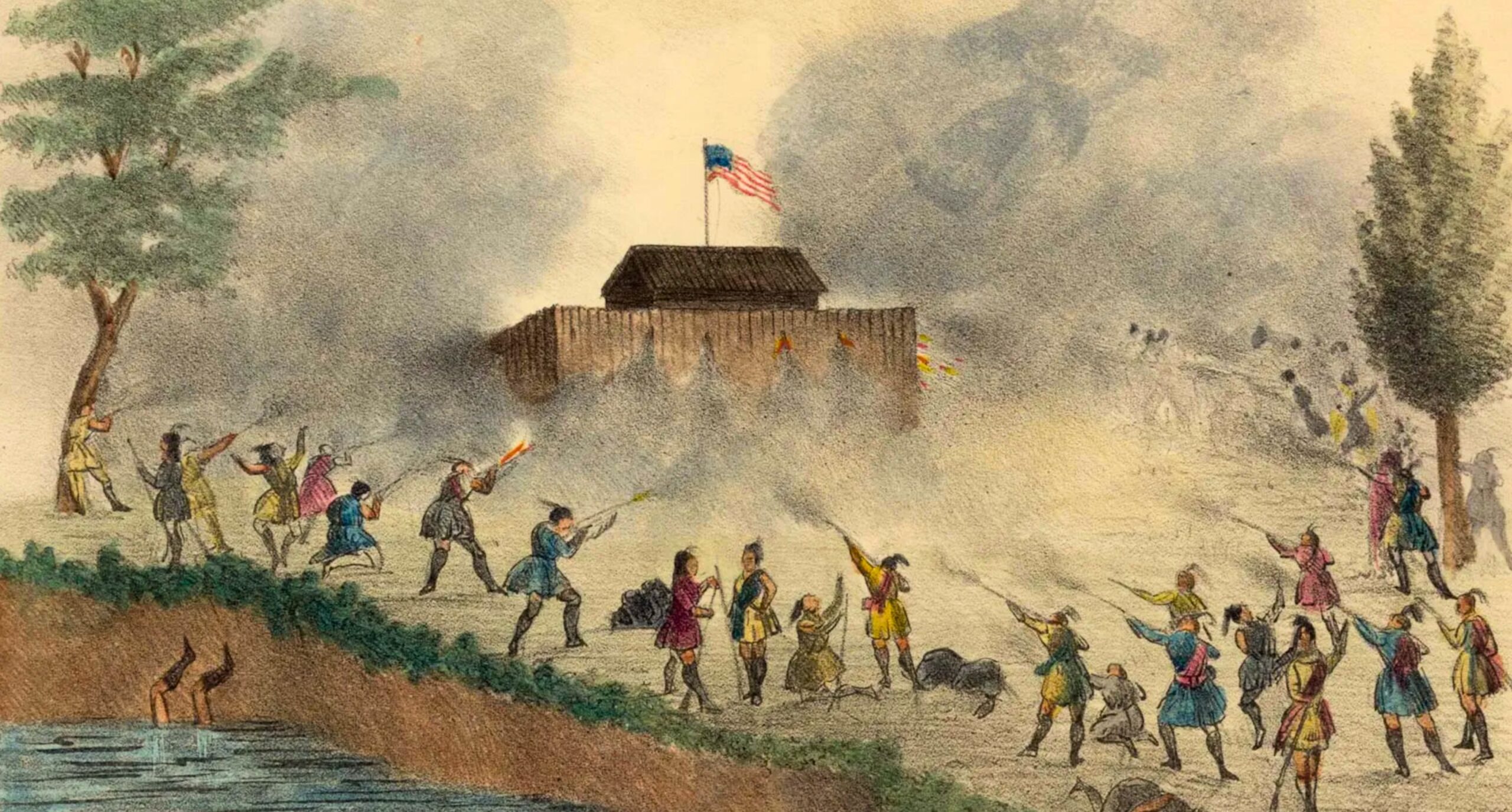
He had reason to feel secure and protected. Above the Agency house, a hundred yards away, Fort King’s sentinels scanned the area. Under a flagpole where thirteen stripes and twenty-four stars rippled in the breeze, over two hundred armed troops busied themselves in the barracks, mess hall, and ammunition and weapons depots.
The soldiers had access to basic amenities and comforts. A blacksmith forged nails. Surgeons tended to the sick. The sutler, who sold goods, was well stocked in beer and even champagne. Officers bathed in a fresh spring where the waters were as “soft as a lady’s hand,” and bedrocks glittered clearly far below, and even the fish glided idly.
Thompson knew that there was a “rulebook” for holding people in bondage just as there was one for eviction. Enslavement without rebellion. That was the goal.
The fort was as agreeable as Thompson could have possibly hoped. His problems were not rooted in where he was stationed. The headaches came with the job itself.
The U.S. government did not send the fifty-three-year-old to the hinterlands simply to evict Native Americans from their homes. The government had sent Thompson to the Florida Territory to force Native Americans from their homes as cheaply as possible.
Removal without war. That was the goal.
Treaties were trifles compared to armies and bullets. Treaties could be printed in newspapers so that citizens knew it was all super fair and aboveboard. Thompson was the guy hired to grin and shake hands. He spent late March 1835 in meetings with Seminole chiefs and other leaders, encouraging their imminent departure, and futzing over logistics. Transporting an estimated three to five thousand Indigenous people west of the Mississippi involved tons of paperwork. He was a man of forms and procedures.
For six months, his lithe, graying figure—he not only supported Andrew Jackson’s commitment to the Indian Removal Act of 1830 but, by total coincidence, physically resembled the president—could be seen pacing up and down the promontory, performing drudgeries. He completed many of his unsavory chores alone. His new assistant, Yancey, was a drunk. Thompson sat dutifully inside the Agency house and toiled away with his quills and letter paper. The Indians had been promised frocks if they relocated westward. But what kinds of frocks? His boss assured him that the frocks should be homespun and sewn in a “workmanlike manner.” Mock-ups had to be stitched. Bids procured.
The envoy, a former U.S. congressman from Georgia, was not ignorant of the risks. He had only traded in his seat on Capitol Hill, after all, after falling into debt and filling out a will. His job title, Office of Indian Affairs Superintendent of Seminole Removal, was just as dicey as it sounded, and Fort King—for all its rustic pleasures—was recklessly isolated. Supply runs to Palatka, some forty-five miles away, took all of two weeks.
The camp was situated within the boundaries of the Indian reservation, a central enclave cordoned off in the years after Spain ceded the peninsula to the United States, in 1821. The systematic process of forcing Indigenous peoples from their homes, spearheaded by the War Department’s troubled Office of Indian Affairs, was now in full swing, and Florida, with citizenry from the Deep South, was eager to join the Union as a slave state. But the project was lagging. Apart from Michigan, nearly all lands east of the Mississippi River had been carved into states, while Florida remained sparsely inhabited and in large part unconquered. No colonial power had ever controlled the swamps and savannas of the interior—an alien land of lagoons, glade marshes, prairies, and hardwood thickets. If America chose a war of eviction, it would face terrain closer to the mangrove-choked waterways and swampy forests of Vietnam than the landscapes of Alabama or Thompson’s native Georgia. If he failed, the entire territory could plunge into chaos.
President Jackson’s Indian agent, who would soon be a pile of bones under his wife’s bed back home in Elberton, knew all this and accepted it. He knew his job would be tedious and lonely, and that his duties might kill him. What he did not expect—what he could not have foreseen—was that in April of 1835, with negotiations at their most delicate, his boss, the president of the United States, would paint an even larger target on his back.
*
April 21, 1835. More campfires meant more people. The nights were growing brighter. Under starlight, the flames encircled Fort King. For three days, leaders of the Seminole, Miccosukee, Tallahassee, and Creek Indians gathered in the surrounding woods, until a hundred blazes glowed like votive candles under the canopies.
For the colonists, it was another surreal sight in a landscape full of them. Fresh army recruits found themselves among whizzing insects, screeching owls, and bellowing gators. Newborn reptiles scampered on the riverbanks. Neon parrakeets flocked over live oaks draped in Spanish moss. Dead fruit rotted on withered evergreens, remnants of a record-cold February. Wild oranges hung, black from frost. Glowworms lit up uncanny forests. Stars, one officer wrote, “were the only familiar objects.”
Below the outpost on the hill, around the multiplying fires, families of cultures just as alien to the outsiders relaxed in shelters of poles and bark ripped from huge pines. Curious artillerymen drifted down, and the families welcomed them and shared their corn, which they baked in kettles, sifted, pounded soft, and sweetened with molasses. The troops snacked on coontie root and gawked at the women’s beads and at their silver ornaments—brooches of flattened quarters, shillings, and picayunes.
The Seminoles hosted a welcoming ceremony two miles away. The officers who attended were fearful they would be killed on the long night walk. The dancing didn’t end until after two o’clock in the morning, until the earth by the fire was left trampled “like a circus ring.” Moonbeams brightened packed dirt.
After sunrise, the leader of the Seminole Nation walked into a clearing near the Agency house. Chief Micanopy was the head of a fragmented coalition of tribes and their constituent bands of loosely allied guerrilla fighters. The Americans knew that there were many factions but often called them all Seminoles anyway, which made it easier to convince the public that the treaties were valid. The designation derived from the Spanish cimarrón, or “untamed,” a reference to Indians who left the troubled Creek Confederacy to build new lives.
Chief Micanopy was, in fact, a Seminole. Hefty, gentle, and in his fifties, he was known to be faithful to friends and to enjoy a glass and a fine meal. He and other chiefs shook the officers’ hands with firm grips that left the Americans with sore digits. Thompson opened the meeting with an “altogether too grandiloquent” speech about an old treaty signed by leaders who did not speak for all bands or families.
The details of the talks were nothing. The pattern was everything.
Thompson was only following a script. The government had a playbook, it turns out, for kicking Native people off their lands without any unseemly, costly bloodshed. The scheme involved several moving parts. First, settlers pushed in on Indians and drove away their game. Once families were starving, Washington sent envoys to meet with them in a clearing. After sharing a meal and laying out gifts, the emissaries would insist that the Indians move to where the animals were plentiful. They were starving, after all, and the government was only trying to be a friend and to help, and to protect them from the corrupt settlers and unfair local courts that would cheat them. If they didn’t leave, the army would attack, but since the government was a friend, it hoped to avoid war.
“The white people are settling around you,” Wiley Thompson announced, reading directly from a letter written by President Jackson to the chiefs. “The game has disappeared from your country. Your people are poor and hungry.”
White people were not settling all around like in Georgia and Alabama. Much of the interior was no good for farming. Some bands were hurting, but Micanopy’s people were flush with livestock. They weren’t hungry. They weren’t poor.
“Every true friend would advise you to remove,” Thompson continued, numbly reciting the president’s address verbatim. “But you have no right to stay, and you must go. I am very desirous that you should go peaceably and voluntarily.”
Talks continued for two days. Thompson ran the scheme, regardless of whether it really fit. An American general placed “his sword upon the table” and brashly informed the chiefs that “he had been sent here to enforce the treaty; he had warriors enough to do it; and he would do it. It was the question now whether they would go of their own accord, or go by force.” The ultimatum was plain: Leave or it’s war.
Hints of the tragicomedy to come surfaced on the second day, when heavy clouds threatened rain and the meeting was held in the barracks. Micanopy had “a pain in the stomach” and did not show, which offended Thompson.
“Tell him,” the agent sputtered, “he is stricken from the list of chiefs!”
The proclamation had little effect on the room. So the envoy composed himself, “rose slowly and imposingly from his seat,” and with “every eye fixed upon him,” extended his arm in a grand gesture. That was when the floor collapsed, and men, benches, tables, ink, and paper tumbled four feet to the earth in a tangled mess. An alarmed warrior yelled. Indians rushed from the barracks. It took a moment for the chiefs to be sure that it wasn’t a “stratagem,” and both sides laughed, and Wiley Thompson resumed the absurd theater that required him to hide his true face behind a thin mask of friendship.
Eight chiefs voted to emigrate. Five, including Micanopy, refused to.
*
News of trouble in the Florida hinterlands could take nearly a month to reach the Oval Office. Replies took another three-plus weeks. From the Agency house, outgoing mail traveled by horse or mule to a hamlet about twenty-five miles north. Contractors then humped it east around Orange Lake to Jacksonville, an eighty-mile slog. From there, letters were ferried by boat and trotted by stagecoach up to North Carolina, where important correspondence was loaded onto a steam locomotive to Virginia. In Washington City, completing the sprawling 902-mile trek, vital messages would have been delivered by courier to Pennsylvania Avenue, and placed among the piles of incoming mail addressed to the office of the president.
“His Excellency” Andrew Jackson was sixty-eight when he caught wind of Thompson’s irksome message, and in the final days of his second term. Wild, cotton-white hair decorated a slender, wrinkled, beady-eyed face. He looked increasingly anxious in his old age, and especially unhappy when he removed his dentures, as he did for portraits, and his lips frowned over toothless gums.
Years of rough living had ruined the president’s health. His digestive system was wrecked by recurring dysentery and colic, and the calomel prescribed by his doctors only made things worse. A duel in 1806—Jackson killed the man—and an 1813 gunfight had planted two lead bullets in him, including one still lodged near his heart. He exhibited many of the symptoms of lead and mercury poisoning, including paranoia, irritability, violent mood swings, excessive salivation, hand tremors, diarrhea, and pallor. He often bled his arm with his penknife.
He may not have been in the best mood when he received Thompson’s letter.
The agent’s message, dated April 27, 1835, arrived in mid-May. Forwarded from the War Department, the gist was that the envoy refused to serve the president’s wishes. Despite clear authorization, Thompson would not help enslave any “Indian negroes.”
“Application was made to me,” the dispatch read, “for permission to purchase negroes of the Seminole Indians.” With Jackson’s blessing, white slavers had shown up at the Agency house. Thompson explained why he had turned them down:
The negroes in the nation dread the idea of being transferred from their present state of ease and comparative liberty to bondage and hard labor under overseers, on sugar and cotton plantations. They have always had a great influence over the Indians. They live in villages separate, and, in many cases, remote from their owners, and [enjoy] equal liberty with their owners, with the single exception that the slave supplies his owner annually…with corn, in proportion to the amount of the crop…in no instance…exceeding ten bushels….Many of these slaves have stocks of horses, cows, and hogs, with which the Indian owner never assumes the right to intermeddle.
Tribal law prohibited the sale of any so-called Indian “slaves,” Thompson reported, and the Seminoles would resist all attempts to violate that precedent. Most seemed to be “slaves but in name” only. Tribute was little more than an in-kind tax, and there was legitimate doubt over how seriously even that obligation was taken. (Florida’s former governor complained, in 1826, that the Indians exercised “no controle over their slaves” and derived “no advantage from their labour.”) It was too dangerous, Thompson advised, to test the bonds between the Black and Native peoples. If the government allowed enslavers to divide the families, the agent warned, “God only knows what the consequences will be.”
No more bad examples of free, dignified Black people. No more bad advice to Indians. That’s what Jackson had authorized his emissary to make happen.
Jackson must have been disappointed by his appointee. Like the president, Thompson was a Southern slaveholder. The emissary understood perfectly well how vital slavery was to the economy of the adolescent Florida Territory. As of 1830, nearly 45 percent of the population was enslaved. Total inhabitants numbered 35,000 or so; only 844 were marked as “free colored.” Florida did not welcome free Black people. That was the Louisiana model—a legacy of French and Spanish occupation. That model helped produce a violent revolt, in 1811.
Thompson knew that there was a “rulebook” for holding people in bondage just as there was one for eviction. Enslavement without rebellion. That was the goal.
Not all toxic recipes were identical, to be sure. At Jackson’s private forced-labor-camp retreat in Tennessee known as the Hermitage, the president denied some one hundred souls access to education, real assets, and freedom of movement. Southerners openly discussed plantation “laws” and their psychological effects. One Louisiana slaver even wrote up a five-page document laying out his restrictions and detailing their intended results. The idea was to prevent trafficked people from realizing that they were equally capable and could live freely. “Never allow any man to talk to your negroes,” the slaveholder cautioned, “nothing more injurious.”
Evidence and information posed a mortal threat to the “peculiar institution” of slavery. Communities of apparently free, “Indianized” Africans and African Americans were intolerable no matter what they were called. The Florida Territory’s governor whined that they were a “serious nuisance,” that they seemed to have “unbounded influence,” that they were “all hostile to the white people” and “constantly counteracting the advice and talks given to the Indians.” Slavers in the territory saw them as a haven for “runaways” and wanted them all reduced to chattel. No more bad examples of free, dignified Black people. No more bad advice to Indians. That’s what Jackson had authorized his emissary to make happen.
Florida was personal to Jackson. He took possession of the land from Spain himself, after invading in 1818, and served as the first governor. The most powerful Americans in the territory were his men. Clinch. Gaines. Gadsden. Eaton. Call. Butler. And Thompson. The board controlling land claims was made up of “a remarkable combination of former Jacksonian associates” dubbed the “Nucleus.” President “Jackson’s Cronies in Florida Territorial Politics” was destined to be a topic of scholarly interest. The two enslavers backed by the president, turned away by Thompson at Fort King, offered a case study in local power: Two men, hearing about a bargain in the woods, asked the territory’s next governor—Jackson’s former aide-de-camp—if they could purchase “Indian negroes” from the Seminoles; the future governor wrote to his pal the president on behalf of his dear “friends at Tallahassee”; and voilà, the Office of Indian Affairs replied that of course the close friends could separate the families.
Except Thompson refused to play ball.
Jackson overruled his envoy, ignored the agent’s explanation and warning of grave risks, and instructed him to follow the original mandate. Jackson did not reply personally. Instead, the acting secretary of war conveyed the president’s position that “the condition of these” families would be the same if they were sold. The letter flatly denied that the targets held rights that chattel slavers strongly opposed: That the Black men were all armed, that many were worldly, bilingual or trilingual, that they traveled freely, and that they owned vast livestock.
“Indian negroes” had no place in the Territory of Florida.
__________________________________
From The Free and the Dead: The Untold Story of the Black Seminole Chief, the Indigenous Rebel, and America’s Forgotten War by Jamie Holmes. Copyright © 2026. Available from Atria/One Signal Publishers, an imprint of Simon & Schuster.

Jamie Holmes
Jamie Holmes is a writer and the author of the books Nonsense and 12 Seconds of Silence. His work has appeared in print or online in The New York Times, The New Yorker, Slate, WIRED, The Christian Science Monitor, The New Republic, The Atlantic, Foreign Policy, USA TODAY, and The Daily Beast. He holds an MIA from Columbia University’s School of International Affairs and previously worked at New America as a Fellow and Policy Analyst in international development. Prior to that he was a Research Coordinator at Harvard’s Department of Economics, where he focused on behavioral economics. He lives in Washington, DC.