
Alia Hanna Habib Offers a Guide to Finding an Agent
Step One: Pick Up a Lot of Books
This first appeared in Lit Hub’s Craft of Writing newsletter—sign up here.
Go to a bookstore. No, we are not usually lurking in the aisles (though we might be), but we are reliably found in the acknowledgments section at the back of a book. The front of the store will be stocked with bestsellers and new releases, so head back to the section with books that seem like they’d be shelved or displayed next to yours and take a look at the shout-outs in the final pages. Go to your own bookshelf at home and do the same with your favorite titles. Finally, do this with all the comps you mention in your proposal. All of these acknowledgments sections will help you build a list of agents to pitch.
The two richest resources for finding info about agents are Poets & Writers, a magazine and website, and the web-only database Publishers Marketplace. Poets & Writers has a detailed directory of agents and the magazine often publishes profiles of agents as well as advice from them. Publishers Marketplace tracks and announces agents’ recent deals, which is a great way to see which categories an agent is currently selling. Particularly with nonfiction, where there is often a multiyear gap between the deal and publication, looking at published books is invaluable, but those books reflect deals that happened at least two years earlier, if not more.
Publishers Marketplace can give you information on newer and junior agents who may have done a few deals but whose books aren’t yet out in the world, though know that even Publishers Marketplace might not give the full picture on what a “baby agent” (as we lovingly call them, though you never should!) might bring to the table. The agent Rayhané Sanders offers helpful, detailed advice on why researching junior agents is worth your while, which reflects my experiences as a baby agent as well:
Publishing is an old-school industry in that if an assistant has been given the green light to start building a list, it means that she has likely worked on very many published books behind the scenes/without credit. Which is to say that even if you don’t see Junior Agent’s name show up on very many Publishers Marketplace deal reports, even if you don’t see her name thanked in the acknowledgments sections of your favorite comps, that doesn’t mean she isn’t ready and able to represent you and get you a book deal. Junior agents at agencies are still building their own lists while they make the transition out of working in other administrative capacities—they are frequently younger, have more time both personally and professionally to devote to your debut, and they are hungry. When I was starting out as a baby agent, I took on manuscripts that needed a lot of work—manuscripts I probably wouldn’t touch today. I don’t have the same kind of time, and my plate is fuller now that I’m older and more established. But at the time, I’d go four, five, ten rounds with an author before taking a book to market. I’d cowrite proposals. I’d spend a lot of time because I was hungry to build my list.
I always advise emerging writers to cull their dream agent list for querying, then slash half the names and replace them with junior agents at their dream agent’s firm. You can find bios and wishlists of junior agents on many agency websites, and you can always do some online sleuthing on Publishers Marketplace or even Google to find out if assistants at agencies have acquired a project or two yet. What you need at this stage of the game is someone who believes in you and wants to go in on a dream together with you, even if you don’t have a long résumé quite yet. A young, hungry agent with a lot of time for you and space on her plate to fill is sometimes exactly what you want.
Having once been a baby agent and now, as a more experienced one, seeing how aggressively my junior colleagues must work to build their lists from scratch, I couldn’t agree more wholeheartedly, though that appeal can be hard to see when you are in the trenches. Writers, especially when roving in packs at writers’ conferences and readings, can get a little name-droppy about their agents. I think of it as the equivalent of walking around with a recognizably expensive designer handbag—right on the line of tacky-but-impressive! Know that dropping a fancy name indicates next to nothing about the quality or the future of the relationship in question.
I took on some of my most beloved (and successful!) clients when I was still a baby agent, and a very special bond develops between author and agent if you grow your careers together. It can be a really fulfilling way to work with a person who may be with you for your entire writing career. (And working with a future power agent at the beginning of her career can have its own “I saw the Velvet Underground in 1965” cachet; in time, you’ll be the one with bragging rights.)
Take comfort in knowing that all agents carry around a haunting set of names of writers we passed on who went on to great success.
It’s absolutely true that a well-established and prominent agent will have deeper publishing relationships than a newer one. A writer may be concerned that a less experienced or younger agent won’t be taken seriously by publishers. As someone who says the quiet part out loud, I saw a bit of myself in the aspiring writer I met at a writers’ conference—when I was still a fresh-faced late thirtysomething—who asked me somewhat dubiously, “But do editors actually get back to you?” Perhaps keep this question to yourself, but also take a good look at the agency where any junior agent works and the books that agency has sold.
Junior agents can draw on the relationships their agency (and their boss) has with publishers. If an editor receives a submission from a newer agent at an agency with whom they have previously done deals, they will likely take it seriously out of respect for the agency relationship. As I have heard from editor after editor, they are also often delighted to have new blood in the game. This doesn’t mean you shouldn’t pitch more senior agents or the power agent of your dreams. Agent Sarah Bowlin of Aevitas has excellent advice on how to balance your submission list between established and emerging agents:
I usually tell people to make three different groups—the “stars” or “dream” agents, the really good people who might be more available, and the assistants or early career agents who are newly building a list—and then query a few agents from each group every round. So, if you get feedback that makes you revise or change something between rounds, you still have some people from each group to go back to.
While simultaneous submissions (the industry term for sending out queries to different agents at the same time) are acceptable and even expected, avoid simultaneously querying multiple agents at the same agency. Agents don’t like to have to compete with their colleagues for projects. The process of signing up clients is already competitive enough, and the agency itself works best as a place of collaboration and mutual support, not internal competition. If two agents at the same agency were interested in repping you, one would have to defer to the other, and possibly be pissed about it. (We spend enough of our day being pissed at publishers, so we best not turn on each other.)
Additionally, if you carpet-bomb an agency with your submission, it may look like you are throwing spaghetti against the wall to see what sticks rather than doing your research in advance to make a thoughtful choice. If a particular agent does pass, you can certainly query another agent at the same shop.
About those passes: They are an inevitability, and you will of course be disappointed, especially if they come from an agent you’ve dreamed about working with. First, know that the most successful agent-author relationships are just like any other one: They work best if both parties have equal passion. Second, take comfort in knowing that all agents carry around a haunting set of names of writers we passed on who went on to great success. Author and legal scholar Dorothy Brown said about passes that a pass doesn’t mean you’ll never be published, just not now, with this person.
Finally, many agents don’t send passes at all. I apologize on our behalf; I know it is upsetting, but it is certainly not personal. For many of us, the hours in the work week don’t permit us to carefully read all unsolicited submissions and provide good service to the clients we already have, which is always our top priority. A nonresponse can mean a pass, though there is no hard or fast rule about the amount of silence that means “not for me.” You can certainly follow up, though I would avoid sending more than two or three follow-up emails. Many agency websites specify how long the agents take to reply and whether they reply to submissions they aren’t interested in.
________________________________________________
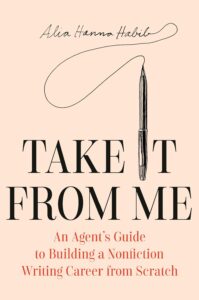
Excerpted from Take It from Me by Alia Hanna Habib. Reprinted by permission of Pantheon Books, an imprint of the Knopf Doubleday Publishing Group, a division of Penguin Random House LLC. Copyright © 2026 by Alia Hanna Habib.

Alia Hanna Habib
Alia Hanna Habib is a Vice President and literary agent at The Gernert Company, which she joined in 2017 after starting her publishing career as a publicist at HMH and working as an agent at McCormick Literary. Alia graduated from Barnard College and earned an MA in English Literature with a concentration in the nineteenth-century novel from Rutgers. She is the author of Take It From Me: An Agent's No-Nonsense Guide to Building a Nonfiction Career from Scratch (Pantheon).