A Timeless Take on Autobiography: Audre Lorde’s Zami: A New Spelling of My Name
Evie Shockley Remembers the Poet’s Innovative Excavation of the Self
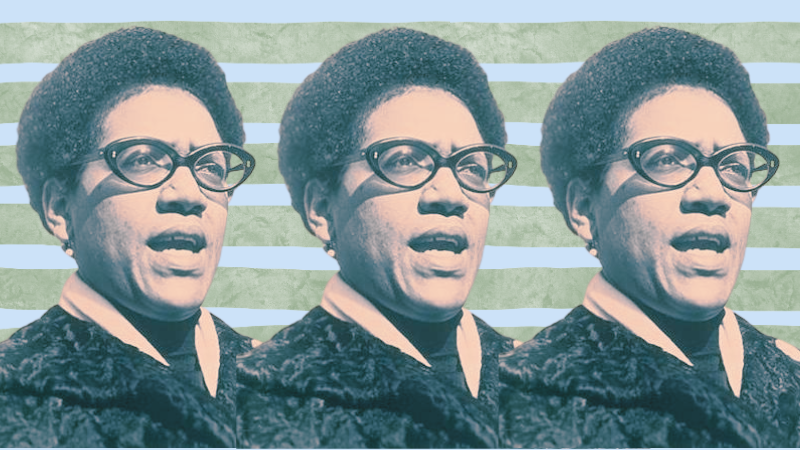
I remember exactly where I was when I learned that Audre Lorde had passed. It was an evening in late fall, already really cold in that characteristically Chicago way. I was at the Guild Literary Complex with one of my best friends, in the audience for a poetry event. Before the reading began, someone came onto the stage and made the announcement that Lorde had made her transition. This was well before the days of social media and the forms of constantly “breaking news” that we are now accustomed to—which is to say that nearly all of us in the room were learning of this loss together. The energy changed immediately. We marked the moment with the reading of one of her poems, followed by a minute of silence….Ashé. I was saddened, of course, but not grieving, because although I certainly knew Audre Lorde’s name and had a sense of her importance as a Black feminist writer, I had not yet really gotten to know her work or her story.
At the time, Lorde was not yet omnipresent on the syllabi of college courses. And her lesbian identity and subject matter made her work less likely to be featured even in Black-oriented popular culture contexts. I had finished high school and college in those days before it became common to encounter Black literature in the classroom, so while my teachers had introduced me to a few canonical figures—Langston Hughes, Jessie Fauset, Richard Wright, Ralph Ellison, Toni Morrison, Gwendolyn Brooks (I could nearly count them on one hand)—I was, as a young adult, busily making up for lost time.
I don’t think I learned what little I knew about Audre Lorde in an English or creative writing class, though I might have dug up on my own the small sample of her poems buried in the huge poetry anthology my professors assigned. Honestly, I believe it was the feeling I got on that November night of having missed the chance to appreciate Lorde during her lifetime that spurred me to add her to the other Black women writers (like Gloria Naylor, Terry McMillan, Ntozake Shange, Alice Walker, Toni Cade Bambara, and Rita Dove) whose work I was greedily consuming in the minutes I could steal from my time-consuming job as an associate attorney.
The story of her life is, by definition, a biomythography: an explanation of the inexplicable.
When the Quality Paperback Book Club (yes, really!) released a three-books-in-one volume of Lorde’s work just a few months later, I was thus primed to read her. And that is when Zami: A New Spelling of My Name entered me with the power of a lightning bolt. I can’t express what it meant to me, in my twenties and still working out how to move through the world while being true to my own sense of self, my own coalescing desires and commitments, to read Lorde’s evocative prose about her Grenadian immigrant heritage, her Harlem-based, Depression-era childhood, her wildly imaginative and rebellious adolescence, her long and lonely quest for community, and her consistently fierce, often empowering, and sometimes devastating bonds with the women and girls in her orbit.
For as little as I have in common with Audre Lorde—as someone born to a family descended from generations of African Americans on both sides and raised during the post-integration Soul era in a barely-middle-class Black, Southern, Protestant milieu—I kept finding myself in elements of her story.
I, too, remembered the mysterious beauty of the lights at night to my myopic eyes—and the magic of looking up into trees through my first pair of glasses and seeing individual leaves! I, too, believed deeply in the aesthetics of naming and the material beauty of words that underwrote Lorde’s early rejection of the descender “y” in favor of the delightful symmetry of her two five-letter names: “Audre Lorde.” (Her choice to drop the “y” resonates with my refusal to allow capital letters to artificially interrupt the visual flow of language in my poems.) I, too, have looked and listened for ways to give name to my desires, trying to parse the social codes that would allow me to locate—and locate myself among—my people.
*
Lorde, ever the theorist, gives us the brilliant and captivating neologism biomythography to describe her book, dispensing with the “self” that is made explicit and primary in autobiogaphy. But not because her selfhood is unimportant; the “auto” morpheme is unnecessary to Lorde’s term because her (self-)authorship—of and in Zami—is a given. After all, she spotlights her writing self (her self-writing) in the book’s subtitle: A New Spelling of My Name. What biomythography foregrounds is the way myth is central to her writing of her life, her writing for her life, her writing life, her life writing. A myth is a story that explains the nature or origins of a phenomenon—a story that often involves the supernatural. Despite everything her family and her twentieth-century US society could do to prevent it, Audre Lorde became “a Black, lesbian, feminist, socialist, poet, mother of two.” The story of her life is, by definition, a biomythography: an explanation of the inexplicable. It tells us how she drew upon the lives and stories of the “women flaming like torches” around her to write herself into being.
In the spirit of Lorde’s linguistic creativity, I’ll throw out a portmanteau of my own that suggests a complementary way of reading Zami: as a bildungsmemoir. We learn from Zami how a girl becomes an artist. In a book whose chapters are indicated almost exclusively by numbers, one of the only two titled chapters is called “How I Became a Poet,” setting up that theme as central to Lorde’s life story. Zami’s other primary thread is how a girl becomes a lesbian. Lorde is potentially both of these things by birth and by temperament, but by her own account, she must teach herself what it is to occupy each of these identities fully, joyfully, powerfully. Ultimately, the two journeys are one.
What I mean is that Lorde expressly ties her physical coming-of-age, the day she begins her menses, to a deepening awareness of her sexual orientation, her body’s responsiveness to women rather than men—what we might call her queerness, though that was not a term she used. She homes in on the “uses of the erotic,” as she puts it elsewhere. She perceives her deeper sense of her embodiment to be a wellspring she can draw on for understanding the world.
Your destination is the brave, beautiful, brash, brilliant woman we know Audre Lorde becomes. This is the story of her becoming.
In a memorable, gorgeously written scene, Lorde fuses the sensory experience of using her mother’s mortar and pestle to pound spices with a sensual explosion at the core of her body; this electric moment opens her mind as well, establishing the circuitry that powers her poetry and other writing. She describes how the rhythm of her pounding established a “thread”—“a vital connection”—that “ran over my ribs and along my spine, tingling and singing, into a basin that was poised between my hips And within that basin was a tiding ocean of blood beginning to be made real and available to me for strength and information.” This highly charged scene gestures toward ideas Lorde would soon return to in the essay “Poetry Is Not a Luxury,” which celebrates the “incredible reserve of creativity and power” that “women carry within ourselves.” She urges us to tap into this deep, dark reservoir of feeling as a source of poetry—that is, “our hopes and dreams toward survival and change, first made into language, then into idea, then into more tangible action.”
Though Lorde’s language for this phenomenon is grounded in female biology, I understand her to be speaking to us all. Just as “women” can mistakenly prioritize the disembodied intellect prized by “the white fathers,” as the essay puts it, I believe any of us—regardless of sex or gender—can find our own deeply embodied “hidden sources of…power from where true knowledge and therefore lasting action comes.” That said, it was vital in 1982, when Zami was first published, for Lorde to name her truths in terms of the Black lesbian womanhood that framed her lived experiences of oppression and fueled her quest for empowerment through love, physical intimacy, and writing.
*
Nowhere are the tensions, misunderstandings, and love between a mother and daughter more tenderly and painfully evoked than in Zami’s portrayal of the push/pull between Lorde’s mother and herself. Nowhere is a more moving representation found of the fears and pleasures, hopes and disappointments of being both Black and lesbian during the socially and politically repressive era of the Red Scare and Lavender Scare. Nowhere do we find the irrepressible blossoming of a Black woman writer’s imagination more gorgeously depicted or finely traced than in Zami. Lorde’s narrative may have its equals on these counts, but nothing betters it.
Rereading Zami to write the foreword to the new Penguin Classics edition of Zami: A New Spelling of My Name, I found it just as gripping, just as expansive, just as heartbreaking, and just as richly descriptive as ever. I have barely scratched the surface here. The narrative covers only the first twenty-two years or so of Lorde’s life, but in that short period she lives twice as much as most people. Zami will carry you from the Caribbean to New England to Mexico to New York; it will slide you forward and backward in time, giving you whispers now of events that will reverberate across the pages later. Here we are, just before it all begins. You are in for a wild ride, but you will arrive in one piece: Lorde has this vehicle firmly in hand. Your destination is the brave, beautiful, brash, brilliant woman we know Audre Lorde becomes. This is the story of her becoming.
__________________________________
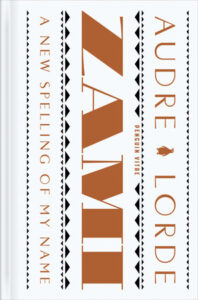
From Zami: A New Spelling of My Name: A Biomythography by Audre Lorde; Foreword by Evie Shockley; Afterword by Melinda Goodman, a Penguin Vitae edition published by Penguin Classics, an imprint of Penguin Publishing Group, a division of Penguin Random House, LLC. Copyright © 1982 by Audre Lorde. Foreword copyright © 2026 by Evie Schockley.

Evie Shockley
Poet and scholar Evie Shockley has published four books of poetry, including suddenly we, which won an NAACP Image Award and was a National Book Award Finalist, and semiautomatic, winner of the Hurston/Wright Legacy Award and a finalist for the Pulitzer Prize. She is also the author of Renegade Poetics: Black Aesthetics and Formal Innovation in African American Poetry. Her poems and essays have appeared in The New Yorker, Kenyon Review, the Los Angeles Review of Books, The 1619 Project, The Black Scholar, LitHub, The New Republic, and the Boston Review. A recipient of the Academy Fellowship for Distinguished Poetic Achievement and the Shelley Memorial Award, Shockley is the Zora Neale Hurston Distinguished Professor of English at Rutgers University.