A Singular Pursuit: Why All Writing (and All Writers) Matter More Than Ever Today
“To write is to think and to think is to be human and to be human, in all its marvelous complexity.”
In February of 2015, the novelist and short-story writer Ryan Boudinot wrote an essay for Seattle news website The Stranger titled, “Things I Can Say About MFA Writing Programs Now That I No Longer Teach in One.”
It was an essay that managed to piss off the entire literary internet all at once. “Writers are born with talent,” declared Boudinot early in the piece. “Either you have a propensity for creative expression or you don’t.”
From there, he makes all manner of declarations about who’s a writer and who’s not, who has potential and who doesn’t. Of the budding memoirist, he wrote: “For the most part, MFA students who choose to write memoirs are narcissists using the genre as therapy. They want someone to feel sorry for them, and they believe that the supposed candor of their reflective essay excuses its technical faults. Just because you were abused as a child does not make your inability to stick with the same verb tense for more than two sentences any more bearable. In fact, having to slog through 500 pages of your error-riddled student memoir makes me wish you had suffered more.”
*
At the time I read Boudinot’s essay, I was thirty-seven years old and laboring through drafts of a memoir, which meant I was simultaneously committing two of Boudinot’s cardinal sins: I was already too old to be a writer, and I was too self-centered. I’d started the memoir as my thesis project while finishing up a master of arts in writing and publishing from DePaul University in Chicago in 2014. It wasn’t an MFA, but it was as close to one as I was going to get, and the two years I’d spent on DePaul’s tree-lined campus in Lincoln Park, attending workshops in the evenings after work as the sun set over the city, reading and writing and studying the essay, learning the language of craft, and having other writers take my writing seriously for the first time in my adult life, were two of the most intellectually nourishing years I’d ever experienced.
To take time out of one’s days or nights or weekends, to excuse oneself from family time, or time with friends, in order to write and think about one’s life, is an act of selfishness that is needed more now than ever.
But what felt like a miracle back then—and honestly, still does now—was that I’d made it to college at all. I had been expelled from one high school and then dropped out of another, and then, at eighteen years old, with a hundred dollars, a snowboard, and a bag of clothes, I’d moved to Colorado. I had a half-baked plan to try and turn pro, but I was also an addict and alcoholic hopelessly stuck in a cycle of self-destruction. And so rather than picking up an equipment sponsor, I picked up a felony instead. I also fathered a daughter at nineteen, abandoned her at twenty-one, and spent the five years after despising myself with almost violent intensity, trying find the perfect ratio of cocaine to ecstasy to alcohol that would allow me to erase all of it from my memory.
Then, through luck or grace or divine providence, I met a former NFL player-turned-entrepreneur while waiting tables at a Baker’s Square restaurant in the suburbs of Chicago. He offered me a job, and then, ultimately, a chance to get sober, and I spent the decade after rehab painstakingly repairing my relationships, committing to fatherhood, and building a sober life beyond my wildest dreams.
By the time I made it to DePaul, I was fairly certain I was—or at least could be—a writer, but I was also completely unsure of what being a writer looked like for a person like me. I was incredibly worried that the literary ecosystem I’d built during those two years would evaporate as soon as I left the program, and the conversations I’d had, which had felt so meaningful, so important, so necessary in my evolution as both a writer and a person, would simply fade into the background of my life. With no one to talk to about writing, and with no workshops to attend, I wasn’t sure what shape my literary life would take. I was rudderless, or maybe more like a Roomba, bouncing off the legs of the sofa and the base of the refrigerator with no real direction, sucking up all the literary breadcrumbs I could find.
School was over, which meant the structure that had been provided to me was over too, and I had a choice to make. Being a writer would take work. It would also take intention and commitment and action. If I was going to finish the book I’d started in grad school—and not just finish it, but publish it, too—I was going to have to figure out if I was actually a memoirist, or, as Boudinot so plainly put it, a narcissist “using the genre as therapy.”
*
Finishing my first book, The Distance Between, was a Herculean effort that at times I thought I might never accomplish. Reanimating some of the worst and hardest moments of my life wasn’t cathartic and it certainly wasn’t therapeutic (is memoir ever?), but it was instructive in a way that few other things in life are. It allowed me to turn my focus on who I was so that I might affect who I wish to be, and to do that across a period of years, a time of extended contemplation where I took the long arc of accountability and fashioned it into the narrative arc of a book.
In those early years, when I was writing and publishing my first essays, and during the writing and publishing of that first book, I would learn that being a writer for me meant writing in the margins of life, in the early hours of Saturday and Sunday mornings, often after a long run when I’d watched the city around me yawn to life—and there was never enough time, and I never had enough energy, but somehow those minutes and hours added up. Even when I had weeks and then months at a time where I didn’t crack open the MacBook and fire up a Word doc, I was still thinking, still unpacking my life with a writer’s brain, seeing stories and insights everywhere, waiting for the moment when I could get back to it. And when I finally would, it would still be hard, and the words would still often elude me, but it never mattered because writing was more than that, it was more than the output. It was like arriving back to an essential piece of myself, a piece that had been around for as long as I could remember but was being refined over time, a toothed rock that had been thrown into the river and was slowly being smoothed by the current.
Being a writer was different, but also better, and I can’t say that I would have arrived at the same place had I not found my way to DePaul. That singular pursuit, the desire to write, had absolutely no benefit to me financially or vocationally—but it was that decoupling from an outcome, that unburdening, that gave the pursuit itself a sense of purity that nothing else in my life had. In my years in that program, nourished and fed by the writers around me, I became more of who I already was.
*
In an evening workshop early in my program, my professor put Edward Hopper’s “Nighthawks” on the screen in the front of the classroom. I recognized the painting, but I didn’t know who had painted it or what it was called, and I didn’t know what it meant or why it was important. I’d grown up in a blue-collar family where conversations about art were never had, and even though I desperately wanted to know something, anything about art, I didn’t—and I didn’t know how to talk about it. In many ways art felt like school had felt for me for so long, like something created for other people, and not for me, a recovered alcoholic and drug addict who still often felt like there were conversations being had that he had no business being a part of.
But on that night, while my heart literally started to beat faster, I thought to myself this is it, this is actually happening, we’re going to talk about art—and then, for the next couple of hours, we did. My professor asked us what we felt when we looked at the work, what we noticed, and why. She facilitated a conversation that transformed viewing the painting to experiencing the painting. The more I learned about what I was seeing, the more interested I became in the image, and the richer the experience became. Gradually, and then all at once, I could see the choices Hopper had made, and how his life and experience in America and New York in 1942 had shaped the work. I could see why people concluded, even though Hopper denied it, that “Nighthawks” was a commentary on urban isolation and human loneliness, and I could see, too, how the conversation we had related to our work as writers.
Later, after talking about one of my classmate’s essays, I suddenly understood that this was it, this directing of attention, this facilitating of conversation, this noticing, was an essential part to being a writer. We read closely and talked about the choices the writer made, and in doing so we learned about ourselves and our own writing and the world around us. We became part of a shared history, a shared conversation. We joined a lineage of artists engaged in the shaping of art—and none of it was tied to an outcome or a verb tense or the “technical faults” of the piece.
If you’ve decided that writing matters…it simply doesn’t matter how you get there, or what anyone thinks about your ability, or your talent, or your age.
I don’t know how many of my classmates continued their journeys as writers, or how many of them went on to publish work, but I know that all of them are changed by their time in that program. Which feels like the point of the whole thing. MFA programs are facilitating the writing craft, to be sure, but they’re also about facilitating thinking and reading and communicating. And it feels to me like thinking and reading and communicating is something we should endeavor to do more of, especially as the world around us, propelled by technology, continues to throttle forward.
*
I wonder what Boudinot would say about his students today, in the Age of AI, because it seems to me that regardless of one’s level of writerly talent, to fall into literature wholeheartedly, to obsess yourself into the writing, to take your life and put it under a microscope and look as closely as you can at its genetic makeup, its DNA, is something we need now more than ever, as AI forces us to contend with what it means to be human.
We’re now living through a moment of incredible transformation, where the future of knowledge work hangs in the balance, where writing—and also thinking—can be outsourced to a machine. And I can’t help but think that the antidote to all of it is found in graduate programs like the one I attended at DePaul, and the one where Boudinot taught. Because to write is to think and to think is to be human and to be human, in all its marvelous complexity, is all we’ll have left if we find ourselves contending with The Singularity in years to come.
MFA programs are sure to change as AI continues to proliferate, but we know that just because AI could write a commentary about “Nighthawks” in seconds, and that the commentary could be good and smart and filled with insights I may have never come up with, it couldn’t replicate what happened inside that classroom that day, it couldn’t ignite a transformation in me that would change the way I saw the world, and the way I wrote about what I saw.
It’s unclear how these programs will change, or how writers will too, but books—and the words those books are composed of, and the writers who wrote those words—have never been more important, more necessary, than they are right now. Because in a world where machines can craft perfect sentences, maybe it’s precisely what Boudinot railed against, the “supposed candor of their reflective essay” with all its “technical faults,” that we’ll miss the most.
To take time out of one’s days or nights or weekends, to excuse oneself from family time, or time with friends, in order to write and think about one’s life, is an act of selfishness that is needed more now than ever. In some ways, I think MFA programs should simply get rid of the admissions process altogether and commit to letting everyone in, every single applicant, every last person who has decided that writing matters and wants to do more of it.
It’s been twelve years since I left that program at DePaul, and I’ve just published my second memoir, And You Will Call It Fate, which tells the story of that NFL-player-turned-entrepreneur who changed my life. It explores the forces that bend our lives in unexpected directions and grapples with the question of how we reconcile the debts owed to those who simultaneously save and harm us. It’s the second of two stories in my life that I felt I had to tell, that I couldn’t not tell, and it was a writing program, and the humans in that writing program, that showed me how to do it.
And this, I think, is where Boudinot and I disagree the most. Because if you’ve decided that writing matters, if you’ve decided to try and locate the words to tell your story in the way only you can tell it, it simply doesn’t matter how you get there, or what anyone thinks about your ability, or your talent, or your age. It only matters that you pursue it as obsessively—and honestly— as you can.
__________________________________
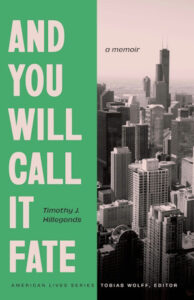
And You Will Call It Fate by Timothy J. Hillegonds is available from University of Nebraska Press.

Timothy J. Hillegonds
Timothy J. Hillegonds is the author of And You Will Call It Fate, A Memoir (University of Nebraska Press, March 3, 2026) and The Distance Between: A Memoir (University of Nebraska Press, 2019), a finalist for the 2020 Chicago Writers Association Book of the Year Award. A Pushcart Prize nominee, Tim’s work has appeared in The Guardian, the Chicago Tribune, Salon, The Daily Beast, The Los Angeles Review of Books, and elsewhere. He serves as a contributing editor for Slag Glass City, a digital journal of the urban essay arts. Hillegonds lives, works, and writes in Chicago.