A Reticent Eloquence: Colm Tóibín on the Poetry of Thom Gunn
“He is ensuring that what he feels and what he thinks are secondary to the subject, the person who is dead or dying.”
In August 1991, in a review of a new anthology of sixteenth-century poetry, Thom Gunn noted two poems by Sir Thomas Wyatt. These were poems that dealt directly with the execution of friends and associates of Wyatt’s, including Anne Boleyn. To call the poems poignant would be to undervalue their direct power. The fourth stanza of the shorter one reads:
The bell tower showed me such sight
That in my head sticks day and night.
There did I learn out of a grate
For all favour, glory, or might
That yet circa Regna tonat.
(The Latin refrain means: [Jove] thunders round a throne.)
“We may assume that the sight was of Ann’s beheading,” Gunn wrote. The second poem, he continued, also “mourns the death of the five with whom the Queen was supposed to have committed adultery…The range of [Wyatt’s] feeling is considerable, for he thinks as he grieves…And he distinguishes between them [the dead men], telling the reader how each meant something different to him; but in these lines he weeps for all:
And thus, farewell, each one in hearty wise.
The axe is home, your heads be in the street.
The trickling tears doth fall so from mine eyes,
I scarce may write, my paper is so wet.”
Gunn wrote of these four lines: “The axe’s work is over and their heads are on display, but the phrases employed are so mildly, almost comfortably familiar that they increase the horror of the line, of which the implication might be that executions have become by now an everyday and homely routine. The understated force is such that it spills over into a kind of authentification of the next two lines, making us read as simple truth an imagery that might otherwise have seemed commonplace in its overstatement.”
These poems deal with ideas of strength and weakness; they dramatize the body itself, as though it were a country in revolt that was once a place of ease or even ecstasy.
The close attention Gunn paid to these two elegies for Wyatt’s friends does not mean that Gunn was actually influenced by these poems when he wrote his own elegies for his own dead friends in the volume The Man with Night Sweats, published in 1992. Rather, we see here and in other essays how alert Gunn was to the style and syntax of English poems of lament, the strategies of control and containment as much as the scrupulous enactment in the diction itself and in the prosody of wavering levels of dark and complex feeling.
Gunn analyzed the inherited poetic tradition of lament. Of Ben Jonson’s “To Heaven” and “On My First Sonne,” for example, he wrote: “The emotions in these two poems are difficult, scrupulously created, and qualified: he cannot live with despair more than any man, but he also cannot pretend that willed equanimity is simple or constant.” Of W. B. Yeats’s “In Memory of Major Robert Gregory,” Gunn wrote of “the care and the cunning of the style” and noted, “its very finish, serving to place all impulsive decisions many drafts anterior to the version we read.”
In the first stanza of Gunn’s title poem, “The Man with Night Sweats,” it is as though there is a struggle going on between Latin and Anglo-Saxon as there is between health and illness.
I wake up cold, I who
Prospered through dreams of heat
Wake to their residue,
Sweat, and a clinging sheet.
Of the twenty words in these four lines, seventeen have only one syllable; only two—”prospered” and “residue”—derive from the Latin. The tone is direct, precise; the “clinging sheet” is not a metaphor or a figure of speech, it is emphatically an actual sheet that is literally damp with sweat. But this single-sentence statement is not simple or casual. “Prospered” and “residue” have a deliberate, distancing, formalizing effect.
In his comments on speech in poetry, Yeats wrote: “All that is personal soon rots, it must be packed in ice or salt.” In “The Man with Night Sweats,” Gunn plays the personal voice against the ice and salt of a heightened, textured sound. The clear rhyme in lines two and four of the first stanza of the poem hits against the lighter rhyme of “who” and “residue,” just as the iambic trimeter in lines two and four hits against the more jagged and less certain meter in lines one and three, lines that suggest a sort of shock or fright, or a stark realization.
The next stanza is merely two lines, the first dominated by two strong, stressed, one-syllable words—”flesh” and “shield,” the second a clear iambic trimeter:
My flesh was its own shield:
Where it was gashed, it healed.
These poems deal with ideas of strength and weakness; they dramatize the body itself, as though it were a country in revolt that was once a place of ease or even ecstasy. And since the body, especially the male body, had been one of Gunn’s great subjects from the beginning, he dramatizes its decline with an awed intensity. In a hospital, for example, he watches a friend being conveyed from
Those normal pleasures of the sun’s kingdom
The hedonistic body basks within
And takes for granted—summer on the skin,
Sleep without break, the moderate taste of tea
In a dry mouth.
(from “Lament”)
Illness, for Gunn, is a kind of lost, forlorn strength:
It truly must be difficult for my friend
To hold on to the substance that is him,
Once sternly regulated in the gym,
Prime flesh now softening on his giant frame.
(from “Courtesies of the Interregnum”)
As with Thomas Wyatt more than four hundred years before, Gunn, in his poems on the deaths of friends, found stark rhymes more forceful than subtle ones, and unornamented lines more powerful than qualified or ornate ones. It could be argued that for these late poems of lament, Gunn returned to systems of control and careful prosody with which he had begun his life as a poet. But that is not entirely accurate. The elegiac poems in The Man with Night Sweats are sharper, plainer, starker than Gunn’s early formal poems. They even admit an awkwardness at times, which was something Gunn admired in some poems by Thomas Hardy.
Gunn’s way of watching and noticing with the full weight of pure sympathy makes its way, with chiseled care, into a reticent eloquence.
These poems are made with some of the simplicity and directness of a song. The clarity in the diction may suggest both a way of absorbing difficult emotion and a way of keeping it at bay. These are ways of memorializing not merely dead friends but often also their long days of dying in a time when AIDS was a death sentence. In their eloquence and their ways of avoiding easy comfort, the poems also deal with the hushed experience of surviving someone else’s death and fulfill the urge to say something not only real and true but formal and exact, as though for a ceremony.
“No poet,” T. S. Eliot wrote, “no artist of any kind, has his complete meaning alone.” Because so many of Gunn’s friends died in San Francisco, a city where Gunn had found happiness and freedom, then these elegies are also a monument to a time of communal sorrow and mourning. Part of Gunn’s method is to keep his own voice as still and impersonal as is possible under the pressure of so much loss. In an essay about Thomas Hardy’s poems of 1912-13 on the death of his first wife, Gunn wrote about a poem that “is concerned with its subject to the extent of excluding the speaker’s personality, even when his emotion is the subject of the poem…for [the poet] sees his emotion as one which anybody in his situation would be able to feel.”
Gunn’s way of watching and noticing with the full weight of pure sympathy makes its way, with chiseled care, into a reticent eloquence. As he creates his quatrains and couplets, he is not merely feeling or thinking, but he is ensuring that what he feels and what he thinks are secondary to the subject, the person who is dead or dying, the one on whom the force of the poem must concentrate.
______________________________
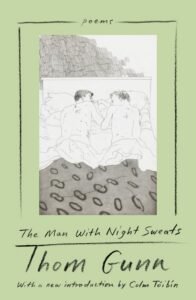
From The Man with Night Sweats: Poems by Thom Gunn, with an introduction by Colm Tóibín. Published by Farrar, Straus, and Giroux, September 2026. Copyright © 2026 by Thom Gunn. All rights reserved. Copyright © 1992 by Thom Gunn. Introduction copyright © 2024 by Colm Tóibín. All rights reserved.

Colm Tóibín
Colm Tóibín is the author of nine novels, including The Blackwater Lightship; The Master, winner of the Los Angeles Times Book Prize; Brooklyn, winner of the Costa Book Award; The Testament of Mary; and Nora Webster, as well as two story collections. He is the Irene and Sidney B. Silverman Professor of the Humanities at Columbia University. Three times shortlisted for the Man Booker Prize, Tóibín lives in Dublin and New York.