A Resonant Silence: Heather Cleary on Translating María Ospina’s Only a Little While Here
"There is a powerful form of resistance to be found in lingering with the unfamiliar..."
“Silence,” writes Anne Carson, “is as important as words in the practice and study of translation.” Carson is talking about two specific forms of silence: the physical—sections of a text that have gone missing or been excised—and the metaphysical—what she describes as “words that go silent in transit,” those “maddeningly attractive” untranslatables. A text can fall silent in so many other ways, as well. Silence is also rhythm, where language takes a breath on the line. Where it allows us to breathe, to process what we’ve taken in.
I thought often about these different kinds of silence as I translated María Ospina’s Only a Little While Here, not because there were gaps in the text or terms that proved especially resistant to transfer from Spanish into English (beyond the fact that one word will never map perfectly onto another), but because Ospina’s award-winning first novel has at its heart yet another kind of silence, one I hadn’t come across in this way before, and which feels urgently necessary at this moment.
Silence is also rhythm, where language takes a breath on the line. Where it allows us to breathe, to process what we’ve taken in.
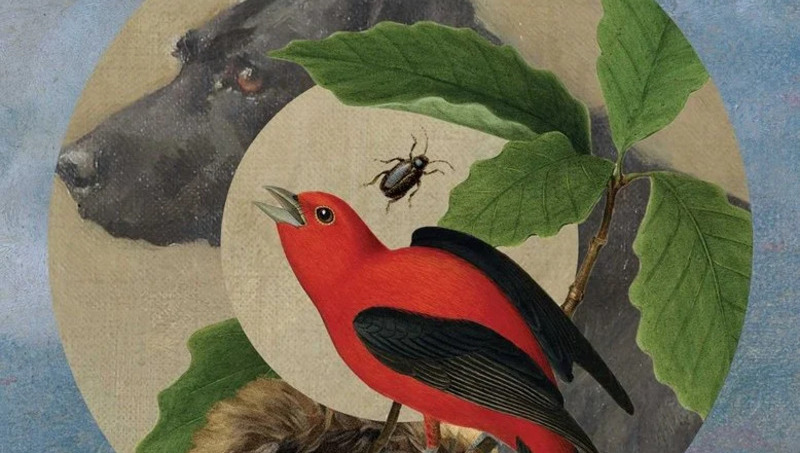
In its lyrical and astute exploration of our relationship with the natural world and with one another, Only a Little While Here traces the subtly interconnected trajectories of five animals: two dogs—one separated from her companion when he is arrested for living on the street, the other abandoned by the family who raised her—who find a second chance in one another inside a Bogotá animal shelter, a scarlet tanager on his harrowing migration south, a beetle struggling to navigate her new urban environs, and a porcupine raised on breast milk. Each of these non-human animals comes into contact with people along the way, but these encounters are only part of their larger stories; though humans have shaped the landscapes through which the novel moves, we are secondary characters in its pages.
In different forms and contexts, we are invited to ask what makes a home, and what happens when a home is lost. Each of these storylines is a moving—sometimes tender, sometimes wrenching—account of one animal’s odyssey, and Ospina does not fall silent when it comes to the moments when their experiences intersect with the political issues of our day. Alongside our non-human protagonists, we catch glimpses of topics ranging from urban development and gentrification to the criminalization of poverty, forced displacement, and environmental destruction, among others. On the journey south from the forests of Connecticut to the cloud-draped peaks of the Andes, for example, the scarlet tanager’s path crosses another migration, one that must contend with borders and barriers the bird does not recognize. As the tanager flies over an ICE detention center in Florida,
his wings beat too quickly for the woman at the monitor to distinguish his entranced body among the thousands of fast-moving creatures that interrupt her view of the choreography forced on these children from the south, children who never imagined the north would be like this.
Similarly, as the dog Kati searches frantically for the man who had cared for her day in and day out on the streets of Bogotá, she finds herself in the middle of a protest demanding more funds for education, and it is here that the third kind of silence I mentioned above comes in:
Perhaps the vibrations of the drums filter upward through the pads of Kati’s paws. She seems confused by the whistles and shouts emerging from hundreds of mouths at once. Maybe she hopes, just for a moment, that he’s somewhere in this raucous crowd, though she might have no idea where to start looking. She slips between the legs of the throng, trying not to get stepped or jumped on, desperately tracking an exit from this forest of frantic limbs.
Ospina gives us access to the actions of these non-human protagonists—inviting us to reflect on their subjective experience and to feel the urgency and promise of their journeys.
This third silence is made not of words that resist translation or gaps in the written record, but rather of a disciplined practice of listening and observing that holds space for difference. Only a Little While Here speaks through a refusal to claim dominion over the experience of the living beings on which Ospina rests her gaze; it speaks through an empathy that does not depend on identification.
The porcupine runs her whiskers along the hand of the woman who has raised her since she took her first breath. Perhaps this makes her feel less out of place. Maybe she recognizes the smell of soap and firewood on the woman’s skin. She waves her tail in the air and finds nothing to curl it around. Who knows if she realized something was about to be lost that cloudless morning when she descended from the croton draco she’d only recently learned to climb and drank her morning milk. Perhaps the woman’s melodious voice telling her to stay calm from the other side of the cardboard box on their way to Bogotá helped her withstand the slamming and bustle of what we would call time (but which must be something else for her).
If there is a central gesture to this novel, it may be the way Ospina gives us access to the actions of these non-human protagonists—inviting us to reflect on their subjective experience and to feel the urgency and promise of their journeys—while always reminding us that we can never really know what it is like to see the world through their eyes. In our present moment, as the production and consumption of hot takes continues to accelerate, there is a powerful form of resistance to be found in lingering with the unfamiliar, in offering attention without the promise of a quick take-away. In listening without asserting. In a curiosity divested of ego. In stepping outside ourselves and into an awareness of the ways that the lives and fates of all human and non-human animals are intertwined.
__________________________________
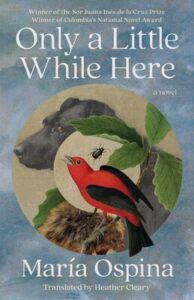
Only a Little While Here by María Ospina, translated from the Spanish by Heather Cleary, is available from Scribner, an imprint of Simon & Schuster.

Heather Cleary
Heather Cleary’s translations include Roque Larraquy’s