A Prophetic Classic About the Dangers of Tech is Back in Print
Paulina Borsook’s Cyberselfish is Truer Now Than When it Was Written 26 Years Ago
Paulina Borsook saw there was something rotten afoot in Silicon Valley in the 1990s, and in her book Cyberselfish: A Critical Romp through the Terribly Libertarian Culture of High Tech, she set out to document and understand a peculiar mindset she saw emerging. Originally published in 2000, Paulina’s observations in Cyberselfish have proved truer now than when it was first written. She saw that the culture of high tech was determinedly anti-government, even as it owed its growth to government subsidization. That tech prioritized the idea of progress and profits and ignored all costs. That it co-opted the language of evolution to make human decisions and power structures seem inevitable. That the industry was hyper-male and tended toward hyper-misogynistic. That its figureheads possessed great wealth but were abysmal at sharing that wealth through philanthropy.
Cyberselfish was published into a moment in which tech and its leaders’ reputations were immaculate and unquestioned. Now we know better. Thanks to a surge of interest in her prophetic insights, Cyberselfish will be reissued this fall to a world that’s finally ready to listen. The following is an excerpt from the new edition.
*
Cyberselfish was written as a description of a subculture. It was never intended as a book of prophecy, but that sadly is what it has turned out to be. Social scientists and historians probably have a name for what happens when a minority culture becomes a majority one: What was written about here has become the dominant ideology of Silicon Valley leaders. The trends and ideas of this subculture coming into domination have had effects far worse than I could have imagined back when I was working on the project in the 1990s.
Happy days, Cyberselfish was fortunate enough to have been well and widely reviewed all over the world when it came out, but it did not sell well. No doubt the dot-com crash (“let’s not think about those tech fools we got taken in by”) followed by 9/11 turned attention elsewhere. Thus the book went out of print decades ago, only a few years after it was published.
Sometimes the algorithm gives, in contrast to all the times it takes away.
There had been some glimmers of renewed interest in the title in 2025; prices on used-book platforms started creeping up from the longtime humiliating low of five dollars (where postage and handling were greater than the cost of the book itself) increasing within a few months to around ten dollars per copy—and then suddenly moving ever upward. Before Cyberselfish became totally unavailable, the asking price was two hundred dollars and higher. Graduate students from around the world reached out, asking if I could help because they could not afford collectible rare-book prices. There was nothing I could do for this new generation of readers.
Around the same time, in 2025, European academics started wanting to talk to me, as did some European media folks; I think the rise of Musk and DOGE were driving these outreach efforts.
In May of 2025, a meteor strike hit my LinkedIn page. Jonathan Sandhu, whom I had not heard of, then a stranger, posted a detailed appreciation of Cyberselfish. Inspired by a mentor of his, Steven Hertzberg, someone else I had no acquaintance with, Sandhu began his post:
In 2000, Paulina Borsook published Cyberselfish: A Critical Romp Through the Terribly Libertarian Culture of High Tech. The title alone told you what you were in for: a scalpel through Silicon Valley’s self-congratulatory delusions. She called the industry’s bluff on its faux-rebel mythos, its anti-government fetish, its pathological allergy to the social contract. She mapped the libertarian ego trip before it bought a hoodie and launched a surveillance startup.
And no one listened.
The book dropped during the dot-com collapse. It vanished almost instantly. Not because she was wrong—but because she was too right, too early, and too unwilling to flatter the cathedral of code.
The world rewarded those who said it all later, softer, or with credentials. And those people got book deals, fellowships, think tank gigs, tenured chairs, and keynote slots.
Paulina got ignored.
And the post continued after that.
Sandhu’s text went viral. Sometimes the algorithm gives, in contrast to all the times it takes away.
The post went on to show up in front of so many people who weren’t acquainted with Sandhu or me or Cyberselfish. And a few of these newly acquainted with the work turned out to be critical to bringing it back from its state of suspended animation.
David Sierra bought a paperback and two hardcovers of Cyberselfish when these were still available for purchase in 2025. Among the many skills Sierra possesses are expertise with computer vision; after I asked him frantically if he could create a PDF of the book, which was needed to help make the case for the book’s revival to potential publishers, he did so within ten minutes (!). All electronic versions had long since been vaporized by Public Affairs, the now-Hachette owned publisher of Cyberselfish; the book had been out of print for too long.
Another person the algorithm mysteriously led me to was Giovanni Lostumbo. Lostumbo would do many things on behalf of the revivification of Cyberselfish, such as search Substack to determine that starting in March 2025 there were more and more mentions of the book, still more proof of its reputational renaissance.
Lostumbo asked if I knew Gil Duran. “No, who’s Gil Duran?” I was told Duran was working on a book named The Nerd Reich. I pinged Duran (whom Lostumbo was already in communication with); he had heard of Cyberselfish and we arranged to have lunch, where we then realized we were natural allies.
As a coincidence, shortly after that lunch, Wired published a piece that more or less said “How did these guys turn out to be such sociopathic louts?”
Duran, who had been interviewed for the feature, was not quoted and Cyberselfish was not mentioned. Displeased, Duran wrote a long post on BlueSky to the effect of “Cyberselfish is really important and what writing about tech ought to be and the work has been unjustly forgotten. Let’s help bring it back into print.” Another case of where the algorithm giveth: Duran’s post took off on BlueSky more so than anything else he had ever posted there and caught the attention of New York Times writer David Streitfeld.
It is unhappily worth mentioning that Cyberselfish was originally composed in a safer time. Freedom of expression wasn’t so in jeopardy.
Streitfeld was intrigued by the death and life of Cyberselfish. He and I talked and emailed for months and in the middle of this process, Duran had me appear on his podcast, aided by the work of his researcher/editor/producer Riley Robbins. The algos looked favorably upon this podcast episode as well, and within days, all copies of Cyberselfish had sold out globally. It then became only available in unauthorized editions or in the abridged audiobook from way back when: I had never been consulted about the abridgment.
The interaction with Streitfeld led to a feature appearing in the Times on Thanksgiving of 2025. That day, my agent, Stuart Krichevsky, emailed: “We always knew you were right.” Publishers became interested in a reprint and thus Cyberselfish has been brought back to life from the Graveyard of Lost Works.
The following souls had the beat and kept it strong: David Temkin, Maria Bustillos, Kurt Taylor Gaubatz, Jeff Ubois, John Rieger, Jason Kehe. Each helped in his or her particular way to resurrect Cyberselfish.
It is unhappily worth mentioning that Cyberselfish was originally composed in a safer time. Freedom of expression wasn’t so in jeopardy.
Online and real-world harassment of people who hew to heterodox points of view hadn’t become so intense and scary. I don’t know that I would have had the courage to write Cyberselfish in 2026; I am just so grateful that what in effect is a twenty-fifth anniversary edition is now available.
That Damned Book a.k.a. TDB was the nickname I had long given Cyberselfish. It went through three publishers and threw me terribly in debt. A friend who bought TDB when it first came out remarked that it was truer in 2025 than when it was written. It seems there have always been larger forces at play in terms of the fate of Cyberselfish; rhetoric that’s positioned for the future sounds a bit touched by the supernatural.
__________________________________
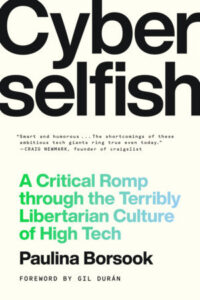
From Cyberselfish: A Critical Romp through the Terribly Libertarian Culture of High Tech. Used with the permission of the publisher, Tin House. Copyright © 2026 by Paulina Borsook

Paulina Borsook
Borsook has worked in and around Northern California tech culture since the early 1980s. Formerly on the masthead of Wired, she has written for multiple tech publications and companies and for countless non-tech publications. She is currently a contributing editor for the magazine "InFormation/every day computers are making people easier to use", which offers both silly and serious critiques of tech as written by people within it.