A Poet’s Account of the Power of the Yodel
“One has to be willing to humiliate oneself in order to yodel, there is no spiritual bypass.”
The yodel: the perfect acknowledgment of that which cannot be hidden anymore and therefore also that which we have always had to hide.
The yodel: the flickering Adam’s apple. Not unlike a sound we sometimes ever inadvertently make, a kind of croaking sound, a sound that is not so much even made as it is emitted and then immediately and often embarrassingly, very forgivably, try to cover up, with a faked cough or a clearing of the throat. But that is it: the yodel must be forgiven. And the yodel knows that the only way to grab the rose is to risk exposing the hand to the thorn. We say “she croaked” instead of saying she died.
The yodel, as all forms of prophetic writing, lives in the threshold. It is the cage opening and the hand moving inwards towards the bird and the bird battering against that same cage. It, the yodel, contains its own violence and its own innocence. The yodel is the fledgling, dying fledgling. It is a thrush. How obvious that such a word should mean the songbird and an infection of the mouth. The yodel is the greatest embarrassment to its family.
It is an exiled sound; an exhale caught on the in-breath, it belongs to a voice that is both of the dead and the child.
There are many books we might open up to hear that yodel making its way to us over the mountain but a great book to look at the way poets throw their voice, or court the tremulous rupture/rapture of the yodel, are the translations of Birhan Keskin’s Y’ol by Murat Nemet-Nejat (I won’t belabor the resemblance of the title itself to the very word under examination.)
You are too human, my darling, too human,
whereas I’m a barbarian, a beast,
my tongue talks of forgiveness, for giving it
for free and yours of justice
revenge
Is there a need to say it, my love
to say it now
the ace sniper I raised shO OOO t me
the snows of Klimanjaro my love
snows of Klimanjaro
sl iiiiii ding down
In these translations, we might find the revenge of the futility of the serenade.
The yodel is, of course, a far cry from, which is to say it is the preposition as a bridge blown up, it is the staircase to nowhere that had once been a somewhere, a far cry from that also laughs, a croaking death that always lives. It is an exiled sound; an exhale caught on the in-breath, it belongs to a voice that is both of the dead and the child. The yodel then is the sound always of the dead child.
*
The farm machinist had left his entire community behind to come yodel with us. But we didn’t begin by yodeling. We began by reading. Sometimes we would also write. He was given Keskin’s Y’ol and from there he began yodeling for the first time. My did he sing! In Chinese opera, there is the cross-dressing figure of the dan. Chinese opera is full of its own particular kind of yodel—a controlled lamentation that whines and thrums at once. The farm machinist, reading Keskin’s Y’ol, incarnated the dan in the figure of a white Midwestern man. He lassoed the moon down and there wasn’t a dry eye in the room when that farm machinist was through. We all felt it: we had encountered the sound of a dying thrush, the last of its species. We could hear the grain of the voice.
In Kim Gek Lin Short’s China Cowboy, she croons between the collapse of the frontier myth and supply-chain reality, the link between soybeans and the wholesome and never nutritive American cereal:
“I open searching and then a closing. An event. Something recent but long ago, I forget who, it happens. I breathe, there is enough. I get scared. I make promises. In my new life I will be white heat, pure I will rise. I. make promises. In my new life I will be swept ash, light I will rise. I get scared. Please in my new life I will mend this rubber seal my soul, a swollen rubber place. Please I am scared. In my new life I will—he pulls the nebulizer off my face, a sunk space, it stretches. Please it is so much like hell. I promise. In my new life.”
The grain, the grain, the grain. From the voice of the one whose body has become the only frontier left, the yodel becomes a site to abduct the abductee from her own abduction.
*
The yodel is a disfigured sound and thus it is always political. It is the nose with the gauze left in it. With wonder and with great shame the yodel is an orphaned sound, a sound that turns the serenade toward an addressee that is destined to never hear it.
I have always believed that poets should sing and sing often, if they are to know how to write, and when.
At a recent Nowruz celebration, my friend said that it isn’t a dinner party in Iran unless it ends in dancing. I could say that it isn’t a dinner party in a Chinese household unless it ends in yodeling.
Revenge…
Historically, femme spirits have been more likely than men to use poison as an act of killing. Being entrusted to rule over the domain of the hearth, the pantry, and the garden, they also had access to a perverse kind of knowledge: the knowledge of the earth.
I believe the revolution requires coordination. I believe that it requires cunning, an engagement with the subtle bodies. I believe it requires knowledge of pharmakon. Of how, at the right dose, a plant might be used as an elixir and how, at the wrong one, it can be lethal. The oppressed have been using the “wrong dose” in the service of their freedom for a long time. In the Black Jacobins, CLR James describes the slaves of a plantation sewing mutiny through poison.
The surreptitious nature of poison, the way it hides, the way it infiltrates, the way it is ingested, the subterfuge, the act of administration, the act of revenge disguised as care and routine—its silence and its secrecy, is what makes it indefensible—as in, unmanageable and uncontrollable. It is the very definition of grassroots.
As we administer poison, as we dole out the little drops of our concoctions, we are singing. We are lulling. We are cooing back. The lull and the coo is, in other words, a form of disguise. We appear as indefensible. The caretakers of children must always appear indefensible. And what is the sound in that lullaby? It is the yodel, transpersonal.
What might a language that rises up from the grassroots sound like, that is so cellular?
You know where to find me
against the slain to the left of
a syncretized San Miguel
at the foot of such an expansive history
Nothing settles harder on the belly
than rocking
back and forth
through obsolescence
I find myself blessed
cloaked away from the
eyes of enemies
and those that wish
to run their razor tongues
against me
Never in the company
of my peers
it’s your children
I shall inhabit (–Jasmine Gibson, A Beauty Has Come)
Pharmakon. Yes, Pharmakon yodels too.
From the voice of the one whose body has become the only frontier left, the yodel becomes a site to abduct the abductee from her own abduction.
Guest & host…
The language of these kinds of poets, who engage in the exchange between guest & ghost, between revenge & grief, are tremulous inhabitations of the yodel.
Once my father shared with me a story, a demonstration of so-called Asian humility, when a friend, another Taiwanese-Chinese exile in America, apologized to my mother’s boss’s husband, for bleeding all over him. One has to be willing to humiliate oneself in order to yodel, there is no spiritual bypass.
In ancient times, to receive a guest was to outline a terrain and it was to mark one’s responsibility to protect that guest. There was no greater upturning of the social order than to betray one’s responsibility to protect a guest. There would be no greater upturning than to allow the act of revenge to unfold upon one’s guest. Host and guest were a kind of belonging, guest to host and host to guest, and in that belonging was a sacred pact unwritten.
“There is no hospitality without sovereignty of oneself over one’s home. The guest becomes the host’s hostage insofar as the host becomes a hostage to the guest’s presence.” That was Derrida.
I think that in a moment of carelessness
I might fly from this silent prison
I might laugh in the face of the jailor
I might begin to live again, at your side
[…]
I am the candle whose burning heart
lights up a ruin
If I choose silence
I will shred a nest (–Forough Farrokhzad, Let us believe in the beginning of the cold season)
The wail of the one—whether wife of the host or child of the guest—who discovers the poisoned body, is always expressed as a yodeled wail.
____________________________
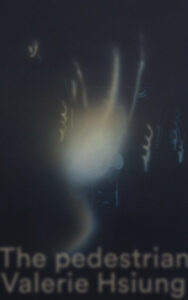
The pedestrian by Valerie Hsiung is available from Nightboat Books.

Valerie Hsiung
Valerie Hsiung is a poet and the author of eight collections of poetry, prose, and hybrid writing, including The pedestrian (Nightboat, 2026) and The Naif (2024). She lives in the mountains of Colorado, where she teaches at Naropa’s Jack Kerouac School of Disembodied Poetics.