A Place For Everyone to Read: Opening a “Cultural Treasure” in Philadelphia
Jeannine Cook on Why She Opened Harriett’s Bookshop
Harriett’s was my last resort.
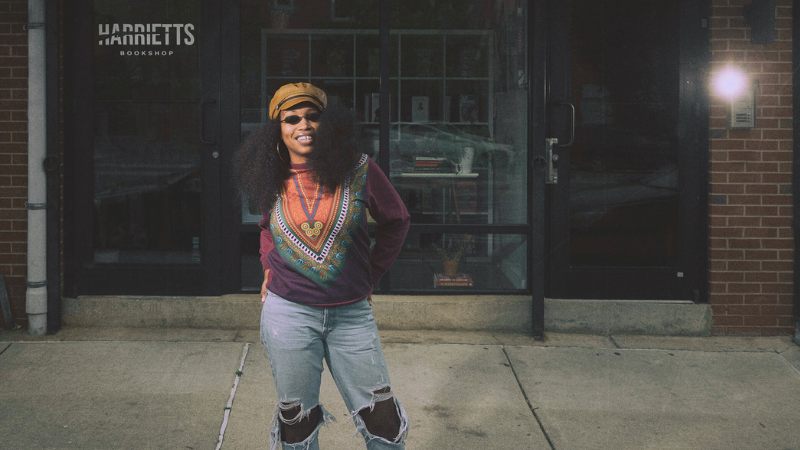
I opened Harriett’s Bookshop, named for historic heroine Harriett Tubman, six weeks before the pandemic, and could have never predicted that my tiny shop would survive and thrive—being featured in Oprah Magazine, Vogue, Forbes, New York Times, Inc., Essence, Washington Post, Google, Today Show, Yahoo, NPR, MSNBC, ABC, and CBS for our out-of-the-box approaches to sharing books.
Or that, in just a few years, we’d expand our network of sister bookshops from Philadelphia to Paris and that I’d be responsible for hosting authors like Michelle Obama, Will Smith, Kerry Washington, Salamishah Tillet, Lorene Cary, Alice Walker, Sonia Sanchez, Sister Souljah, and Nikki Giovanni, just to name a few. Or most importantly, all the everyday people, places, and things (jawns as a Philadelphian might say) that Harriett’s would someday touch.
The only issue was I opened Harriett’s because I needed a quiet place to write. And then I lost track of my mission, so everyone else had a place to read.
At our opening in the Fishtown section of Philadelphia, people from all walks of life showed up in droves to purchase what books we had.
According to my landlord, our Fishtown storefront had been a nail salon, a café, and most recently a cell phone repair spot. It was painted a decrepit shade of lavender-ish gray and had peeling rubber trim and a giant hole in the floor. I called it a portal, painted it with my uncle, and threw some putty and a rug over the hole. It was like playing make pretend. Sometimes a healthy imagination is helpful. Now, five years later, this building will be a home for Harriett’s.
On February 1, 2020, I opened Harriett’s to celebrate women authors, artists, and activists. Americans typically learn about Harriett Tubman in the third grade—that she ran the underground railroad and freed the enslaved. But to me she has always been more than a historic figure or a slave: Harriett is my guide, and following her footsteps makes me feel brave. Like Harriett, my first stop toward freedom was Philadelphia, where the story of my bookshops begins.
At our opening in the Fishtown section of Philadelphia, people from all walks of life showed up in droves to purchase what books we had. My sister stayed up all night to talk me through fits of anxiety, Marie was there early checking out readers from 6 a.m. to 6 p.m., my aunt drove up from North Carolina to give me her journal to read.
But six weeks later, midday in mid-March of 2020, we received an email from the mayor that read—“effective immediately”—shut the doors to your cute little bookshop and don’t open them again. Then there was a deadly COVID-19 outbreak, and my mother, who was living in Trinidad, got stuck at my place in Philadelphia on a visit, and then heat waves, and my sister got married, and #MeToo, a racial uprising, vaccines, anti-vaccines, the contested election, wildfires, a war, and even Ruth Bader Ginsburg died—2020 was that type of year.
But here we are a few years later, and Harriett’s, a small independent bookshop, survived all of that.
A Shopkeeper should do the job that ONLY she can do, let others take care of the rest. Easier said than done.
We survived to serve hundreds of thousands of people worldwide. We survived to build bookshops in unconventional places from movie theaters to barns. We survived so we could distribute literature in our city and then to organizers at protests from Minneapolis to Louisville. We survived to get Harriett Tubman Day passed by Congress as the first federal holiday named for a woman. We survived so we could deliver books to children on horseback. We survived so I could write this book.
Five years later, the bookshop has been featured by Oprah’s magazine twice for being one of 2,433 independent bookstores in the country that still exist.
Who would have imagined that in less than five years, we’d have books and multiple bookshop concepts across the globe named for women in history?
When I first met my landlord, Ms. Sang, I told her, “I want to open a bookshop here.”
“A bookshop?” She scrunched up her forehead in dismay. “In Fishtown?” She shook her head no.
“Yeah, a creative space celebrating women authors, artists, and activists under the guiding light of Harriett Tubman.”
“Harriett who?”
“Tubman.”
“I don’t know her. But I see something in you,” my landlord said, looking me in my eyes the way people look at me sometimes, with a peculiar, puzzled pause. “But, if you meet Oprah Winfrey, I want to be there.”
“Oprah?” I laughed. Not what I expected.
“I’ll make a deal with you,” she said, pointing at me uncomfortably close. “You get the lease to this storefront if you promise to introduce me to Oprah someday.”
I didn’t know how I could ever meet Oprah, or how that could be a priority when I didn’t know how I was going to pay my next month’s rent.
But I said, “Okay. You have a deal.”
We shook on it.
Five years later, the bookshop has been featured by Oprah’s magazine twice for being one of 2,433 independent bookstores in the country that still exist. This number has steadily decreased in the last few years and, in our own ways, we are each at risk.
Ms. Sang calls me and says, “I saw you on the news.” Out of the blue she tells me she is tired and ready to sell her building to me. “There’s no one who will love this place like you.” I felt like I’d passed a test even though she hadn’t met Oprah yet, then she added, “But I still want to meet Oprah.”
I do love the building, except for the plumbing and HVAC that need to be replaced.
I want to finish the remodel and close on the sale—another Olympic-sized task for an average-sized Jeannine, but to whom much is given . . .
A Shopkeeper knows she has to own her own building if she wants to sustain. Rent is the silent bookshop killer because it never stops beating you up even when you’re down.
I have recently been given the Philadelphia Cultural Treasures award. But it’s Harriett’s that is the cultural treasure, not me. I am using the award to reimagine the bookshop, because every few months I redesign it to promote a different book and theme in my community. I am also going on a pilgrimage to Paris to write my debut novel.
__________________________________
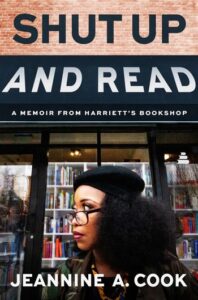
From Shut Up and Read: A Memoir From Harriett’s Bookshop. Used with the permission of the publisher, Amistad. Copyright © 2026 by Jeannine Cook

Jeannine A. Cook
Jeannine A. Cook is the founder and owner of three avant-garde bookshop concepts, Harriett’s in Philadelphia; Ida’s in South Jersey; and Josephine’s, a literary installation in Paris. She holds an MFA from Drexel University. She is the author of the novel It’s Me They Follow.