A Modern History of American Science and Healthcare in Four Presidential Administrations
David Blumenthal and James A. Morone Consider the Legacies of Barack Obama, Joe Biden and Donald Trump
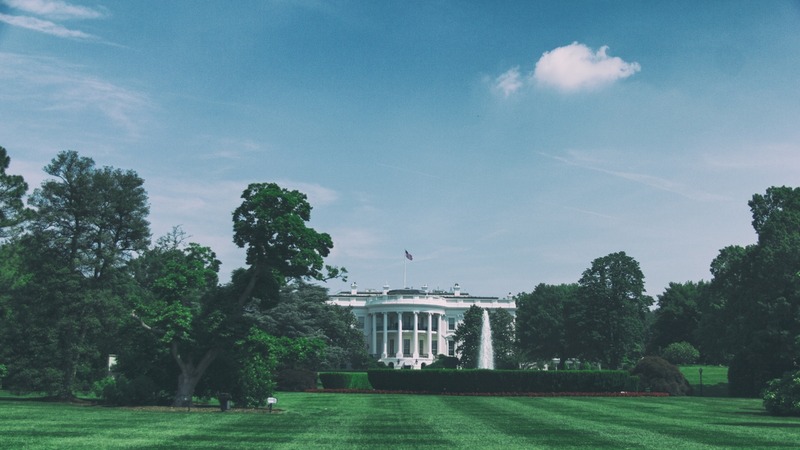
The old political hands all warned President Barack Obama to stay away from health reform, that it would sink his administration as it had sunk others. Obama ignored them, lunged for national health insurance and, sure enough, it blew up in his face—exactly as the veterans had predicted. The Tea Party sprang out of the grass roots and roared at befuddled Congressional representatives in town halls across the country. Frightened moderates begged the president to dump the idea.
Amid the uproar, the Obama team trooped into a gloomy Oval Office to ponder its next move. The president listened to each advisor until he came to the one responsible for rounding up the votes in Congress.
“Well, Mr. President are you feeling lucky?” As soon as the words were out of his mouth Phil Schiliro panicked. In Dirty Harry, Clint Eastwood had asked, “are you feeling lucky, punk?” But the president’s reaction flew off in an unexpected direction and became Oval Office legend. Obama stood up, walked over to his desk and, with his back to the room, asked softly, “Phil, where are we?”
Throughout this tumultuous epoch, the battle over America got wrapped up in the baffling intricacies of health care—first insurance coverage, then COVID.
What a weird question. Schiliro looked around for help, but his colleagues just shrugged. They had no idea either.
“Um…we’re in the Oval Office?”
“Yes,” said Obama, “and what’s my name?”
“President Obama?”
“No Phil, its President Barack Hussein Obama and we’re in the Oval Office and you’re asking me if I feel lucky? Of course I feel lucky.”
Most descriptions conclude that Obama used this quirky exchange to overrule his panicky advisors and run full steam ahead on health reform. He would have to ignore the naysayers and save the effort three times before finally winning the Affordable Care Act (or ACA). But the story reveals something deeper. Obama was enacting the two roles that presidents play.
First, Presidents embody America. Barack Hussein Obama stood for the rising, diverse America that thrilled progressives and perhaps signaled an emerging minority-majority. Presidents tell us—they tell the world—who we are. Today, this role grows perilous because the nation fiercely disagrees about its identity. Even as Obama stood for the new America, a media ravenous Donald Trump was running from one TV studio to another calling Obama a foreigner, a Muslim, a liar, and illegitimate. The 21st century pitched the United States (one might say, the disUnited States) into a screaming culture war. And throughout this tumultuous epoch, the battle over America got wrapped up in the baffling intricacies of health care—first insurance coverage, then COVID.
Second, presidents make policies. Obama stuck with health reform when most of his advisors—and, six months into the battle, most of his party—begged him to fold. One man’s insistence set the agenda and thrust the entire nation into a furor that spread across three presidential administrations. Eventually it produced the most important health reform in four decades. Today, presidents drive health policy, health care, even the nation’s health. And that’s something new. Until recently, the president made health policy within a complicated matrix of experts and interests. Washington swarms with health specialists. They sit in Congress, populate think tanks, and lobby from K Street. But today, the president towers over the field. The Obama, Trump, Biden and Trump II presidencies have changed—well, almost everything.
Thanks to Obama’s tenacity, the United States ended a 100-year battle and brought the nation to the threshold of the grand liberal dream—universal health coverage. Of course, there is still a long way to go, but we can now get there by expanding programs that already exist. For the first time in almost a century, Democrats can run for the White House (as Joe Biden and Kamala Harris both did) without promising to rewire the entire health care system.
But listen to the eerie silence. Despite the bitter path to this threshold—the debate started in earnest in 1915—almost no one cheered. That’s because the ACA spent a decade under assault (Republicans in the Congress voted repeal over 70 times) and by the time its future was more or less secure, an epidemic was barreling across America, killing over a million people.
Contrary to conventional wisdom, President Donald Trump—after denial and equivocation—led a solid campaign against COVID. Off camera and off Twitter, he listened to his health advisors, weighed their advice against the economics team, closed borders, endorsed shutdowns, oversaw trillions in COVID relief, and led a scramble for medical supplies. More important, his smash all the rules approach to vaccine development threw aside normal procedure and merged science, technology, logistics, and great piles of cash. The result: A vaccine developed at unprecedented speed that saved millions of lives.
And then he blew up the American scientific establishment.
As his reelection campaign foundered, Trump turned on his health advisors. Yes, they had made mistakes. The CDC botched the testing effort. Scientists mangled the message on masking. They never figured out how to convey fast-changing viral reality. But in this White House, they did something far worse. They disagreed. As Trump lunged after dubious panaceas—most notoriously, injecting bleach and focusing sunlight inside the body—the health team carped, and contradicted, and corrected. That infuriated the president. Trump hectored Dr. Anthony Fauci in the middle of the night, called the team into the Oval Office and dressed them down for being negative, and terrorized COVID coordinator Dr. Debbie Birx when he loomed over her outside the press room with, as she described it, “brow furrowed and pupils narrowed into hardened points of anger.”
Trump ghosted his health advisors. He, and his followers, began to jeer their advice—masks were unmanly, shutdowns were tyranny, the science establishment was corrupt. When Tony Fauci botched the ceremonial first pitch at a Washington Nationals game (it skittered off toward first base) Trump delighted in mocking him.
Then a real shocker. Trump bragged about the COVID vaccines—his COVID vaccines—during a rally and his own people booed. Before long he’d pirouetted to lead the skeptics. MAGA world turned against vaccines. These scientific miracles had eradicated diseases like polio and measles; they saved lives against COVID. Now the president’s followers rejected them. Medicine, science, experts, big pharma—they were all the enemies of the people.
Amid the backlash, Joe Biden stepped into the oval office and went big on two Trump breakthroughs—cash and vaccines. Memories of the infirm old man at the end of his term cloud the whirlwind of the first Biden years. Although Biden had won the election by more than seven million votes, Trump refused to concede and, by sheer force of will, carried most of his party with him—two thirds of the Republicans in the House shrugged off the violent insurrection and voted to overturn the results. But beyond the tumult the Trump and (especially) the Biden administrations engineered the most effective anti-poverty campaign since the New Deal. Back in the sixties, the ramshackle War on Poverty left a memory of futility. Critics dreamt up a clever line that stuck: The United States declared war on poverty and poverty won. Well, not this time.
The national government pumped $5 trillion into the economy (in two years) and Americans leapt out of poverty by the millions. Under Biden, the United States saw the saw the biggest reduction in childhood poverty in its history—rates that had been roughly on a par with poor countries (like Mexico) suddenly equaled generous social democracies (like Switzerland and Germany). Lower income people got enhanced food benefits, middle income families received checks, and workers suddenly enjoyed very generous unemployment benefits. Health care coverage expanded in great bounds. The federal government offered greater subsidies and more generous regulations with stunning results: some 95 million people enrolled in Medicaid, another 63 million on Medicare, and 20 million in the ACA marketplaces. The US crept toward that eternal liberal dream—a right to health care. The United States had never tried most of these policies. COVID made them possible. And Pennsylvania Joe—with his old-fashioned, New-Deal, lunch-bucket values—led the charge.
In the end, Biden fell one vote short of hanging on to most of it. The pandemic programs expired and poverty rates bounced right back up to the old, dreadful, American levels. Once the people were cut off from all that help, they pummeled the Democrats. But social reformers have an ambitious new playbook to follow next time the stars (and the votes) align. Perhaps the most important thing to emerge through the great waves of legislation is not any one policy but a new set of ideas about what works in creating a more equal and prosperous society.
Ultimately, social resilience springs not from leaders but from the people themselves….The mystic chords that bind us together matter more than any policy.
At the time, however, the Biden battle against COVID got most of the attention. Thanks to his predecessor, unusually powerful vaccines dropped in the administration’s lap before it took office. Biden’s early months testify to the value of classic leadership virtues: the president’s preparation, focus, consistency and familiarity with the machinery of government. The nation got two million shots into arms during the administration’s first 100 days. As a Biden aide told us, allocating scarce vaccines felt like drawing up Schindler’s list. COVID was killing 3,500 Americans a day. Vaccines could save them. Who would get the shots and live? Who would not? “Shots in Arms” became the administration’s mantra.
But problems began to mount. The Biden team was slow to distribute COVID tests. The virus kept mutating. Vaccines reduced illness and death but did not prevent re-infection. The public grew weary and confused. This fed an anti-vax movement that flummoxed an administration which hadn’t imagined its breadth or power. Hating vaccines became a MAGA litmus test. Resistance turned political and fell into the partisan divide.
The uproar over vaccines were partially the legacy of a Trump administration that fought for re-election by attacking scientists. Then a fateful Biden decision made things worse. Biden’s team struggled with a trade-off: Vaccine mandates saved lives, but people hated them and the administration knew they would take a hit in the polls. As the deadly Omicron variant filled hospitals and morgues, they reluctantly required vaccines. But that spread a very different virus: Distrust of all vaccines. Vaccination rates fell—and continue to fall—in conservative districts. The unexpected trade off was lives saved from COVID in the short term versus future lives potentially lost to measles, pertussis, polio, RSV, influenza and other preventable diseases.
Trump came roaring back for a second term and stoked the animosity. Seven decades of bipartisan respect for science fell into the roaring culture war. The administration dismantled agencies, fired scientists, stopped data collection, terminated billions of dollars in research grants, challenged lifesaving vaccinations and issued executive orders announcing a crisis in science based, in part, on “the falsification of data by leading researchers.” It rocked an establishment that had, till recently, been a source of national pride—Americans had won more Nobel prizes in Physics, Chemistry and Medicine than the rest of the world combined (roughly 56%) in the past quarter of a century. Now the scientists fell into deep disfavor. Once again, the president made all the difference when he went after science, racing past deep misgiving in both Congress and much (but not all) of the country.
Each president profoundly changed American health. But for all that, there’s something even deeper and more important to worry about. Ultimately, social resilience springs not from leaders but from the people themselves. A healthy society requires a nation pulling together. People must rely on one another, worry about one another, care for one another. The mystic chords that bind us together matter more than any policy. It will be the next president’s job to find a way to restore them—before the next killer pandemic hits.
__________________________________
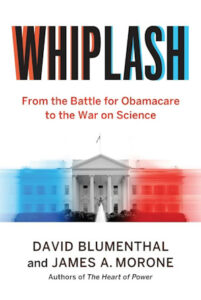
Whiplash From the Battle for Obamacare to the War on Science by David Blumenthal and James A. Morone is available from Yale University Press.

David Blumenthal and James A. Morone
David Blumenthal is professor of the practice of public health and health policy at Harvard University. James A. Morone is John Hazen White Professor Emeritus of Political Science, Public Policy, and Urban Studies at Brown University. Together they are the co-authors of Whiplash: From the Battle for Obamacare to the War on Science (Yale University Press).