A Chorus of Poets: On the Possible Existence of Multiple Homers
Henry Power Considers Theories on the Authorship of the Iliad and the Odyssey
Dawn touches the sky with her rosy fingers, and I realize that I forgot to put the bin out. I turn on the radio, and the news is full of stories about powerful men with fragile egos catapulting the world into chaos, and about human beings who endure under impossible circumstances. The stories are familiar from two poems I first read when I was eight years old, written (or so I was told) by a blind man named Homer. I have thought about those poems every day since. Homer is already on my mind as I drag the bin onto the street, and Homer will still be on my mind when night comes, the tamer of gods and men.
I teach literature at a university, so it’s impossible to escape Homer in my working life: echoes of the Iliad and the Odyssey can be found everywhere in the literature of the English-speaking world, and beyond. But I see their traces everywhere, not just in the poems and novels I discuss with my students. Two thin-skinned colleagues square up to each other in a faculty meeting; I don’t anticipate actual violence, but I do have a vision of Achilles reaching for his sword after being provoked by Agamemnon. Protesting students have pitched their tents on the hill outside my office window; I see Hector and his troops camped out on the plain, ahead of tomorrow’s fighting. My son calls to ask when I’m getting back, and whether there’s anything he can eat; I think of Telemachus, patiently waiting 20 years for his father’s return.
It’s extraordinary to think that a single poet could provoke such different responses—but we’re not talking about a single poet.
It doesn’t stop when I get home. As I scrape burnt fish fingers from a grill pan, I think of the shipwrecked Odysseus clinging to jagged rocks like an octopus and leaving shreds of his skin behind. Opening a bottle of wine, I think of Helen passing the intoxicating nepenthe to her guests in Sparta (“whoever drinks from this cup will shed no tears today”). And when the house is still and it is time for bed, I think of the various places Odysseus slept on his long journey: under a pile of leaves on the Phaeacian coast, on the ground outside his palace the night before he attacks the suitors, and also—softer and more thrilling—the beds of the witch Circe and the goddess Calypso. Then at last his own bed, carved from a living olive tree, with his own wife, Penelope.
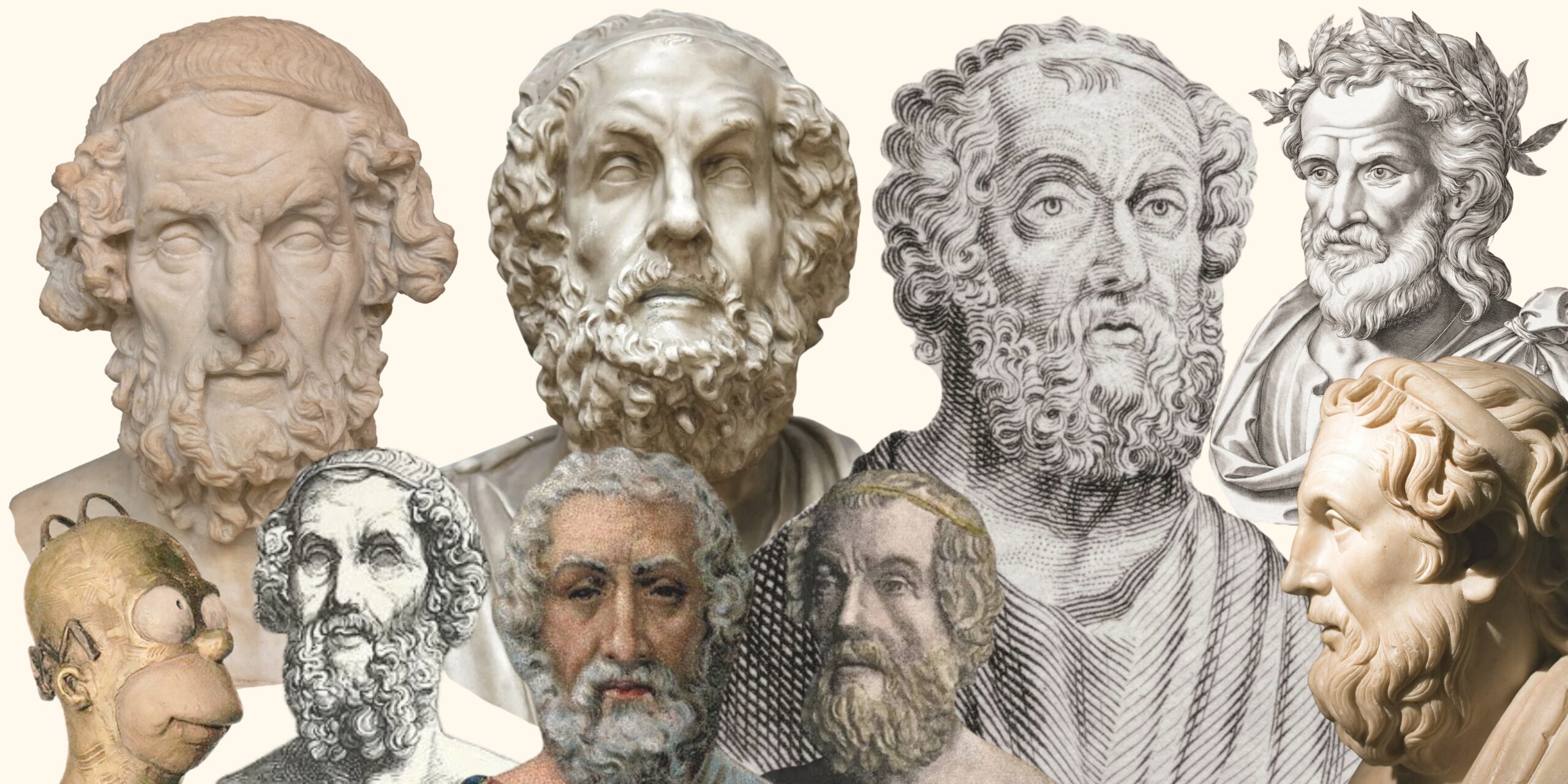
I don’t just think about the goddesses, witches, warriors and monsters who inhabit these poems. I also think about the person who wrote the stories that have shaped our culture, and which haunt my imagination. And this is where things get complicated. Homer did not write them. He could not read or write, in Greek, in English or in any other language. Besides this, he did not exist. But perhaps that’s too negative a way of putting it. Better to say that Homer is the name we give to the tradition that generated these poems. Or instead of saying “There was no such person as Homer,” we could say: “There were thousands of him.” These poems were not the work of a single man. They were songs which grew over time—improvised, reworked and amended by generations of singers. And those singers drew on the stories told to children at bedtime, or by soldiers on the march, by people at work on farms and fishing boats, in kitchens and at looms.
It’s no exaggeration to say that the Homeric poems contain thousands of voices, of men and women whose names are lost to us. At some point in the seventh century BC all those voices were fixed in two written texts. That explains the bewildering range and variety of the Homeric poems: strange and familiar; violent and gentle; harrowing and witty; interested in massive geopolitical shifts and in tiny domestic details; populated by characters we feel we know, and by other-worldly gods and monsters.
This is a book about the Iliad and the Odyssey, and about the voices miraculously preserved in their Homeric amber. More than that, it’s about the poets who have heard these voices, and brought them back to life. Because there is so much in the poems, Homer has been reimagined in countless ways. Homer is a poet of warfare, of magic and of family life. Homer is a learned philosopher, but also a folk musician—an establishment figure, but also one who belongs at the margins of culture. It’s extraordinary to think that a single poet could provoke such different responses—but we’re not talking about a single poet. The voices, lives and experiences of a whole culture are concentrated in those two poems, and thousands of voices have emerged from them.
*
European literature has nothing older than the Iliad and the Odyssey. It is bizarre that the most ancient poems in our culture should be so immense and so complex, and over the past 2,700 years many people—scholars, enthusiasts, poets and lunatics—have applied themselves to what is sometimes called the Homeric Question. How did a society just getting to grips with the alphabet produce works of such sophistication? It’s hardly less strange than if the oldest European painting was Guernica, or the oldest piece of European music was OK Computer. As one scholar has put it, reading Homer is like “opening the caves at Lascaux and discovering the Sistine Chapel ceiling inside.”
The problem was brilliantly framed by a German classicist, Friedrich August Wolf, in 1795. Wolf compared the text of Homer to an enormous ship constructed miles inland by someone with no knowledge of sailing and no access to the sea. It seemed obvious to Wolf that the “Homer that we hold in our hands now is not the one that flourished in the mouths of the Greeks in his own day.” His theory—that the poems must have been patched together much later from various ballads—was not universally accepted. Nonetheless, since Wolf the question of Homer’s origins has never gone away. Was he one or many? Did he write or sing?
A major shift in our understanding of the poems came with the work of a young Californian scholar, Milman Parry. Parry was reading the Iliad on a beach in Los Angeles in the summer of 1923 when the thought came to him. Could these poems have been improvised by singers drawing on a repertoire of formulae? Parry, aged only 21, sketched out his theory in a master’s dissertation. He went on to write a doctoral thesis at the Sorbonne, and was soon offered an academic post at Harvard. But his ideas remained only theoretical. A chance meeting with a Serbian scholar in Paris gave Parry the thought that he might be able to test this theory, by traveling to Yugoslavia and immersing himself in a living culture of oral poetry. Parry’s field research in the early 1930s proved that he was right: the guslari he met in the Balkans—many of them illiterate—improvised freely as they sang, but drew on inherited themes, motifs and formulae.
The search for talented singers took Parry to the town of Bijelo Polje in Montenegro, where he was introduced to Avdo Međedović, an illiterate farmer in his mid-sixties, who sang him the song of “Osmanbey Delibegović and Pavičević Luka”; at 13,331 lines, it was almost as long as the Odyssey. Međedović was neither singing from memory nor composing from scratch, and Parry argued that the Homeric poems must have emerged from a similar oral tradition. The Iliad and the Odyssey were not composed by a single poet, or even by two different poets. Nor were they stitched together from fragments. These epic poems were the creation of countless singers over many generations, drawn together by a particular singer on a particular day.
Most scholars now agree that the Homeric poems were composed orally, that they preserve elements of earlier songs, and that we can’t think of them in the same way that we do later poems by literate poets. That still leaves room for hugely divergent views on how the poems came into being. For some, Parry’s research, for all its brilliance, has led to an under-valuing of the poems’ artistry: it’s important that we continue to imagine a single inspired poet coming along and doing something extraordinary with the raw materials supplied by a folk tradition. Others would argue that we think like this because we’re trapped by anachronistic notions of sole authorship and by our post-Romantic ideal of writerly genius. Isn’t it just as plausible—and just as exciting—to see the poems as having emerged from a thriving culture and tradition? As Giambattista Vico put it in the early eighteenth century, “The Greek people were themselves Homer.”
There’s no need to pick a side. It seems equally perverse to deny the significance of the tradition as a whole, or to downplay the role played by a particular brilliant singer. How we balance the two is a matter of opinion, and probably also an indicator of personality type. When Wolf argued for a fragmentary Homer in 1795, the romantic poet Johann Wolfgang von Goethe was immediately impressed, but could not shake his sense of a supervising creative intelligence at work: “The Iliad and the Odyssey, even if they should have been through the hands of a thousand poets and redactors, show the powerful tendency of the poetic and critical nature towards unity.”
Homer is the first poet and the poet of poets. To write poetry is to be haunted by Homer.
The debate about the origins of the Iliad and the Odyssey is almost as old as the poems themselves. The uncertainty over Homer’s nature and existence has proved extraordinarily generative for poets, who have been free to imagine him (or her, or them) in a thousand different ways. Again and again writers have been haunted by this great unknown predecessor. I don’t mean this in some vague or abstract sense; I mean they have actually conversed with Homer’s ghost. The first major Roman poet, Ennius, describes a dream in which Homer’s ghost appeared to him and explained that souls transmigrate after bodily death; this poetic spirit would now take up residence in Ennius. The exchange marks the transition from Greece to Rome as the world’s cultural center. Ennius’s poem was revisited in the fourteenth century by the Italian humanist poet Francesco Petrarch in his epic poem Africa. Petrarch pictures the ghosts of Homer and Ennius together, and Homer’s ghost points out to Ennius a solitary figure, Francescus, working on a great epic poem, Africa. There’s a poignancy to the encounter, since Petrarch was unable to read Homer: he struggled with Greek, and no complete Latin version was available. In 1360 he wrote a letter to Homer “in the realm of the dead” in which he writes mournfully about the long wait for a translation: “Penelope did not wait for her Ulysses any longer or more anxiously than I have for you.”
Homer’s ghost often appears at moments of transition. Dionysios Solomos was among the Greek poets who turned to Homer in the early nineteenth century during the struggle for independence from the Ottoman empire, invoking the greatest ancient poet to define the culture of the emerging modern nation. Solomos is now best known for writing the words to the Greek national anthem (which at 632 lines is the world’s longest). In a shorter poem, “The Shade of Homer,” he encounters the poet “resting on the shore;/over his old torn clothes…slowly he arose,/and as if still sighted drew near me.”
Sometimes Homer’s spirit is invoked by writers who want answers about the origin of the Iliad and the Odyssey. Lucian of Samosata, writing in the second century AD, claims to have visited Homer in the underworld and asked why he began the Iliad by singing of the wrath of Achilles. The ghost shrugs: “it was the first thing that popped into my head.” This is often the way with Homer’s ghosts: they don’t put on airs. When Lemuel Gulliver is on his travels, a necromancer offers him the chance to summon up any spirit from the dead. Naturally he chooses Homer, who emerges pursued by a massive train of commentators and scholars—whom he’s desperate to shake of. Gulliver reports that Homer’s “eyes were the most quick and piercing I ever beheld.” Swift overturns the tradition of Homer’s blindness in Gulliver’s Travels partly to remind us of the poet’s eye for detail, but also to emphasize the possibility of direct connection between Homer and his audience.
Forget all the theories and commentaries, Homer seems to say. Forget about the language barrier. Just look into my eyes, human to human. Homer often turns up to vindicate the poets who have followed him, to let them know that they have understood him correctly. “Homer secretly seems inclined to correspond with me,” wrote Alexander Pope as he embarked on his translation of the Iliad, “in letting me into a good part of his designs.’ And if a poet is uncertain about the path they’re on, Homer can provide reassurance. Patrick Kavanagh’s pointedly short poem “Epic” (1960) recounts a boundary dispute between two Irish farmers in 1938. The poet begins to lose faith in his subject—why write about such a trivial matter as Europe descends into war?
Till Homer’s ghost came whispering to my mind.
He said: I made the Iliad from such
A local row.
Other poets have occasionally appeared in ghostly form. Most famously, it was the shade of Virgil who guided Dante through the various circles of Hell. But it is striking how often Homer’s ghost has appeared to his successors. That must be partly because Homer is the first poet and the poet of poets. To write poetry is to be haunted by Homer.
____________________________
From Homer-Haunted: The Many Afterlives of an Ancient Poet by Henry Power. Copyright © 2026. Available from Bloomsbury Continuum, an imprint of Bloomsbury Publishing.

Henry Power
Henry Power studied Classics and English at Oxford and then took his PhD at Cambridge. He is now Professor of English Literature at the University of Exeter. He has published widely and his most recent book is an edition of Alexander Pope’s Major Works for Oxford University Press. He is also a regular contributor to publications such as the Times Literary Supplement, Evening Standard and Literary Review, and has appeared as a guest on In Our Time on BBC Radio 4.