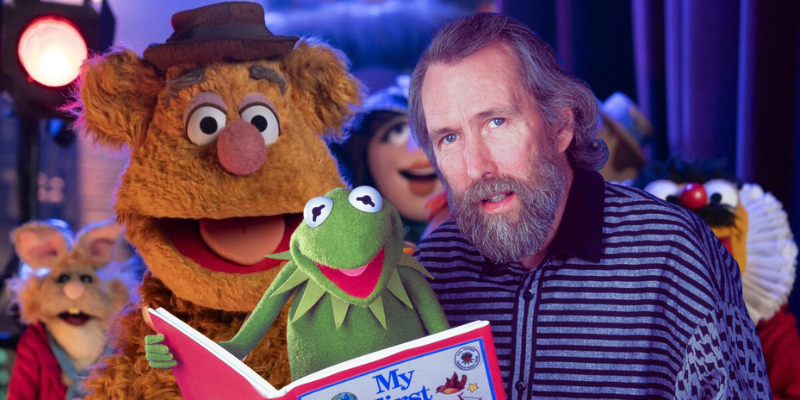
A brief literary history of The Muppet Show.
Last week on a Disney+ account near you, Seth Rogen—the hardest working man in show biz—announced the return of the Kerm.
A one-off Muppet Show special starring Sabrina Carpenter, Maya Rudolph, and other human and furry celebrities brought Jim Henson’s beloved creations to a zillennial audience.
The Muppets’ original variety show left the airwaves in 1981. But that friendly frog has a way of returning. Since swinging off primetime main, the Muppets have taken Manhattan, and shot themselves into outer space. They’ve made champions of comic moguls like Rogen, Lorne Michaels, Jason Segel, and Tina Fey.
In 2015, they even attempted an ill-fated comeback. But fans revolted when this reboot hinged on a Piggy/Kermit break-up.
As crossover hits many times over, the Muppets’ cultural legacy is a about as unprecedented as it gets. But I may love the gang best for their dabbling in the canon.
What follows is a brief history of the Muppets’ literary entanglements. How did our favorite furry arm candy come to find themselves, over and over, in the stacks?
*
It’s perhaps fitting to start with the Muppets’ origins. Though most people associate Henson’s hand crew with Sesame Street, Kermit’s original iteration was a lot darker—and decidedly not for kids.
The OG Muppets were born from Henson’s childhood obsession with variety artists, like Milton Berle. Puppets were a gimmick. Henson first put fist to sock in response to an advertisement for child puppeteers, and the rest was sort of history.
Once he’d developed a few characters, Henson shopped his creations around late night. And to pay the bills, featured Proto-Kermit, Proto-Cookie Monster, and Proto-Rowlf-the-Dog in advertisements.
The world of the Muppets—a strange, intricate place, where inter-species romance goes unquestioned—grew around the show. The writer’s room took advice from a fellow noted world-builder: Dr. Seuss.
Michael Frith, former executive vice president and creative producer of Henson Productions, recalled Muppet steering salvos in an oral history told to Slate’s Studio360. “The best single lesson I got in storytelling was from Ted Geisel. He once said to me, ‘You can create any world you want. It can be as fantastic as you want it to be. But once you’ve created that world, you have to be true to its rules.'”
In both the variety show and their first few movies, the Muppets hewed to this advice. The gang enjoyed original storylines based on their own rich character games. Miss Piggy the diva, Kermit the moral compass, Gonzo the maverick, etc.
In 1990, many worlds were rocked when Henson died suddenly. He was right in the middle of several projects—including a terrifying adaptation of Roald Dahl’s The Witches, and a negotiation to sell his flock to Disney.
In 1992, Brian Henson—picking up the mantle for his late father—had an idea that could honor his father’s humanist legacy, and appeal to that coveted crossover audience (read: Michael Eisner). The gang would do an adaptation.
In another oral history, Henson Jr. explained why Dickens’ A Christmas Carol seemed like the perfect project. “The Muppets are famous for questioning the status quo, and anti-establishment irreverence, so we took that and pointed it at Charles Dickens,” he told The Guardian in 2015.
And though it’s now more canon than the George C. Scott or Jean-Luc Picard versions (fight me), the original Muppet Carol was going to be—well, pretty gonzo.
“Robin the Frog was going to be the ghost of Christmas past, Miss Piggy was going to be this bacchanalian ghost of Christmas present, and Animal was going to be the ghost of Christmas yet to come. We were going to do a romping parody,” Henson said. The idea to put Dickens’ own language into the film—and eventually, the “man” himself—was late-breaking.
Fidelity to the source material proved key to the film’s success. The narration made a scaffold in the story. Ditto Michael Caine’s sincere performance; he told Henson he would only play Scrooge if he could so with the integrity of a Royal Shakespearean.
Dave Goelz, the voice of Gonzo/Dickens, speaks for the trees when describing this gambit’s success. “I’ve never been able to watch Christmas Carol dry-eyed. The comedy deepens the emotion—it ambushes you…It’s such a powerful piece of literature, and to be able to do it with our goofy characters and make it work, it’s a huge satisfying success.”
Five years later, Henson Jr. returned to the library for Muppet Treasure Island. Some lessons from Carol were evident: this adaptation also featured master British (human) actors, like Tim Curry. But unlike Carol, Treasure Island is “not a very faithful adaptation.”
Craving a return to the zaniness they’d benched in the wake of Jim’s death, Henson Jr. and his team “really twisted the story in order to make it funnier.” New characters, like Clueless Morgan and Polly the Lobster, were added to Stevenson’s classic. Some of these contributions were thanks to screenwriter Kirk R. Thatcher, who was fresh off the Star Wars universe.
Thatcher would also helm the last Muppet literary adaptation (at least, so far). But The Muppets’ Wizard of Oz, made for TV in 2005 and starring Ashanti, Queen Latifah, and Quentin Tarantino (!) was a critical flop.
Most viewers found this film lacked both the sincerity and the wit that had buttered and grounded previous Muppet reboots. Kathi Maio of Fantasy and Science Fiction called it “the nadir of the Oz adaptations.”
*
Though mixed, the Muppets’ dabbling in the canon may have saved the franchise in the wake of Jim’s death. Henson Sr.’s imagination was so peerless, it sprouted its own fairy tales—as any Labyrinth or Dark Crystal fan can tell you. So returning to the classics, in form and content, has always been wise for our felt friends.
Critical consensus suggests that Rogen’s reboot knew this. These old/new Muppets are as zany, soulful, and shady as ever. They’re up on culture, even if they haven’t exactly “adapted” to it.
Let’s hope they never do.

Brittany Allen
Brittany K. Allen is a writer and actor living in Brooklyn.