“Everything We Do Matters.” Minneapolis’s Moon Palace Books is a Hub For Anti-ICE Resistance
James Folta Talks to Bookseller Angela Schwesnedl
Angela Schwesnedl from Moon Palace Books in Minneapolis picked up my phone call on Saturday almost two hours to the minute after Alex Pretti was murdered in the street by ICE officers.
“If you haven’t seen the video, don’t,” she told me. “It’s an execution.”
We had made a plan the day before to talk about Friday’s huge ICE Out protest, march, and general strike against the federal occupation, but Alex Pretti was dead, and we began in somber sadness. The early reports of the murder would continue to filter out to us, to me hunched in a friend’s small office in New York while taking notes, and to her in the back of a Minneapolis store while managing diaper distribution.
But ICE agents, rioting in bloodlust and balaclavas, had momentarily overshadowed our conversation and the day of solidarity. I heard hesitation in Angela’s voice as we transitioned to talking about Friday’s strike. How could anything feel worth discussing as we were learning how wonderful Alex Pretti was, meeting him in the worst way possible, reading an obituary that should have been an autobiography?
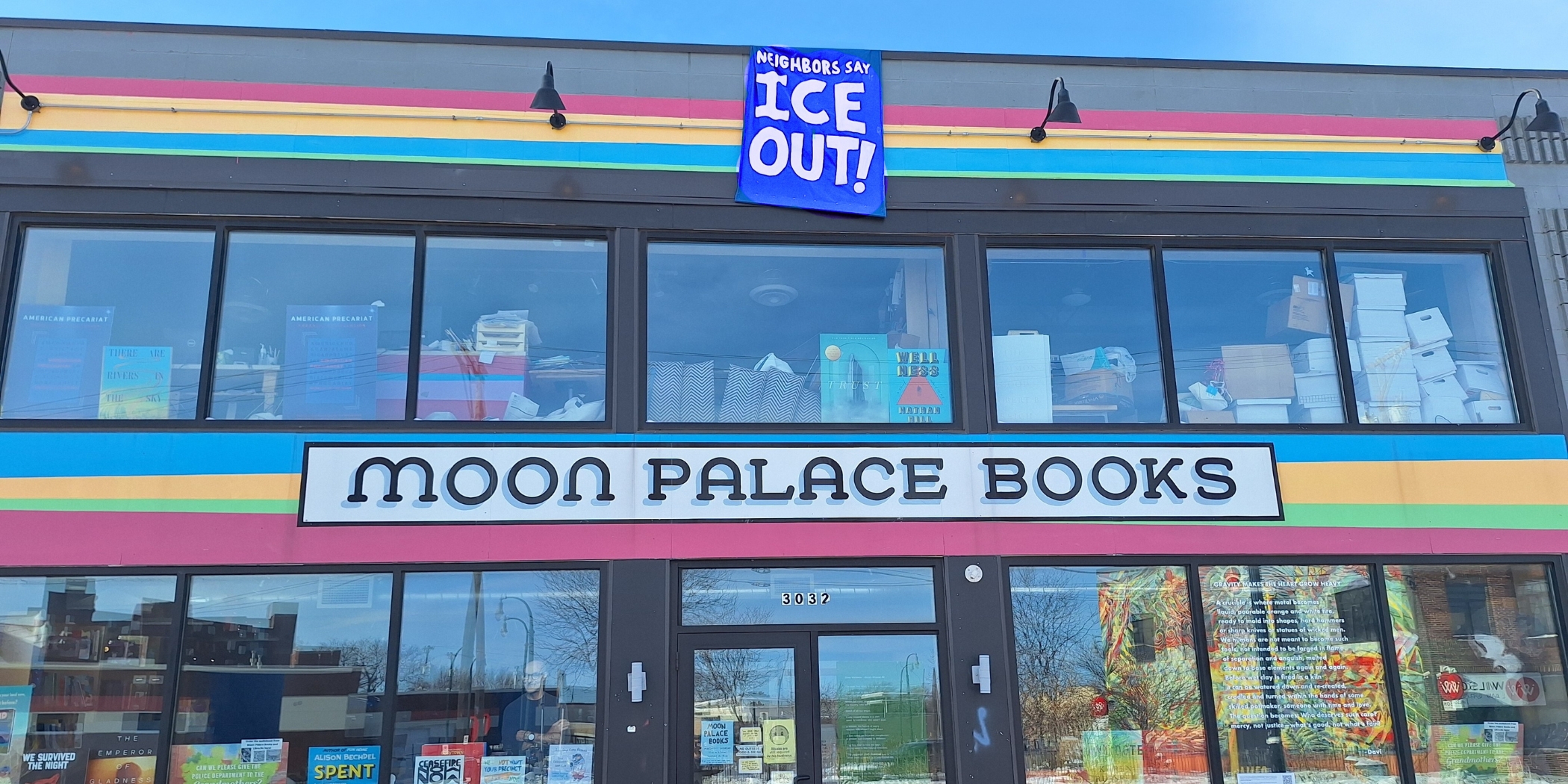
Moon Palace participated in the strike and was closed on Friday January 23rd—“We didn’t make any sales and everybody was fine with that,” Angela said—but kept their doors open to their neighbors.
“It felt pretty great,” she said. “Kids came in while their parents went to the march and folded zines in Somali so that we could pack whistle packs.” The zine explains how a whistle keeps people safe, and includes advice like “Stay loud, form a crowd.”
But ICE was unrelenting. “Somebody got kidnapped,” she told me with a sigh, “and then another attempt was made, and enough people were able to show up and blow their whistles to keep somebody from being taken.”
Moon Palace Books is near a light rail stop that was overwhelmed by people on their way to the march. “People came in to warm up. One of the reasons we wanted to at least keep our doors unlocked was not to sell things, but that we wanted people to be able to get warm off the street.”
I wasn’t surprised to hear that ICE had shown up in force to threaten the march, but I was startled to hear that the strike day inspired a wider ICE backlash that was visible to Angela through her window.
“ICE was so active in my neighborhood in the morning,” she told me, “I live about halfway between the bookstore and where George Floyd Square is, and halfway between where Renee Good was murdered, and we saw multiple ICE vehicles and convoys in that short distance.”
That observation drove home for me how ensnaring this oppression must feel, how vast the spatial footprint of ICE’s boot. But the reaction is just as vast, and even more persistent, Angela was proud to tell me about Moon Palace’s place as a node in a larger community network. The store is a place to stay warm, connected, and protected, which was especially vital in Moon Palace’s neighborhood, which Angela told me was a good distance from Friday’s march.
“It just felt important to have a huge number of people downtown for the march and still have people with whistles in the neighborhoods ready,” she said, “So I think we were able to do that.”
But ICE was unrelenting. “Somebody got kidnapped,” she told me with a sigh, “and then another attempt was made, and enough people were able to show up and blow their whistles to keep somebody from being taken.”
I was happy to hear that at least one kidnapping was thwarted, a victory of organized community protection I’d only see from afar, in chaotic videos. But Angela described it as just another part of the larger collective effort.
“It’s really amazing, I think, how united Minneapolis is, and probably most of Minnesota, with people getting supplies and whistles to bring back, or signs on how to keep businesses and neighbors safe,” she said, “There’s a local print shop that’s been providing stuff for people for free and we just bring it all over to the store because we’re in a good location.”
I asked her if she’s noticed a difference in how the store has fit in to the neighborhood, and she described it as part of a larger arc in Moon Palace’s reorientation that began well before ICE marched in at the end of 2025.
“I feel like since 2020, our block in the neighborhood has been pretty tight,” she said, “And so a lot of what we attempted to do before ICE arrived was help to get other businesses on board with what they needed to protect their employees or their customers.”
I was curious if she noticed people coming to the store for different kinds of books. What are people reading under occupation? Are Minnesotans reaching for political theory for inspiration? History, to search for echos? Poetry, as a balm?
“I don’t know if people are buying differently necessarily,” she wondered, then added, “I mean, Heated Rivalry. There’s a lot of that, you know.”
We laughed. “A copy of Heated Rivalry and a free whistle,” she said, “that’s the revolution there.”
Personally, Angela has been turning to history books, and just finished A Flower Traveled in My Blood, about the Dirty War in Argentina, the children stolen by the state’s paramilitary squads, and the women who fought to find them.
“It did help me realize how important it is that we’re still at the point where people run to danger, and where people assist and help when someone’s being taken, and that we’re not at the point where people turn their eyes or are too afraid to see what’s going on.”
I asked her what it’s felt like on the ground, and what we might not be seeing from the outside.
“One of the things that I don’t think is getting talked enough about outside of Minnesota,” she said after a pause, “is how much this feels like ethnic cleansing. People are so afraid to go out and participate in public life regardless of their citizenship status. This isn’t about immigration.”
As chilling as that description was, and how often she has seen neighbors fearful to leave their homes, the community reaction is striving bravely, and to Angela, is meeting the moment.
“All the bookstores here are fighting this,” she said, “I can’t overstate how involved all the stores are and how much work everybody is doing. It is a really incredible moment to be here. And to be part of this.”
Angela’s pride in the quiet bravery and solidarity has stuck with me. Not only as a source of inspiration, but as a hinge of divergence in America. What Angela described simply and movingly, about the collective fight and how important it is to run to danger, is inconceivable to the regime’s cheerleaders, who have no imaginative capacity to understand moral courage or physical bravery.
I was reminded of Adam Gopnik’s description of heroism in an article about the massacre at Attica Prison. The official investigators of the deaths during the infamous riot were under intense and explicit pressure to conform their testimony to an official, state-exonerating narrative. But when they chose instead to tell the truth about the murders, it was “an act of historical imagination to have recovered their unostentatious courage.” Such brave but small work asks us “to change the meaning of what we mean by heroism.”
Before we hung up, I asked Angela how she was feeling, what it was like to be in a city besieged, in a bookstore at the center of history.
“Everything we do seems small and insignificant, but everything we do matters,” she said. “And it’s huge.”
___________________________________
Moon Palace has linked to this guide on how you can help if you’re outside of Minneapolis.

James Folta
James Folta is a writer and the managing editor of Points in Case. He co-writes the weekly Newsletter of Humorous Writing. More at www.jamesfolta.com or at jfolta[at]lithub[dot]com.