8 Badass Librarians We Need to Celebrate This International Women’s Day
Jess deCourcy Hinds on the Librarians Who’ve Inspired Her
In the late Victorian era, Melvil Dewey, inventor of the Dewey Decimal system (and a womanizer) argued that women make excellent librarians because we have “a clear head, strong hand… and great heart.” I don’t agree with Dewey about much, but he was right about the great hearts of librarians. During my 17 years in the field, I’ve found myself empowered by the feminist space that is librarianship. I attended a women’s college, and in many ways, my career has felt like a continuation of this experience.
Nationally, 89 percent of librarians are women and 80 percent are white. These numbers absolutely need to shift—public servants should reflect the demographic of the people they serve. However, I also want to celebrate the powerful women—and one feminist man—who demonstrate some of the most thrilling examples of people who have shone in the field.
Here are eight librarians—from as far back as the 17th century—whose stories might put a little spring in your step as we set our clocks ahead and gain a little more sunlight.
*
Sor Juana Inés de la Cruz (1651-1695)
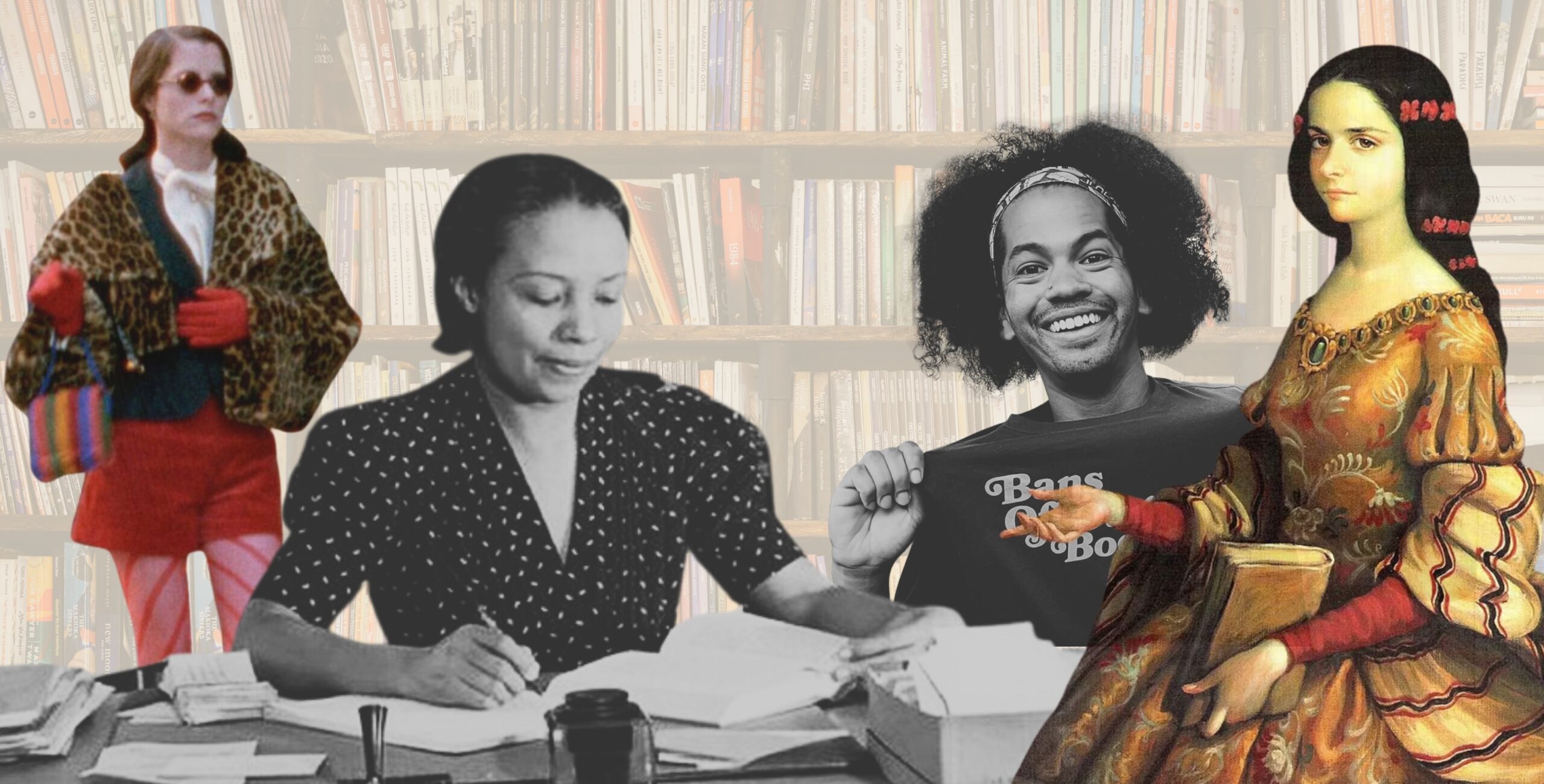
Sor Juana, as she’s affectionately called, is widely known as a Mexican nun and poet, but I also think of her as a librarian. She built a treasure trove of books, maps and scientific instruments in her apartment. Her advocacy for women’s right to an education and the freedom to read are considered some of the earliest feminist manifestos. Anyone needing to rekindle their fire to fight for literacy and human rights should dip into a few of her poems. Tragically, Sor Juana died at age 44 in a plague after the church forced her to renounce all non-religious books and give up her library. We can tap into Sor Juana’s passion as we fight for intellectual freedom.
Dorothy Porter (1905-1995)
Dorothy Porter, the first Black graduate of Columbia University Library School, led a movement to index international Black literature, poetry and song—and make these materials accessible to researchers around the world. During her career, Parker worked at Howard University, the 125th Street Branch of New York Public Library, and the library that would become the Schomberg Center for Research in Black Culture in Harlem.
A pioneer in social justice cataloging, Porter advocated for revision of the Dewey Decimal system, noting that Black authors were cataloged under a Dewey number reserved for “Colonization” regardless of the subject or genre of the book. Porter made significant contributions to African Diaspora studies and American libraries and during her 43-year career traveled the world and built networks of scholars. “The only rewarding thing for me is to bring to light information that no one knows. What’s the point of rehashing the same old thing?”
Mary the Librarian in Party Girl (played by Parker Posey, 1995)
Parker Posey shines as a professional party girl who is forced to pay off bail money by working at her godmother’s library. At first, the job is nothing more than an odious chore, but Mary soon channels her passion for nightlife into the Dewey Decimal system. If you’re ever feeling frustrated that you’re one of the only people in the world who cares about keeping books neat and orderly, prepare to laugh at this scene of Posey’s unhinged tirade about someone who puts a book back in the wrong spot. For a more joyful clip, check out Posey’s librarian dance. It will make you feel that anything is possible.
Mychal Threets
Reading Rainbow is back with host Mychal Threets, a fiercely inclusive man, and spreader of #LibraryJoy. Mychal gained a following on TikTok during the pandemic with his videos about the love of reading, libraries and “library kids.” His videos address topics such as children with special needs and how everyone is welcome in the library. Banishing the notion that libraries should be silent, studious places, he invites parents to bring children with disabilities to the library and allow them to run and vocalize if needed. Mychal’s gentle, effervescent nature and advocacy for kindness and acceptance have invited comparisons to Mr. Rogers.
Where else can you find free public space for teens focused exclusively on their emotional and educational growth?
Threets’s vulnerability about his struggles with mental health, and his passionate testaments to libraries and reading as a support to well-being, have helped him connect even more widely with audiences. As Threets shared in an interview with Reader’s Digest, he believes in being authentically himself on camera “as happy as possible while letting some vulnerabilities shine through.” He wants kids to know that he isn’t an actor. “I stammer. I stutter. And I think it very much shows that, hey, [I’m] a real person.”
Martha Hickson
Martha Hickson, a recently retired New Jersey high school librarian, faced criminal charges over LGBTQ books in her library. Accused of being a pedophile sharing pornography with children, Hickson suffered harassment for three years. Her library was vandalized, hate mail poured in, and students and adults alike went after her books—and her.
Hickson’s riveting story is featured in Kim Snyder’s new PBS documentary The Librarians—free and available for streaming on YouTube. The documentary, which was produced by Sarah Jessica Parker, features Hickson, Louisiana librarian Amanda Jones, author of That Librarian, and others who haven’t made headlines. In the film, it’s easy to see how Hickson would be an excellent librarian for teens with a frank, direct approach to life. In response to a censorship complaint that a 5th grader could access a book with the word “penis” in a school library, Hickson responded in a calm yet direct tone, “Fifth graders have penises.”
In December 2024, Hickson cheered for New Jersey Governor Phil Murphy at the Princeton, NJ ceremony for the Freedom to Read Act. As she shared with American Libraries Magazine, “I feel I’m leaving a legacy behind.” Hickson has been honored with numerous awards for her advocacy, including the Judith Krug Award for Outstanding Librarian Award from the National Coalition Against Censorship and the Lemony Snicket Prize for Librarians Against Adversity.
Jean Darnell
Jean Darnell, longtime Texas librarian and former administrator of library science with the Philadelphia Public Schools, authors the Awaken Librarian blog, which is compelling, candid, humorous and innovative. Darnell now trains educators and librarians on GenAI full-time. She also spoke on this subject on the Dr. Phil show, demonstrating how librarians can communicate to the masses and serve as leaders in technological innovation. Her resources on AI are indispensable for anyone trying to wrap their heads around this new technology.
Emily Drabinski
Queer people feel much more at home in libraries thanks to Emily Drabinski’s scholarship. The former [2023-24] American Library Association president’s most famous article, “Queering the Catalog: Queer Theory and the Politics of Correction,” published in 2013 in The Library Quarterly, analyzes deep layers of homophobia and transphobia in classification. When several of my high school students presented on bias on the Dewey Decimal system at a conference in New York in 2019, they treated Drabinski as a rock star and were thrilled to take selfies with her.
Drabinski wrote “Queering the Catalog” after working on a reclassification project at Sarah Lawrence College and noticing “things in the wrong place.” Shelving queer books under such categories as “mental illness” was disconcerting to say the least. As Drabinski explained, she sought to understand “the relationship between how I understood myself and how the systems I had to fit myself into understood me.” Now the Chairperson of the Graduate School of Library and Information Studies at Queens College, Drabinski has written on many topics, but one tenacious question repeats through all her work:
How did these structures, systems, and processes we take as fixed and forever come to be this way, and what can we do to make them different? And while we’re working toward change, can we use those structures, systems, and processes to redistribute power and opportunity?
Ricci Yuhico
There may be hope for the world if all teenagers could visit the New York Public Library’s Teen Center and meet Ricci Yuhico, the managing librarian of Young Adult Services at the Stavros Niarchos Foundation Library (SNFL) and officially a cool New Yorker.
Growing up, Yuhico imagined herself becoming a teacher like her father, who taught in the Philippines. But after a job working in a library in college, she witnessed “the power of public service” and never looked back. She doesn’t want teens to feel intimidated in libraries. As a teen, late fines discouraged Ricci from regular library use—but she kept reading, thanks to her father’s persistence in scouring bookstores for bargains that would captivate her imagination.
Describing herself as “a public servant first and foremost,” Yuhico joined NYPL in 2016 and heads one of the city’s Teen Centers that offers “state-of-the-art tech, media tools, gaming consoles, recording studios, art supplies, and more” as well as free classes for college and career planning. When you walk into this space, it’s awe-inspiring to see teens thriving in a lightly supervised but safe, beautiful public space filled with caring adults. Older teens who have aged out of afterschool programs still need the kind of nonjudgmental support Yuhico and her staff provide. Where else can you find free public space for teens focused exclusively on their emotional and educational growth?
“Teens that come into my library really face the challenge of digesting information that is being presented to them at an unprecedented velocity,” says Yuhico, who devours YA literature, which she believes has no age limit. “I could likely go on and on about how crucial reading was to me growing up…” One reading habit she still has from her teen years is skip to the end of a book to see if the book had a happy ending or not.
We don’t know if there will be a happy resolution to the problems plaguing our country, and we can’t skip ahead to find out. But I believe if we support and uplift librarians, there will be more sunlight for all of us.
Jess deCourcy Hinds
Jess deCourcy Hinds is a writer and librarian in NYC. Her work has been featured in numerous outlets, from NPR to the New York Times' Modern Love column to literary journals such as Quarterly West. She works as a youth librarian at two Title 1 schools, and teaches graduate-level courses on children's literature. Photo credit: Doug Weiner.