7 movies that were tragically cut from our Best Literary Film Adaptations bracket.
I’ve worked on a number of brackets now for Lit Hub, and I don’t think I’ve seem as much internal contention over what to include than this one. We’ve got a lot of opinions on film adaptations over here.
What I’m saying is that I see all your comments about the movies we left out, and you can take solace that every single member of the Lit Hub staff is disappointed by an omission too. 64 is a finite number, and opinions are—well, you get it. Here are a few movies that I would have been excited to see on our bracket, but didn’t quite make the cut.
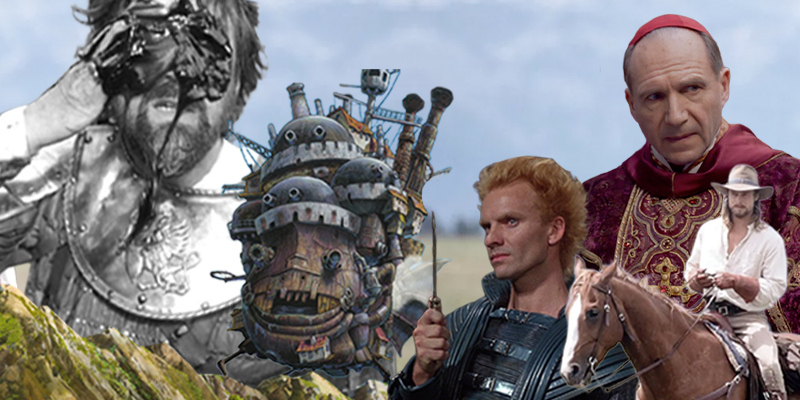
Howl’s Moving Castle
dir. Hayao Miyazaki, 2004
Based on: Howl’s Moving Castle, by Diana Wynne Jones
We almost had a whole quadrant for children’s movies, and if we had, this would have been high on the list, but alas. I would also argue that this is not the strongest Miyazaki, though it’s still quite good. The movie looks gorgeous as expected—the food, the planes, the moving castle—and has a great voice cast in the dub: Christian Bale, Emily Mortimer, Billy Crystal, Blythe Danner, and Lauren freaking Bacall. And I love Miyazaki’s tender humanism on full display in the anti-war message, the compassion for older people, and even in some of the critiques of modernity. Would have made a great addition to the bracket.
Legends of the Fall
dir. Edward Zwick, 1994
Based on: “Legends of the Fall” by Jim Harrison
I love this sappy and over-kneaded drama, but I understand that not everyone likes a movie about how Brad Pitt is so hot that it ruins an entire family for generations.
The Edge of Tomorrow
dir. Doug Liman, 2014
Based on: All You Need Is Kill by Hiroshi Sakurazaka
This is one that kept coming up in our discussions about the SFF/Horror quadrant. I’m mostly in the skeptics camp about Edge of Tomorrow, née Live Die Repeat, but it’s a tidy sci-fi movie with a great premise, really well shot action sequences, and great montages. At the end of the day though, this movie isn’t one that a lot of people “Watch, Talk About, Repeat.”
Conclave
dir. Edward Berger, 2024
Based on: Conclave by Robert Harris
There was a long period of time when I was consistently describing situations as “Conclavian.” I love this movie.
Hard to Be a God
dir. Aleksei German, 2013
Based on: Hard to Be A God by Arkady and Boris Strugatsky
This is a mad and frankly disgusting movie that takes some very, very big swings with a medieval sci-fi premise from the Strugatsky brothers. Hard to Be a God is about a planet that has not been allowed to advance beyond the Middle Ages, and descended into a filthy, despotic, and violent world. Decades into the future, a team of scientists visits in order to evaluate their progress. The movie doesn’t make this plot very clear, and is more concerned with the texture of this filthy world. This isn’t bad, because the film is shot impeccably, in gorgeous black and white that makes all the mud and shit and open-mouth coughing of this utterly disgusting squalor look great.
I know I’m probably not selling this, and ultimately, the movie is just too weird to have made sense to include in our bracket. But it’s one that I’m always recommending, if you’re looking for something ambitious and challenging to watch.
Silence
dir. Martin Scorsese, 2016
Based on: Silence by Shusaku Endō
We had too many Scorseses, at the end of the day, to be able to include this beautiful movie based on a beautiful book. Incredible performances by a cast of actors who were in the midst of being diminished by capes and action movies—let them sit in scenes and emote!
Dune
dir. David Lynch, 1984
Based on: Dune by Frank Herbert
Here’s my big heartbreak of the bracket: Lynch’s busted Dune.
Look, we all love how Villeneuve’s Dune looks, we all love that every cool actor is in it, we all love how he’s reworking the story so it makes more sense on screen. But I still prefer the weirdo, Toto-soundtracked, mall kiosk version from the ‘80s. Lynch takes all kinds of big swings, especially with the world-building and design—the guild navigator fish tanks, the block-y digital force fields, the inflatable Harkonens, and more. Maybe I just have too much of a soft spot for pre-CGI sci-fi that looks like it was made by theater kids who broke into the prop closet.
Plus the 1980s cast is just as much of a supergroup as the new Dunes. You’ve got Twin Peaks royalty—Kyle MacLachlan, Brad Dourif, Everett McGill—plus Sean Young and Patrick Stewart. And Sting with a knife as Feyd-Rautha! There’s a reason why he’s the image on the character’s Wikipedia page.
I think ultimately the problem with adapting Dune is that it’s very difficult to get what’s interesting about that novel onto the screen. You have a lot of inventiveness in the universe Herbert creates, and lots of cool planets, and ships, and space guys. But at heart, Dune is a think-y, systems novel with a historical story plugged in. Look at page one: the book is framed as an historical document. The opening quote comes from “‘Manual of Muad’Dib’ by the Princess Irulan,” placing us in a position where the story of Paul Atreides has already passed into myth. This approach adds a lot to the novel, but it strips a lot of narrative tension from the plot, which basically boils down to “Paul was prophesied to do this, and, well what do you know, it happened just like we expected.”
I get that Lynch’s Dune is messy and strange, but this old movie’s maximalist approach dovetails with the way the book works best, as a hyper-real fable. Villeneuve’s take—more serious, anti-camp, Brutalist designed—is like how Nolan approached his Batmans. It’s making something that’s kind of silly into something more recognizably adult: darker, more cinematic, and more obviously reaching for the Oscar. It’s not bad, but ultimately, I prefer the weirdness of the earlier version.

James Folta
James Folta is a writer and the managing editor of Points in Case. He co-writes the weekly Newsletter of Humorous Writing. More at www.jamesfolta.com or jfolta@lithub.com.