5 Book Reviews You Need to Read This Week
“A proud belletrist, Koestenbaum shakes against narrative like a vibrator that switches on in its plastic packaging.”
Our favorite criticism of the week includes Daniel Felsenthal on Wayne Koestenbaum’s My Lover, the Rabbi, Becca Rothfeld on Arthur C. Brooks’ The Meaning of Your Life, Robert Rubsam on Charlotte Wood’s The Natural Way of Things, Daniel Mendelsohn on Yann Martel’s Son of Nobody, and Giles Harvey on Ben Lerner’s Transcription.
Brought to you by Book Marks, Lit Hub’s home for book reviews.
*

“Sigmund Freud believed that every crush has a strand of disgust, that people are attracted to what repulses them. The Vienna doctor may no longer be a reigning scientific authority, yet he landed upon an emotional truth and one with literary resonance to boot: The enchantment of an infatuation always counterbalances the reality that our lovers — irksome, confusing, and unflaggingly human — depart from whatever ideal archetype we have stored in our heads.
Maybe this is why My Lover, the Rabbi, the rare novel by the poet and critic Wayne Koestenbaum, is the most convincing depiction of romance I’ve read in years.
…
This is a novel about Jewish bodies and how people respond to them, the toll of obsession, and the conflicting currents of desire and unease that shake and startle a deep romantic fixation. It courses with the same dumbfounded contemplation that marks actual erotic yearning: What is love, anyway, and how can one human command such attention from another? … Koestenbaum sustains his urgency over the course of 450 pages because he’s an unbeatable stylist with a track record of dilating small moments of observation into wide swaths of philosophy and psychology.
…
My Lover, the Rabbi unfolds in short chapters, with a rhapsodic, repetitive voice that echoes the work of the 20th-century Austrian madman Thomas Bernhard. But while Bernhard’s oeuvre is conspicuously sexless, Koestenbaum’s latest is practically a pillow book. We move from evocations of a ribald, steamy affair to the more diffuse qualities of the rabbi that obsess the narrator, from the grief that the rabbi feels for dead family members to the sundry figures in his social circle. As the novel progresses, it becomes a kind of detective tale of the loins: The narrator must understand, in order to hold onto himself amid the thrashing winds of his passion, what circumstances motivate the rabbi’s behavior.
A proud belletrist, Koestenbaum shakes against narrative like a vibrator that switches on in its plastic packaging. The locus of energy in My Lover, the Rabbi is not plot but comical, unhinged prose and extensive, psychoanalytic character readings. Paeans to matters of the flesh — birthmarks, necks, genitals, odors, butt hair, the asymmetry of noses — accumulate thrilling details without worrying overmuch about expedience.
…
The abundance of light that Koestenbaum sheds on the rabbi is humorous, sure, but also humanistic. This Jewish body can be illuminated at any number of angles. But there is no description that captures the many sides of the rabbi’s soul, and so Koestenbaum offers a gloriously Sisyphean attempt, a measure of respect for the human in all its biological imperatives and psychological complexity. The point, as with the best and most liberated sex, is not to arrive at a particular destination — for all that this book uncovers of the rabbi’s biography, he remains shrouded. Congress with the rabbi is about the immensity, the rapture, of the ride.”
–Daniel Felsenthal on Wayne Koestenbaum’s My Lover, the Rabbi (Vulture)
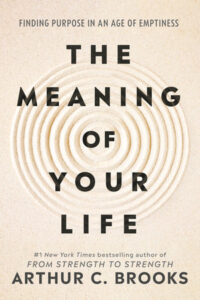
“The bromide has it that a liberal is a person who won’t take his own side in an argument. To this we might add a corollary: there is a certain kind of conservative pundit who has never really had a side to take … No specimen of this endangered breed is more irritating or more exemplary than Arthur C. Brooks, whose new book, The Meaning of Your Life: Finding Purpose in an Age of Emptiness, strains to match the febrile mood of contemporary conservatism.
…
In 2016, Brooks could not even conceive of the spasms and breaches of etiquette that Trumpism would produce on an almost daily basis. How was he to navigate the brave new world that MAGA would build over the next decade? Some of his more spirited peers on the professional right, such as David Frum and Jonah Goldberg, declared themselves Never Trumpers; less honorable figures, such as Tucker Carlson, reimagined themselves as disgruntled men of the people and started dressing in plaid. Brooks, for his part, equivocated … A bout of frantic rebranding ensued. In 2020, Brooks began writing a popular column about happiness for The Atlantic; by 2022, he was commanding hefty speaking fees and churning out best-sellers. The business of happiness, he discovered, was booming. And make no mistake: it was a business … He has acquired a jaunty wardrobe of loud suits and colorful pocket squares, and he exudes an avuncular charisma in videos he posts on YouTube … He has so thoroughly expunged his image of any unsavory political taint that he has co-authored a self-help book, Build the Life You Want (2023), with Oprah—and, as he never tires of informing his readers, paid a number of visits to the Dalai Lama. As of January, 2026, he had joined CBS News as a contributor and become a columnist at the anti-woke outlet The Free Press. His metamorphosis into social scientist-cum-sage appears to be complete.
…
It would be one thing if Brooks were reconciled to writing Enneagram tests, but The Meaning of Your Life is self-help that dreams it is philosophy. It makes a scattered show of its erudition in the form of drive-by efforts to project philosophical literacy … But none of these ornamental flourishes can conceal his fundamental incuriosity. ‘Until recently,’ Brooks writes hazily, of the meaning of life, ‘the definition probably wasn’t so important, because of the way people lived, just naturally going about life in ways that delivered meaning every day.’ Which people? How recently? Readers of The Meaning of Your Life could be forgiven for thinking that despair was invented in 2007, the year the first iPhone was released. Brooks has no interest in the broader sweep of history and, indeed, no apparent knowledge of the philosophical accounts of encroaching meaninglessness which have been on offer for centuries.
…
Reading Brooks, in all his fatal mildness, I could start to see how the ominous Highest Good might come to seem so appealing. A fanatical belief in something—and the irrepressible urge to proselytize that goes with it—is far more invigorating than the all-encompassing blandness of the therapeutic imperative. The post-liberals stand for cruelty and inanity, but Brooks can’t admit to standing for much of anything at all.”
–Becca Rothfeld on Arthur C. Brooks’ The Meaning of Your Life (The New Yorker)
“Among Franz Kafka’s many story fragments, there is one about a jail cell with only three walls. The narrator does not know how he found himself in this prison, how he came to be naked, where he is, or what he might have done to deserve this fate. He can see only the three walls of stone; in front of him, where the fourth would be, a yawning gap looks out across a misty void. No one is keeping him in the cell. His freedom is looking him right in the face—yet, terrified by the possibility of life outside, he cannot bring himself to reach for it. He has effectively jailed himself. ‘Much better to have nothing and do nothing,’ he concludes, and beds down in his cage.
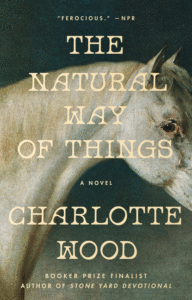
One of the ideas that Kafka’s parable conveys is that a prisoner is molded into the shape of their prison. This is especially true if, as in Charlotte Wood’s The Natural Way of Things, that prison is modeled on the society that constructed it.
…
This atypical prison is designed to house atypical prisoners. Its 10 inmates are strangers, yet eventually they recognize one another from the news: Each was made the face of a national sex scandal. Wood tells us a bit about each woman—one, a participant in a televised singing contest, was abused backstage; another was raped by a Catholic cardinal—but she focuses on two in particular. Yolanda, the child of a working-class single mother, was assaulted by a group of athletes; Verla was exploited by a prominent politician whom she still loves. All the women were lured into confinement by the promise of a settlement; when they arrived to talk over the details, they were drugged and incarcerated on this run-down ranch by people whose identities and intentions never become quite clear.
The women now feel humiliated for having been fooled—a mental state that compounds and mirrors the shame they felt during their moments of notoriety. In a mid-book disquisition that gives the novel its name, Wood ponders how, when a man sexually assaults a woman, the femaleness of the victim—rather than the maleness of their abuser—is always placed at the center of their story.
…
These women are approaching Kafka’s fourth wall, the mysterious way out—if not from the ranch, then at least from the limits that bound them at home. Yet…Wood does not take that final step. Again and again, we are told that Yolanda is a wild girl and Verla is an educated liberal who places herself above the others; whatever new perspective they acquire is subordinated to the narrow demands of Wood’s didactic story. Verla is particularly ill-served; she holds on to the belief that her politician lover will come to her rescue for a preposterously long time—until, all at once, the scales fall from her eyes. This is entirely believable, in the sense that many people take years to recognize abuse. Still, because her epiphany is driven not by Verla’s psychology but by the rote requirements of the plot, it is not convincing. Whatever transformation occurs reflects the brute metamorphosis of character into symbol, not the fullness of realism or the vividness of fiction.
This limits Natural Way as a novel; worse, it dramatically dulls the impact of Wood’s critique. She wants us to see how a society that treats women as naturally inferior traps, exploits, and denigrates them. Unfortunately, her plot confines these characters to another narrow set of roles, and most of them are portrayed as incapable of leaving their cage. The novel ends with the group of women gleefully giving up their own lives in exchange for small bags of luxury cosmetics—a metaphor so reductive and condescending that it scans as misogynistic. How else to read this moment but as the culmination of that ‘natural way of things,’ which pins the blame on contemporary, commercialized womanhood? They might as well be doing it to themselves.”
–Robert Rubsam on Charlotte Wood’s The Natural Way of Things (The Atlantic)
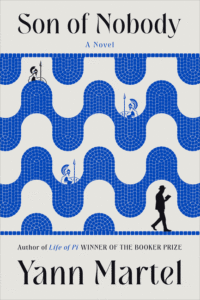
“In the latest revisionist treatment of the ancient texts, the focus is on class rather than gender. Yann Martel’s new novel, Son of Nobody, is about the discovery of a lost Trojan War epic whose protagonist is no semi-divine princeling, like Achilles in the Iliad, but rather a lowly foot soldier named Psoas, who has a beef with his highborn superior officers. This downmarket and decidedly un-Homeric casting allows the tale, and Martel’s novel, to ask: ‘What is it that makes a hero a hero?’
If the novel derives its subject matter from Homer, it owes its structure to Vladimir Nabokov. Its pages are split between translated fragments of the epic, called the ‘Psoad,’ and an extensive commentary, in the form of footnotes, by one Harlow Donne, an ambitious graduate student who claims to have discovered it … Donne’s discussion of the work alternates between scholarly exposition…and increasingly intimate autobiographical musings, primarily on his failures as a husband and a father.
…
Martel…has set himself no small challenge in taking on Homer, academia and family tragedy; the results are a mixed bag. His portrayal of academic life will leave real professors wincing, if not giggling … Despite the obvious research that Martel put into his novel, there are too many gaffes about Homer and Greek epic to persuade any expert.
…
The great problem with Son of Nobody is that the book’s central device — that is, the twinning of the lost ancient epic and the modern story of its discoverer’s life challenges, each meant to ennoble a ‘son of nobody’ and make you feel for him — is wholly unpersuasive.
In large part, this is because Donne’s ongoing narration of his disintegrating marriage — which, let’s remember, is supposed to be a mirror of the Trojan War — is so banal, so soggy with earnest platitudes, that it can’t support the weight of the analogy to the epic conflict.”
–Daniel Mendelsohn on Yann Martel’s Son of Nobody (The New York Times Book Review)

“Like Lerner’s previous protagonists, the narrator is something of an intellectual klutz, at once Chekhov and Chaplin. Preparing for the interview in his hotel room, he knocks his iPhone into the bathroom sink, breaking it. He has no other means of recording the conversation, but instead of telling Thomas—the prospect is too humiliating—he hatches a face-saving proposal: this evening, they’ll just catch up off the record before conducting the interview proper the next day (once the narrator has bought a new phone). Thomas has no objections, but when the talk turns naturally to the subject of his childhood he wonders if they shouldn’t start recording … Thus ensnared in a fiction of his making, the narrator takes his phone out and pretends to press Record.
Lerner’s work, which abounds with liars, fiction begets fiction. As the night wears on, and Thomas shares an archive’s worth of memories and wisdom, we come to feel the narrator’s giddy dread: all this precious speech is being lost, going unpreserved for future generations. Except here it all is, page after page of luminous table talk … And so the irony of Lerner’s title comes brightly into focus: since there was no recording, there can be no transcription. What we are reading, instead, is the narrator’s reconstruction, a volatile compound of the fictive and the real.
…
Words, Lerner shows, lead double lives, including the one he has taken for his title. To transcribe is not simply to make a written copy (whether faithful or not); it is also to convert a text or a piece of music into a different form. Thomas, like Kluge, is steeped in Kafka, whose fiction the novel repeatedly invokes.
…
Except nothing in this exquisite, shape-shifting novel is quite what it seems—words least of all. For Lerner, language is both a symbol and the medium of human reciprocity, a long collective poem we each assume is ours alone.”
–Giles Harvey on Ben Lerner’s Transcription (The New Yorker)

Book Marks
Visit Book Marks, Lit Hub's home for book reviews, at https://bookmarks.reviews/ or on social media at @bookmarksreads.