5 Book Reviews You Need to Read This Week
“With minimal skepticism, he platforms schemes that range from the contested and implausible... to the wholly impossible.”
Our favorite criticism of the week includes Adam Becker on David Ariosto’s Open Space, Laura Miller on Serena Kutchinsky’s Kutchinsky’s Egg, Joan Frank on Colm Tóibín’s The News From Dublin, Adam Gopnik on A. M. Gittlitz’s Metropolitans, and Adam Nicolson on David George Haskell’s How Flowers Made Our World.
Brought to you by Book Marks, Lit Hub’s home for book reviews.
*

“Space ain’t the place. The cosmos is a fascinating subject for scientific investigation, but there’s currently no plausible argument for sending large numbers of people to live and work in space. Two of the three worlds nearest our own, the moon and Mars, are desolate hellscapes of radiation and toxic dust; the third, Venus, is blanketed in a crushingly thick atmosphere that keeps its surface hot enough to melt lead … But to the modern space barons like Elon Musk and Jeff Bezos, these are pesky details. They insist that our fate lies in the stars. And there is no shortage of media to promote this message — both the science fiction that Bezos and Musk, like a lot of us, were raised on, as well as reporting that uncritically repeats the views of these oligarchs and their business competitors. A new entry in this latter category is Open Space: From Earth to Eternity — the Global Race to Explore and Conquer the Cosmos, by David Ariosto … The book bills itself as ‘a front-row seat to the future,’ with ‘unprecedented access.’
…
It’s easy to see why so many people agreed to speak with him. He asks questions and dutifully reports the replies, adding only the most cursory analysis of his own. When that analysis does come, it’s often couched in strained prose … By failing to cast a skeptical eye on the space industry, he becomes a cheerleader for it.
…
The book’s disjointed narrative starts out by tracing international efforts to return to the moon, which Ariosto frames as a race without considering whether that framing is apt … After that, he turns his gaze farther afield, first to Mars and the rest of the solar system, then to the stars. Along the way, with minimal skepticism, he platforms schemes that range from the contested and implausible (A.I. data centers in space, colonizing the moon and Mars, nuclear fusion-powered rockets) to the wholly impossible (faster-than-light spaceships and endless free energy).
…
If the lack of critical assessment were its only problem, Open Space might still be worthwhile for a behind-the-scenes look at the space industry. Unfortunately, the book’s credibility is fatally undermined by a cavalcade of errors … He repeatedly suggests that quantum entanglement could be used for faster-than-light communication, an infamous canard among physics students. In an endnote, he mistakes a NASA satellite for an asteroid 15 times farther away. He even manages to confuse the liqueur fernet with the mixed drink fernet con coca. These are just some of the things he gets wrong — all of which a Wikipedia search or phone call to an expert could have set him straight on. Are there other, less obvious missteps? We can’t know, because we don’t have access to his sources.”
–Adam Becker on David Ariosto’s Open Space (The New York Times Book Review)
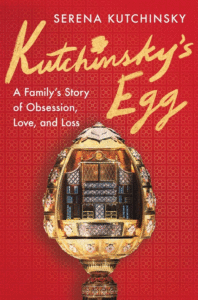
“Telling stories about ourselves and our families is a time-honored form of courtship, whether we’re trying to charm a potential lover, a new friend, a customer, or in Serena Kutchinsky’s case, readers … She comes from a family packed with story-worthy characters, people whose innate sense of drama she has clearly inherited and spun into an irresistible saga. The egg—officially known as the Argyle Library Egg and encrusted with 24,000 pink diamonds—is a compelling object, a 2-foot-tall, 33-pound bid to rival the fabled eggs made by the legendary French jeweler Carl Fabergé for the Russian czar in the late 19th century. Still, it’s just an object, even if is worth more than $11 million. What makes Kutchinsky’s Egg so spellbinding is not the egg but the Kutchinskys themselves.
…
Serena’s great-great-grandparents fled the pogroms in Poland in the 1890s, aiming for America but getting stuck in London, probably due to a cholera epidemic that choked off immigration, though there is family lore about the couple being scammed out of their life savings. Her great-great-grandfather set up as a humble watchmaker and clock repairer in London’s East End. His son, her great-grandfather, married the daughter of a German Jewish jeweler so fancy he was an official supplier to the crown prince of Bavaria and taught his son-in-law ‘the art of cultivating a higher class of clientele’ … Many years later, Serena—who became a journalist—would recognize the peril in this practice, at which her father also excelled. High-end jewelers are prosperous, but their clientele is fabulously rich, and identifying with their tastes and desires can lead to a hazardous yen to live beyond one’s means.
…
Somewhere around the point where the craze-prone Paul sponsored a polo team that beat Prince Charles’ team in a particularly memorable match, I had half-forgotten the titular egg, despite the fact that it had motorized doors that opened up to reveal a miniature, diamond-encrusted library. That’s how diverting the Kutchinskys, with their multifarious feuds and scandals, can be. (In passing, Serena refers to an anonymous letter her mother once spotted among her father’s papers containing ‘a secret involving someone close to the family’ that was ‘so grave that, even now, nobody will tell me exactly what it was.’) The story of the egg and its making is also full of artifice and betrayals, but in essence it was a massive gamble rooted in Paul’s grandiosity and fundamental misunderstanding of his own profession.”
–Laura Miller on Serena Kutchinsky’s Kutchinsky’s Egg (Slate)
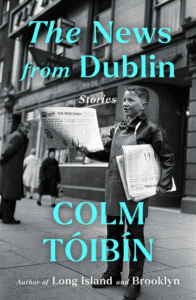
“Here’s an offbeat tip: consider keeping an alternate book handy as you dip into Colm Tóibín’s new story collection, The News from Dublin. Lightweight nonfiction may work best — as a sherbet course between Tóibín’s intense, rich entrees. Likewise, you’ll want to take each of these nine stories slowly: say, one per night at most.
It’s to be expected. Tóibín’s trademark insight, clarity, and precision demand full-hearted attention. In fact, his prose may deserve a literary patent, if only for its music: a particular purity and resonance in the reading ear. Each word and sentence feels vacuum-packed, enlisting our imaginative gear through all the senses; lines that often strike with a hymn’s sonority — building a quiet urgency.
…
Oddly, several of these pieces don’t pack Tóibín’s customary punch. In ‘Sleep,’ which first appeared in The New Yorker, a narrator’s repressed grief for the death of his brother — refracted through mulling the cultural differences between himself and a younger lover — finally alienates that lover. Similarly, ‘Barton Springs,’ a meditation on beautiful youth doomed to mortal decrepitude, feels somehow too personal to make the visceral leap into a reader’s recognition. More mysteriously, ‘The Catalan Girls,’ patiently tracking the lives of a widow and her three daughters who’ve moved from Spain to Argentina — while superbly inflected with political, economic, sexual, and language realities — seems simply to run too long to sustain the kind of coiled power Tóibín’s oeuvre usually embodies.
By contrast, the wrenching title story affirms Tóibín’s mastery.
…
Most of News delivers what Tóibín fans relish … It’s all there: the burnished density of atmosphere, the sentences built simply yet so solidly they issue their own force field — wondrous for sheer grace. Perhaps the term ‘Tóibínian’ will come to stand for this exact quality of satisfaction.”
–Joan Frank on Colm Tóibín’s The News From Dublin (The Boston Globe)
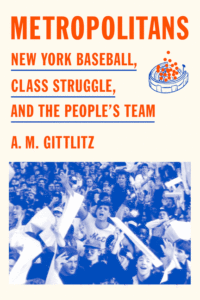
“Some books, to amend a motto from Shakespeare’s Twelfth Night, are born ironic, some achieve irony, and some have irony thrust upon ’em. A. M. Gittlitz’s Metropolitans: New York Baseball, Class Struggle, and the People’s Team (Astra) is a shining new example of the rare third kind. Given the realities of modern baseball, one expects Gittlitz, a journalist and an Occupy Wall Street veteran who writes from a hard-left, Marxist perspective, to dissuade his readers from rooting for something as obviously and cynically commercial as a sports franchise, or from imagining that a ‘people’s team’ can exist when all teams are owned by a succession of plutocrats, each more sickening than the last. We assume that he will point out the futility of identifying with something so flimsy and compromised as a professional baseball club. The terms in his subtitle can only be meant mockingly, we think, as we open his pages, expecting to watch hope collapse as he lays bare the usual brutal commodification of pleasure at the highest possible price.
Not a bit of it. An all-consumed, obsessive Mets fan, Gittlitz truly believes that the Mets are the people’s team and that they have been engaged in genuine, if often contorted, class struggle on our behalf for the past sixty-five years or so.
…
To demonstrate his belief, Gittlitz runs through the history of the Mets—not unappealingly, since genuine obsession is always appealing—and reminds the reader of all the moments when the Mets at least seemed to stand for what was once called the counterculture. He makes a much better case than one might have thought possible … To hit home his points, Gittlitz connects what happens on the field with all that happens off it. His cultural history can be a bit out of focus. He insists that baseball was a powerful tool of Cold War propaganda for the United States, which forced the game to be played in alien corn.
…
Gittlitz’s book is long, loving, and pained. A Marxist in love with the Mets occupies a difficult position. By the end, the requisite contortions lead him to a fate almost worse than capitalism: he must confront the thesis, offered by Jacobin’s founding editor, Bhaskar Sunkara, that it’s the Yankees who represent ‘an authentic working class,’ even as ‘squeezed middle-class Mets fans try to carve out their own path in vain.’ Could the Yankees really be the people’s team? Gittlitz, all but conceding the struggle session, can only sigh and see the Yankees’ populist strength as a version of Hobbes’s Leviathan, ‘whose despotic reign is legitimized solely through unbeatable strength.'”
–Adam Gopnik on A. M. Gittlitz’s Metropolitans (The New Yorker)
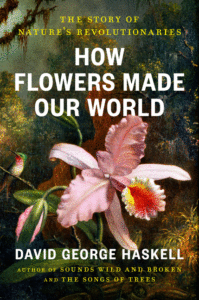
“[Haskell] has written widely loved books about the secrets of forests and the sounds of the living world and now, in How Flowers Made Our World — a rather inert title for a work of real passion — has become the advocate for the enormous silent presence of flowering plants in almost every nook and cranny of our lives. Haskell takes flowers seriously. He loves his subject.
…
Haskell considers plants living ‘creatures’ and deprecates the way natural history museums sideline flowers in favor of carnivorous dinosaurs and other glamorous meat-eaters … It is a prejudice that has produced a massive, worldwide destruction of flowers and their habitats when, Haskell insists, we should see them not as mere beneficiaries of human action but rather as the frame-makers, the wholeness-managers of the systems on which we all rely.
…
For much of the book Haskell is a trustworthy companion, rational but not entirely rationalist, knowledgeable but understanding of what the ignorant need to know, expert but — and this may be a surprising word for a book of popular biology — kind. His emphasis is on symbiosis and communality, both between plants and with plants.
But he raises the pitch in his peroration. Our love of flowers, he says, is ‘a form of inherited wisdom scribed by evolution into our nerve endings and brain chemistry. In the presence of flowers, our senses glow. Beauty awakens inside us’ and ‘we’re freed momentarily from the husk-like ego.’
You feel like cheering. More Haskells, please, and more flowers.”
–Adam Nicolson on David George Haskell’s How Flowers Made Our World (The New York Times Book Review)

Book Marks
Visit Book Marks, Lit Hub's home for book reviews, at https://bookmarks.reviews/ or on social media at @bookmarksreads.