5 Book Reviews You Need to Read This Week
“The Bidens seem stuck in a version of America that does not exist and perhaps never did.”
Our flock of fabulous reviews this week includes Scaachi Khol on Jill Biden’s View From the East Wing, Lincoln Michel on Deb Olin Unferth’s Earth 7, Michael Faber on M. John Harrison’s The End of Everything, William T. Vollmann on James Ellroy’s Red Sheet, and Kristen Martin on Zinzi Clemmons’ Freedom.
Brought to you by Book Marks, Lit Hub’s home for book reviews.
*
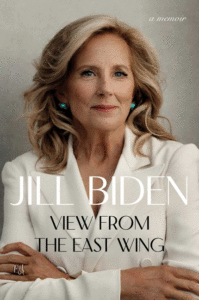
“I guess the question is: What are you expecting? Are you reading a Jill Biden memoir in some delusion that she’ll be willing or able to hold her husband accountable for his poor performance against Trump 2.0? Why would she somehow be able to be critical of the Democrats, beyond her disappointment that her husband lost all his institutional support by the end of his first term? Or are you just reading it to discover Biden’s trenchant thoughts on what she liked about the other wives of other presidents and prime ministers? Maybe you were excited to find out how many soups were served at a particular state dinner (two) or all the gardening the good doctor (of education) did at the White House. Maybe you, like me, love the feeling of boredom.
…
“So many passages in Biden’s book read like this, an attempt to remind us that her husband was the better candidate, but compared only to the current president, with his ever-molting hands curled around a Diet Coke can, ripping into a well-done steak while he tries to rename the Kennedy Center. Trump being three years younger than Biden doesn’t matter anymore, because nothing the Bidens do matters anymore. Since Trump won, they’ve hardly been a political presence—perhaps because Joe spent some time in cancer treatments—never mind a political adversary. Joe Biden is no longer a tangible or relevant Trump adversary; he’s just a guy in a history textbook.
…
“The Bidens seem stuck in a version of America that does not exist and perhaps never did. To crow on for page after page about how kind and empathetic your husband is provides no value to an electorate who cannot rely on him anymore. I know the man loves ice cream! Me too, but no one writes a book about it! Most of the book’s short chapters end with a kind of sixth-grade-book-report recap of Biden’s argument, which is merely that they were good people who were trying their best and should have been given even more chances to run the country. A brief chapter about COVID ends with, ‘I give thanks for the clarity and steadfastness Joe brought to that confusing and terrifying time, and to the doctors and scientists who developed a vaccine, and to all those across the country who did their part to get us here.’ Why am I reading a workplace evaluation? Just show me some shirtless photos of Hunter Biden and leave me alone!
…
“You know how sometimes you go on Instagram and you’re confronted with an anniversary post from a couple that sucks? The female contingent—they’re always straight, big surprise—writes a loquacious paragraph about how they’ve gone through so many ‘ups and downs’ and that they’re ‘still standing’ and their ‘love’ is ‘eternal.’ That’s how View From the East Wing reads. It’s a woman defending her husband to an audience who didn’t ask. It’s a memoir about a relationship that almost no one is interested in, a president whose legacy has already been ripped apart by colleagues and enemies alike, and a moment in time that doesn’t necessarily feel kinder, just less obvious in its cruelty. In yet another first lady memoir, you’re certainly getting what you paid for. It’s just that the whole thing could’ve been a Facebook post.”
–Scaachi Khol on Jill Biden’s View From the East Wing (Slate)
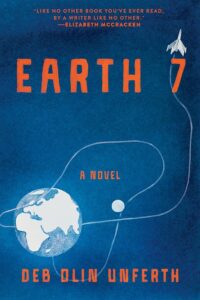
“Earth had a pretty good run, until humans came along. We poisoned the plants, destroyed the animals and generally ruined the place. This is the starting point of Earth 7, Deb Olin Unferth’s stellar and sweeping science fiction novel that is part cosmic comedy and part dirge to our dying world. ‘It’s the end-time,’ Unferth writes. ‘Every part of the planet is done with us: the air, the ground, the water.’ What to do now?
…
“Unferth has honed a narrative voice that falls somewhere between mystic, stand-up comedian and fairy-tale teller. There are frequent funny asides and philosophical musings. ‘Earth had gotten the best the universe had to offer, in all categories,’ Unferth writes, ‘and the achievement had nearly killed her.’ The novel has a freewheeling spirit that recalls Italo Calvino’s space fables in Cosmicomics. While this might rankle a certain type of science fiction reader who expects rigorous world building and a straightforward plot, Unferth’s playfulness injects new life into some trusty old tropes that have calcified into clichés.
…
“Unferth writes with haunting beauty about our reckless destruction … But Earth 7 is a celebration as much as a lamentation. We’re part of this world, ‘a place where terrible and wonderful beauties are coming to pieces at every moment and others are constructing themselves out of the remains.’ Unferth reminds us that while we may be facing microchip uploads and Martian colonies, our human and planetary heritage endures. Love, wonder, horror and all of life—it’s here in Earth 7 and here on actual Earth. It’s our home, while we can keep it.”
–Lincoln Michel on Deb Olin Unferth’s Earth 7 (The New York Times Book Review)
“John Harrison’s prose has thrilled me since I was a teen. It has thrilled others, too, including Angela Carter, Deborah Levy and Robert Macfarlane, but snobbery about the genres in which he made his mark—science fiction and fantasy—has hindered the respect his achievement deserves. His rigorously realistic novel Climbers, published in 1989, looked as though it might change that, but subsequent work has remained genre-fluid and uncompromisingly peculiar.
“Unlike most novels with such ambitions, it ticks no hot-topic boxes and appears uninterested in our daily news feeds. It shows us a society that has long since forgotten Trump, social media and Middle Eastern genocides. And yet it burrows deep into our psyches—into the psyche of our civilization—and exposes the terrifying insecurity of life right now.
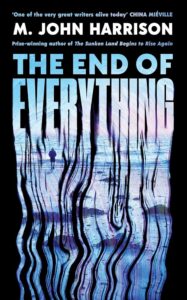
Caution: it won’t be for everyone. In my second-hand copy of Harrison’s 2020 Goldsmiths prize-winning novel The Sunken Land Begins to Rise Again, next to a bit where a character is ‘too depressed to try and tease out whatever meaning might be hidden in all this,’ the previous owner has scribbled ‘SUMS UP THIS WHOLE BOOK!’ Such a reader would be even more exasperated by The End of Everything, which turns the dial up several notches. Harrison still evokes painterly fugues of light and pungent smells, but they’re offset by a growing bleakness, and there’s less humor. Some of the dialogue feels like Harrison’s own metaphysical musings rather than characters’ speech. And of course there will always be readers who balk at SF, refusing to countenance that our lived reality is saturated with it, and that the time for earnestly realistic state-of-the-nation novels may have passed. Dreamlike and baffling, The End of Everything elucidates humanity’s disintegrating existence with strange clarity.”
–Michael Faber on M. John Harrison’s The End of Everything (The Guardian)
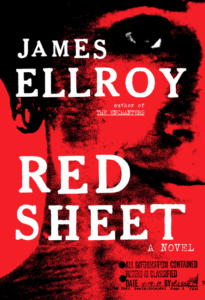
“I read James Ellroy not quite as I would Raymond Chandler and Ross Macdonald, those L.A. noir maestros whose lyrical loneliness is simply beautiful and whose plot-machines (call them trick coffins) I can never admire enough, right down to the last countersunk death’s-head screw. In place of the 20th-century moral code of Chandler’s Philip Marlowe and the family neuroses of Macdonald’s characters, I find in Ellroy’s books the semi-despairing ugliness of Georges Simenon. But Ellroy also likes to be semi-funny, his specialty being sadistic slapstick (which sometimes disgusts me), and unlike these other authors he likes to meditate on the American dream of financial and reputational success.
…
“Whenever I start another Ellroy novel, I become a fly, buzzing ghoulishly over multiply stabbed corpses and taking refreshment from some backdoor schemer’s cask-strength whiskey bottle. Chandler sells us a place: the foggy, mysterious Los Angeles of his era. Ellroy overlaps Chandler with his L.A. Quartet, which, starting with The Black Dahlia (1989), takes us through the 1940s and ’50s. His more recent L.A. Quintet, beginning with Perfidia (2014), drifts from Pearl Harbor, Japanese internment and homegrown Nazism to the domestic paranoia and racial turmoil of the postwar years. Red Sheet is the fourth book in this series, and Ellroy’s third novel with Otash in the driver’s seat.
Marilyn, Nixon, the Kennedys, Bay of Pigs—we’ve seen Ellroy messing with this material long before the Quintet. When I reviewed American Tabloid (1995) more than 30 years ago, I quoted a few lines of dialogue that packed in J. Edgar Hoover, Marilyn Monroe, ‘Jack the Haircut’ (Kennedy), ‘Dracula’ (Howard Hughes), Jimmy Hoffa, Tricky Dick, ‘Beard’ (Fidel Castro) and the invasion of Cuba.
…
“Red Sheet reminds us of that late wan beacon of Thomas Pynchon’s, Shadow Ticket, his third book—after Inherent Vice and Bleeding Edge—to rewrite the detective novel as debased comic history. An old signaler invented a formula that he is now riding to the grave. Well, why not?”
–William T. Vollmann on James Ellroy’s Red Sheet (The New York Times Book Review)
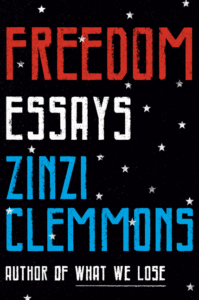
“Throughout eight essays that “reflect a world buckling under the consequences of centuries of interlocking injustices,” Clemmons weaves affecting memoir with incisive criticism and reporting to map out the limits of personal, political, racial, economic, and gender-based liberation—and to muse on how those bounds might yet be surpassed.
…
“Readers may come to Freedom just for what Clemmons calls out as ‘some morbid desire for gossip: to know the who, what, where’ of her #MeToo moment. But they would be remiss to skip the essays that appear between ‘Freedom’ and ‘Freedom, Pt. 2,’ among which is the strongest in the collection: ‘Chasing Robbie,’ a probing investigation into the school segregation that still plagues the Philadelphia suburbs. Refracted through the lens of the 2018 killing of one of Clemmons’s few Black peers in tony Swarthmore public schools, the essay reflects on the consequences of systemic disinvestment in Chester, the nearby majority-Black city where Robbie was born, taught, and died. Similarly compelling is ‘Home Going,’ in which Clemmons traces her father’s family’s migration to Los Angeles in the 1970s, motivated by the promise of economic opportunities that had previously seemed out of reach for Black people. Reflecting on building her own life in California, the author harks back to Joan Didion as she picks apart the myth of the ‘California Dream’ and sits with ‘the deep turbulence at the heart of this place.’
It is an embrace of complexity that animates Freedom. For all the forces of subjugation that Clemmons critiques as curbing our freedoms, she is anything but defeatist—that would be too easy. She draws instead on the African diasporic tradition of seeing liberation as ‘expansive, revised continually over time through generations of struggle and triumph,’ referencing the Mozambican slogan ‘A luta continua!—The struggle continues!,’ which once echoed throughout South Africa. Freedom serves as a potent reminder of how much remains in that struggle.”
–Kristen Martin on Zinzi Clemmons’ Freedom: Essays (Alta)

Book Marks
Visit Book Marks, Lit Hub's home for book reviews, at https://bookmarks.reviews/ or on social media at @bookmarksreads.