5 Book Reviews You Need to Read This Week
“The beauty and breadth of the landscape stand in counterpoint to the horrors of the human lives playing out upon it.”
Our selection of stupendous reviews to read this week include Alex Preston on M.L. Stedman’s A Far-Flung Life, Megan Milks on Jordy Rosenberg’s Night Night Fawn, Chris Vognar on Rebecca Solnit’s The Beginning Comes After the End, Sarah Chihaya on Emi Yagi’s When the Museum is Closed, and Elaine Blair on Vigdis Hjorth’s Repetition.
Brought to you by Book Marks, Lit Hub’s home for book reviews.
*
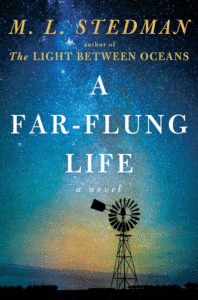
“About a child of mysterious parentage; and it too is a book in which a lot of awful things happen. Think of it as A Little Life, but with dingoes and willy-willies.
…
Life in their world is hard: Storms and droughts ravage the land; the locals are judgmental at best, at worst vicious and even murderous; the gentle but skittish Pete wrestles with the psychological aftershocks of war. So many terrible things happen that the reader develops a kind of flinch, bracing for the next calamity whenever there is a brief lull in the misery.
The beauty and breadth of the landscape stand in counterpoint to the horrors of the human lives playing out upon it. Stedman describes the everyday elements of station life with graceful accuracy.
…
What separates great literature from cheap melodrama is not the grief the story contains, but whether the writing has earned it. Stedman lands every blow thanks to her patient accumulation of ordinary life, the shearing and mustering and fence-mending, the slow mapping of relationships that ensures each loss registers as something more than plot machinery.
A Far-Flung Life makes the argument that a family is not defined by bloodline or by the catastrophes visited upon it, but by the daily, dogged work of holding itself together.”
–Alex Preston on M. L. Stedman’s A Far-Flung Life (The New York Times Book Review)
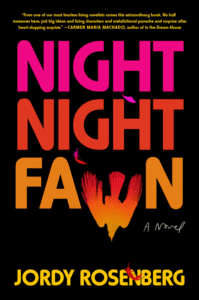
“Not since Jeannette Winterson’s memoir Why Be Happy When You Could Be Normal (2011) have I read such a blistering—or satisfying—indictment of a queerphobic parent. Rosenberg’s Night Night Fawn is all the more audacious for assuming that parent’s point of view. (As the author has made clear in a Q and A at the back of the advanced review copy, Barbara closely resembles and is named after his late mother.) The result is exultantly brazen, a zinger of a novel: equal parts reckoning and memorial and pained, bitter laugh.
…
Rosenberg is a scholar of eighteenth-century literature and gender and sexuality studies as well as a fiction writer, and his novel’s pleasures are enriched by the studied, historically grounded quality of his characters and style.
…
To ventriloquize one’s parent is a bold move, and fictitious Barbara would absolutely read it as a betrayal. At the same time, it’s an intimate gesture to hold someone so close. Rosenberg’s affection for this character and her sharply observant, often brutally frank voice is evident, and he frequently plays the clashing perspectives for laughs.”
–Megan Milks on Jordy Rosenberg’s Night Night Fawn (4Columns)
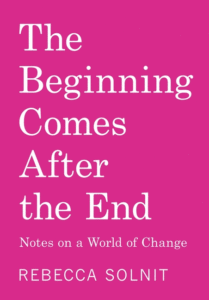
“The nonstop news cycle that now envelops us claims many casualties. Attention spans are waning. So is patience. And let’s not forget historical context, or the knowledge that nothing unfolds in a vacuum, and anything that seems to have happened overnight is in fact a work of progress, moving forward at an often glacial pace.
This is cause for hope for Rebecca Solnit, author of the slim but powerful The Beginning Comes After the End, Not the Pollyanna, “It’s all going to be OK” hope, but an optimism born of perspective. For Solnit, a prolific essayist, author, and activist who is very much concerned about the current direction of the country and the world, the positive advances of recent history hold promise for fighting our way out of the mire. Hate, division, and authoritarianism aren’t new enemies. And studying the past can reveal hard-earned triumphs to go with the dire precedents.
…
The falling apart part is crucial. That’s where we are now. But it’s really where we always are, in the midst of a process we can’t see because we’re too close. Exploring various advances toward a more equitable, sustainable world, from civil rights movements to ecological awareness, Solnit turns to another nature metaphor: the spreading of seeds.
…
Solnit’s argument conveys an idea that might seem paradoxical: radical gradualism. Which isn’t the same as insisting that everything (or anything) will get better on its own, or that all is fine or normal: “I’ve encountered, often enough and then some, the habit of turning my ‘some things are good’ and ’some things got better’ into ‘she said everything is good and everything is better but it’s not.’” Solnit would be the first to insist that the work is never finished. On the other hand, it also deserves to be recognized, if only to keep us moving forward.”
–Chris Vognar on Rebecca Solnit’s The Beginning Comes After the End (The Boston Globe)
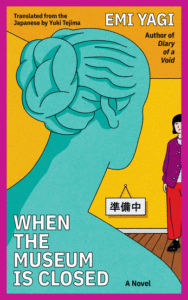
“Its protagonist, Rika Horauchi, has a new part-time job. The nature of this job is fantastical to readers, but Yagi wastes no time on exposition; she simply drops us into a world that is half fairy tale, half workplace mundanity. Rika spends most of her days toiling in a frozen-foods warehouse, but her new gig is in a museum, where she has been hired to make conversation, in Latin, with an ancient Roman statue of the goddess Venus. Her efforts as Venus’ conversation partner are described with the same deadpan matter-of-factness as Rika’s warehouse job, making the latter seem just as strange and unrealistic as the former—and vice versa.
…
As Rika has more and more encounters with Venus at the museum, she allows herself to grow close to her unlikely companion. Her protective layer thins; outside of work, she slowly develops bonds with her neighbors, an old woman and a perceptive, neglected child. Rika also allows herself to embrace her own desires, getting brightly colored highlights in her hair. She begins to feel the stirrings of physical yearning, as Venus asks her to consider her own experience and needs for the first time.
The frisson of attraction is palpable from their first meeting, when Venus insists that Rika receive a chair that’s the right size, a fuss that attention-shy Rika would never have made herself. The marble statue, who has had centuries to ponder her own desires and discomforts, must retrain the woman to put herself first.
…
The world of Venus and Rika, though, is vague. They talk in an unnamed museum in an unnamed city. Venus is amusingly casual and surprisingly more street-smart than Rika, despite her centuries-long captivity; beyond the shock of her attitude, though, we learn very little about her. One might think that an ancient living statue might be the most interesting character in this story, but we never discover what motivates her, beyond a clichéd desire to get out and see the world. The novel’s villain is the handsome male curator Hashibami, who wants Venus for himself; a consummate collector, he thinks of female beauty as something that can be revealed and perfected only by the male gaze. Hashibami, who we find out lives in the museum, seems to want both to possess Venus’ timeless beauty and to embody it himself. There’s a rich commonality between him and Venus that could be explored here—who’s manipulating Rika more? But the novel ultimately retreats from these complicating questions. The final message is a little too clear; the fairy-tale setting makes the fairy-tale plot too easy.”
–Sarah Chihaya on Emi Yagi’s When the Museum is Closed (The New Yorker)
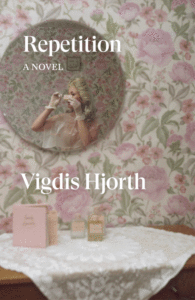
“Hjorth has been returning to this material for more than two decades, offering different perspectives on the constellation of prodigal daughter, ambivalent siblings, convention-bound mother, and tyrannical father. Her novels have ranged over different parts of the timeline, some focusing on a limited period of months or years, others pulling back to tell the whole thing. It’s as if she’s asking: Where is the story? What is the best way to tell it? In a sense, Hjorth’s narrators did not experience the crucial events of their lives in chronological order.
…
On its own, Repetition is an oblique, somewhat cryptic work. The settling of debts between the older narrator—with all her riches of knowledge, irony, independence, experience, and distinction—and her defenseless younger self has the feel of a private project. But considered as part of Hjorth’s body of work on the story of family abuse, Repetition offers her most sustained attempt to imagine the parents’ morally compromised existence.
…
The narrator has reached the limit of what she can know about her parents. And perhaps that Hjorth, too, has reached the limit of what she can tell us about this family from the perspective of the wronged daughter. There is something a bit strained about this iteration of the family story: the air is thin around the old couple in their chairs.”
–Elaine Blair on Vigdis Hjorth’s Repetition (Harper’s Magazine)

Book Marks
Visit Book Marks, Lit Hub's home for book reviews, at https://bookmarks.reviews/ or on social media at @bookmarksreads.