5 Book Reviews You Need to Read This Week
“A portrait emerges of an artist with a vision, a distinctive way of seeing the world.”
Our quintet of quality reviews this week includes Katy Waldman on Daniel Poppick’s The Copywriter, Tommy Orange on Patmeena Sabit’s Good People, Madison Mainwaring on Marisa Meltzer’s It Girl, Paul Grimstad on Michael Lentz’s Schattenfroh, and Rebecca Ruth Gould on Edward Said’s Representations of the Intellectual.
Brought to you by Book Marks, Lit Hub’s home for book reviews.
*
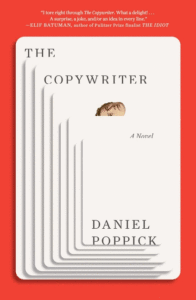
“Looming over the novel is a question: can this existence—this openhearted, roguish, aimless scavenging—yield anything of value, or is it just a waste?
…
“But the book more properly invokes a different tradition, that of office fiction, whose subject has always been the pressure and pain experienced by creative minds as they’re warped under conditions of mechanization or depersonalization. It’s a genre littered with broken coffee machines, surreal personnel interactions, and soul-withering software tools; the vibe is project management with a side of ego death. D__ belongs to an arcade of alienation that includes Joseph Heller’s mid-level ad exec in Something Happened (1974), the beleaguered paper pushers of Joshua Ferris’s Then We Came to the End (2007), and the virtuosically bored I.R.S. agents in David Foster Wallace’s The Pale King (2011)—white-collar workers who use their verbal facility to make nothing happen, day after day, until they retire or expire into a bigger nothing. The advantage of having a narrator with a poetic disposition is that he can tune in to the metaphysical dimension of this everyday suffering, articulating it with a metrical precision.
…
“Some actions, the book implies, might cut you off from poetry. (In the course of his copywriting career, D__ is asked to craft language advertising a lecture by a war criminal; borrowing a phrase from Bartleby, he refuses.) But plying a bullshit job need not be one of them. In fact, Poppick seems determined to prove that submerging yourself in the inanity of the grindset can pay creative dividends. One of The Copywriter’s most moving aspects is its expansive definition of poetry, which admits bureaucratese and launch-party banter and could theoretically apply to any part of life. D__’s copywriting struck me, at times, as genuinely transcendent…”
–Katy Waldman on Daniel Poppick’s The Copywriter (The New Yorker)
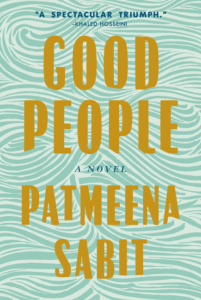
“Writing with the austere precision of a master of the domestic interior, Sabit has constructed a narrative that functions as a trial where the defendants—the Sharaf family—are never allowed to take the stand in their own defense. Early on, we understand that a body has been found in a canal. It is a moment of immense, quiet violence that sets the plot in motion. Sabit, however, makes the radical choice to keep the Sharafs at a distance. The story is told through a polyphony of outsiders—neighbors, business associates, schoolteachers, reporters. It is a chorus of ‘good people’ whose observations, colored by their own smallness and prejudices, slowly assemble a portrait of a family they never truly knew.
…
“At the heart of this storm of voices is Zorah. By keeping her silent and her motivations filtered through the memories of others, Sabit elevates her to a tragic figure of immense proportions. We see her through a prismatic view, from the gas station attendant who meets her for a moment to the family attorney. One is reminded of the way a house is viewed from a moving car—vividly clear yet entirely unreachable. This is a mystery that isn’t meant to be solved in the way of true crime. In our not so brave and not so new world, everyone knows everything and says nothing. Sabit also speaks voluminously about the impossible burden and loneliness of the second-generation experience. There is a profound sadness in the way the ‘good people’ here settle on a version of truth that satisfies their own worldview.
…
“Good People is a work of significant moral heft. Sabit has written a book that is as much about the act of seeing as it is about the person being seen. It is a haunting, beautifully controlled exploration of what happens when the life you have built is dismantled by the very people you hoped would call you a friend. And in its final pages, the story leaves us with a silence that is far more devastating than anything a documentary or a thriller or another kind of oral history might have included.
We are living through a particularly intense, brutal time of not seeming to agree or even understand collectively as a country what it means to be an American, what it means to belong to a people who weren’t born here, or whose ancestors weren’t born here. I believe we need literature to help give language to the many nuances lost in headlines, in social media posts and in political rhetoric that always seems to miss how we all belong to one another, to this experience of being human.”
–Tommy Orange on Patmeena Sabit’s Good People (The New York Times Book Review)
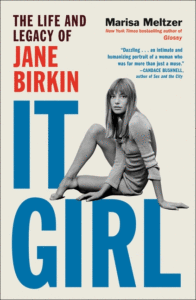
“As the muse of muses, Birkin was still being used to make a point, even in this reconsideration of the gendered power dynamics of art-making. It is easy to say she was voiceless, powerless, and left no trace; it means you don’t have to do your homework and try to look for her and what she wrote and thought about the subject.
In It Girl, Meltzer went ahead and did this…Her performances, taken separately, as they often are, seem to be the haphazard result of good timing and talented collaborators. But in Meltzer’s telling, a portrait emerges of an artist with a vision, a distinctive way of seeing the world. Birkin’s genius was in her life and in her actions just as much as in her look. It’s the reason why her cool translates across time; why we continue to exclaim over the way she wore her T-shirts and always looked a little messy, a little undone. Her daughter Lou Doillon described it as ‘total freedom, and a freedom that does not care about the judgments of others.’ The fact that Doillon was talking about her mother’s decisions with her family rather than her wardrobe goes to show that Birkin insisted on such liberty on many fronts.
I thus disagree with Meltzer’s pronouncement that ‘we can dress like her,’ or even the idea that Birkin makes Frenchness accessible to the outsider, given her transplant status from Britain and her penchant for ready-to-wear. Copy her clothes as you will, you cannot replicate her style. She does not inspire an exact following of her outfits, but rather the identification of the structures that let you live, just as she found them for herself.
…
“…however much of Birkin’s success depended on a cocktail of privilege and childhood wounds, she was refreshingly unique, in a way that’s difficult to approximate today. She did not formulate her image to maximize clicks and likes and engagement. She never shaped her persona to game an algorithm. Yes, we see her through the eyes of the men who photographed and wrote for her, and this dynamic was unquestionably exploited behind the scenes. Yet when she looks at us, her gaze still feels relational, intimate, as if she is seeing, responding, engaging with someone, rather than an abstraction of what an audience might want. While the death of the muse and reciprocal rise of the influencer have made certain gains for feminism, there are nevertheless losses in this trade, ones less easily determined than the question of who holds the camera.”
–Madison Mainwaring on Marisa Meltzer’s It Girl: The Life and Legacy of Jane Birkin (The New Republic)

“There is an especially gnarly chapter more than halfway through Ulysses called the ‘Oxen of the Sun’ in which Joyce’s weirdly adversarial virtuosity takes the form of a pastiche of the evolution of English prose, which is at the same time an allegory of the nine months of fetal gestation (the chapter is set in a maternity hospital). It is mostly a slog, but it is an exhilarating slog. As you hack your way through Joyce ‘doing’ Malory and Bunyan and Swift and Pepys and Defoe and Sterne and Goldsmith and Burke and Gibbon and Lamb and De Quincey and Carlyle and Pater, and on up to ‘Irish, Bowery slang and broken doggerel,’ a part of your reading mind succumbs to a serenely disbelieving loop: He did this. He did this. If ‘Oxen’ occupies a region of Ulysses where Joyce’s exquisite ear for memorably musical sentences (‘Mild fire of wine kindled his veins’) takes a back seat to the leaden hum of meta-literature, that is no reason not to be awed by his chutzpah. Michael Lentz’s Schattenfroh—rendered heroically from German into English by Max Lawton—lives mostly on the nether side of the line Joyce crossed in ‘Oxen.’
At one thousand pages it is almost by definition a slog. It can be considered in a lineage of similarly demanding tomes that push playful modernist experiment into a region that might be called ‘impossible’: i.e., the excruciatingly self-involved later Joyce of Finnegans Wake and strange lesser-known works of maximally perverse obscurantism like Arno Schmidt’s Bottom’s Dream. Some authors of quasi-impossible books like Nabokov (Ada, or Ardor), Pynchon (Gravity’s Rainbow) and Wallace (Infinite Jest) nevertheless manage to write unfailingly entertaining sentences that never lose a certain vernacular crackle, and that are often funny.
This is not quite Lentz’s mode. Schattenfroh is mostly humorless, or is of such a recondite species of humor that it elicits not so much laughter as an invitation to puzzle out some multi-leveled, intra-literary riddle. Most pages exude that unnerving queasiness which results from seeing a worrying lack of paragraph breaks in the foreseeable near future. The sentence music is generally less hooky-melodic (see Joyce’s mild fire above) and more rebarbative/para-academic: ‘working through means dispelling any and all doubts by toggling any possible opposing positions back and forth for so long that they come to be mentally pulverized.’ So runs a typical sentence in Schattenfroh, as the bristlingly Latinate precariously appends two subordinate clauses, and leaves not so much a pleasant ring in the ear as a strenuous grinding of gears.
…
“While all of this is in some way satisfying for anyone who cares about modernism and modernist aesthetics, there is something basically broken about Schattenfroh. I don’t mean broken in an aesthetically volatile and deliberate way, but broken in its approach, in its very thinking. More than just a thousand pages of structurally opaque innuendo, the (perhaps occasionally alluring) incoherence of Schattenfroh is, I think, an unconscious response to an increasingly diffuse literary ecosystem, as if Literature-with-a-capital-L were beginning to cannibalize itself in sputtering paroxysms of half-baked invention which, in the end, didn’t mean or even do very much. What if the patience-trying, stultifyingly protracted, relentlessly abstract Schattenfroh was (once the prestige reek of ‘literature in translation’ were scrubbed off it) just a vivid sociocultural symptom wherein the Big Difficult Modernist novel is having an existential flip out and perhaps not of a controlled philosophical kind?”
–Paul Grimstad on Michael Lentz’s Schattenfroh (The Baffler)
“What is the task of the intellectual at a time when, at the heart of liberal democracies, genocide is normalized and protest suppressed? How can we heed the voices of intellectuals such as Refaat Alareer, martyred in a targeted Israeli air strike on December 6, 2023, and Gazan poet Saleem Al-Naffar, killed the following day? How do we continue the work of Omar Harb, who died of starvation during the Gaza famine on September 4, 2025? Before she was targeted and killed in an Israeli strike on April 16, 2025, photojournalist Fatma Hassouna addressed a demand to the living: ‘If I die, […] I want a death that the world will hear, an impact that will remain through time, and a timeless image that cannot be buried by time or place.’ If being an intellectual means, in part, carrying forward the legacy of those who died in pursuit of our vocation, what obligations does their systematic annihilation impose on us now?
To answer this question, it is instructive to turn to the work of one of the most prominent public intellectuals of the past half century: the late Edward Said, whose books are currently being reissued by the UK-based publisher Fitzcarraldo Editions. Said knew that intellectuals must be willing to immerse themselves in the spirit of a movement larger than themselves, must be willing to speak as part of a collective, especially when that collective stands up for the voices of the oppressed. Yet they must also be willing to act alone, without reward or recognition, their only satisfaction being the knowledge that they are speaking inconvenient truths. Intellectuals must be ready for the moment when their radical commitment to the cause of truth leads to isolation, unpopularity, and widespread condemnation.
…
“In selecting Representations of the Intellectual—along with Said’s 1979 book The Question of Palestine—to reissue in new critical editions, Fitzcarraldo has chosen wisely. The Question of Palestine was the first book by a mainstream US publisher to put Palestine at the center of public debate. Fifteen years later, Representations of the Intellectual was the first book to reflect in general terms on the task of the intellectual from an explicitly Palestinian perspective. Both books were landmark works in the context of their times, and both have much to teach us today. The conditions Said diagnosed have never left us, and the ongoing genocide in Gaza has brought the relevance of his work into even sharper relief.
…
“Said insists that the intellectual’s task is not reconciliation with power but friction against it. Gaza names the moment when the mandate of the oppositional intellectual can no longer be deferred, aestheticized, or selectively applied. The annihilation of an entire intellectual class; the destruction of Palestinian education; the targeting of teachers, students, archives, and universities; and the criminalization of Palestine solidarity expose not only the brutality of the settler-colonial state but also the bankruptcy of the liberal institutions that claim to safeguard knowledge while facilitating its erasure. At this historical juncture, the question is no longer whether the intellectual can afford to speak out, but whether silence is itself complicity.”
–Rebecca Ruth Gould on Edward Said’s Representations of the Intellectual (Los Angeles Review of Books)

Book Marks
Visit Book Marks, Lit Hub's home for book reviews, at https://bookmarks.reviews/ or on social media at @bookmarksreads.