5 Book Reviews You Need to Read This Week
“There is a sense, in this biography, of him tending his own flame while attempting to urinate upon it at the same time.”
Our quintet of quality reviews this week includes Becca Rothfeld on Olivia Nuzzi’s American Canto, Dwight Garner on Ted Geltner’s Flagrant, Self-Destructive Gestures, Laura Miller on Maggie Nelson’s The Slicks, Hillary Kelly on Hans Fallada’s Every Man Dies Alone, and Rachel Syme on Carla Kaplan’s Troublemaker.
Brought to you by Book Marks, Lit Hub’s home for book reviews.
*
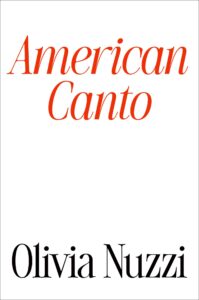
“Ethically speaking, Nuzzi’s journalistic breach was grave: She had compromised her reporting by becoming intimately involved with a subject and a source. But as a piece of human drama, her lapse was gripping. In the hands of a writer willing to submit to the harsh discipline of humiliation, a crisis can be an opportunity—not for anything as facile and self-serving as PR rehabilitation but for a reckoning with our depths and depravities. And was this ever a crisis! Was it ever depraved! Has it yielded a commensurate masterpiece?
American Canto, Nuzzi’s much-anticipated attempt to write her way out of a reputational pit, is a scramble of fragments. Many of them are about the larger-than-life gaucherie of the Trump era, which Nuzzi has been covering with flair since it began; some are about manta rays, microplastics and other phenomena that she vaguely positions as symbolically potent; still others are quotations from sources as varied as Leonard Cohen and Carl Jung. And of course, there is plenty of coloratura about Nuzzi’s present situation—which, while she was writing, appears to have involved languishing on various modest hikes around Los Angeles as the wildfires bore down on the city. ‘The Politician,’ as she refers to Kennedy throughout, makes only brief appearances, often in sections that are so elliptical that anyone who was not already familiar with the story would find them unintelligible.
…
“A public hungry for scandal might be more satisfied if American Canto were uniformly excellent or uniformly terrible. But in our unsatisfying reality, it is what most debut books are: highly uneven and largely forgettable. To be sure, vast swaths of it are impressively and aggressively awful . . . But at its worst, Nuzzi’s prose is not just stilted or repetitive. It is ostentatiously mannered, itching at every turn to announce its showy lyricism. It reads like a Joan Didion pastiche—but it is worried and overworked in a way that Didion, a master of taut precision, would never have countenanced.
…
“A book that consisted solely of impressionistic dispatches from 10 years of reporting on Trump would have been good, perhaps even great, but it would also have been less splashy. It would not have occasioned a fawning New York Times profile or given rise to breathless speculation in innumerable group chats. And yet the gossip that is ostensibly this book’s chief selling point is scarcely in evidence. The few bombshells it contains are feeble.
…
“Good literature and good gossip have in common that they are both savagely and mortifyingly honest. They plumb the depths and reveal the sordid details. They don’t save face; they rip it off to expose the raw venation beneath. But as Philip Roth once wrote in American Pastoral, a better book about this country, ‘All that rose to the surface was more surface.’ Beneath posturing there is only more posturing. And in all that posturing, not one glimpse of the worm that crawled into Olivia Nuzzi’s brain and made her fall so ravenously in love.
–Becca Rothfeld on Olivia Nuzzi’s American Canto (The Washington Post)

“Jesus’ Son—the title comes from a Velvet Underground song—detonated across American letters and has never really stopped detonating. By now we know what people mean when they say that something feels or sounds ‘like a Denis Johnson story.’ There will be hard times and bad luck and bleak surroundings and beautiful losers, nursing chronic hurts, with a narrow shot at redemption. As his would-be imitators would discover, there was also something extra, something you can’t pick up at a writer’s workshop. ‘Collect and squirrel away in your soul certain odd moments when the Mystery winks at you,’ Johnson once advised. His stories were pinned together by such moments, of the sort not everyone can A) recognize or B) wrestle onto the page.
…
“Geltner’s biography, the first to be written of Johnson, is a mixed bag. It lacks the confidence, fluidity and insight of his previous book, Blood, Bone and Marrow (2016), a biography of Harry Crews. There is something tentative here. A certain amount of critical texture is absent. But he captures Johnson’s lonely intelligence and gets the story told. It’s hardly uninteresting. Geltner pays attention to the working artist—a cynic might use the word ‘careerist’—behind Johnson’s seemingly wayward path through the world. ‘You’re only hanging out with us so you can write about us later, aren’t you?’ one regular at the Vine asked. And indeed, Johnson had a book deal in his pocket.
Later, when he was teaching writing in Arizona’s Florence State Prison, an inmate asked, ‘I wonder, did you take the job here in order to learn about prison?’ Johnson was soaking up material he would use in his 1983 novel Angels. Johnson seemed to know he was special. (He bragged to a girlfriend that his I.Q. was 162.) He had a sense of vocation. ‘To write a short story you have to be able to stay up all night,’ Lorrie Moore wrote, and Johnson could. There is a sense, in this biography, of him tending his own flame while attempting to urinate upon it at the same time.”
–Dwight Garner on Ted Geltner’s Flagrant, Self-Destructive Gestures: A Biography of Denis Johnson (The New York Times)
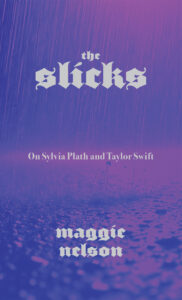
“The problem with intellectual fashion is that you can fall out of it so easily. For Maggie Nelson—whose much-praised 2015 memoir The Argonauts captured a particular flavor of highly personal/political writing in the mid-2010s—such shifts must be disorienting…Nelson was frank, idealistic, and decidedly earnest, a trait she shared with, say, Lin-Manuel Miranda, a figure adulated during the same period who suddenly and drastically became cringe as the Obama years lurched into the Trump era.
It’s impossible not to recall 2015 when reading Nelson’s latest, The Slicks, a very slim volume—more of a long essay, really—about Taylor Swift and Sylvia Plath. In essence, the book argues that both Swift and Plath have been stigmatized for being excessive, for producing too much work that is too much about themselves, and wanting too much acclaim for it, qualities that Nelson maintains are unfairly reviled in women artists. She complains that both women have been subject to ‘the same script that has greeted female profusion, personalism, and ambition literally for millennia,’ a script that consists of the ‘rote shaming of making the personal public; calls for the artist to look outside herself for subject matter; charges of her vulnerability being faux, or deployed as a manipulative marketing tool; tongue-clucks about self-indulgence and being “in need of an editor.” ‘
…
“It turns out that The Slicks seems to have been inspired by precisely three New York Times items: a review of Swift’s 2024 album The Tortured Poets Department, a podcast in which three critics discuss the album, and an op-ed by columnist Ross Douthat, who is not a critic but a father who spends a lot of time listening to Swift while driving his ‘tween-age daughters’ around and wishes Swift would occasionally write about something besides herself. None of these are quoted at any length in The Slicks, and Nelson describes the first two as simply the institutional pronouncements of ‘the New York Times,’ rather than naming the people, both women, who voiced them. The Times may still be the paper of record, but this seems a pretty slender hook on which to hang a book-length essay.
…
“Nelson sees some profound connection between these two women—specifically in the unfair way she feels their work is regarded—but in the end fails to convincingly demonstrate it. One peril in writing about what ‘people’ are saying about an artist is that each of us swims in a different soup of party conversations, social media posts, online articles, comment threads, and classroom discussions. Maybe Nelson has been surrounded by Swift and Plath haters. I haven’t. Way back in my antediluvian undergraduate days, Plath was spoken of by my professors—male and female—with the utmost respect. Many of my friends adore Swift, and the rest pay no attention to her. The only evidence Nelson offers for the pervasive biases against Swift turns out to be both tenuous and disingenuously presented. She leans way too hard on a presumption of gendered disgruntlement that hasn’t prevailed in a decade. I may not care about Taylor Swift, but I do care about good criticism, and The Slicks isn’t that.”
–Laura Miller on Maggie Nelson’s The Slicks: On Sylvia Plath and Taylor Swift (Slate)
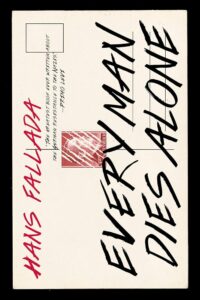
“The Quangels’ dream of overthrowing the regime from within gives Every Man Dies Alone an inspirational core. Lauded for its portrayal of defiance—Primo Levi called it ‘the greatest book ever written about German resistance to the Nazis’—it was celebrated anew in 2009 with the arrival, finally, of an English translation by Michael Hofmann, accompanied by biographical and critical commentary in an afterword by the scholar Geoff Wilkes. Fallada’s examination of a social microcosm—one apartment building’s residents in 1940s Berlin—spreads out to encompass the whole city. Capturing both the upright and the compromised, the forceful and the reluctant, the novel becomes a nuanced portrait of the sometimes corrosive, sometimes energizing nature of fear. As Wilkes underscores, Every Man Dies Alone excels at describing something far subtler and harder to discern than staunch resistance: the plight of ordinary Germans at the moment of their greatest moral trial. How, in a climate of absolute fear, do people weigh the decision between rebellion and accommodation? How do they hold on to a sense of decency but also stay alive?
…
“What makes Every Man Dies Alone so compelling, and unsettling, is its demonstration that an oppressive political sphere works in deeply personal ways. Interactions with the state do not have foregone conclusions—citizens still operate as individuals and make impulsive, sometimes self-sabotaging decisions. Nowhere is that more evident than in the case of Inspector Escherich, the Gestapo agent tasked with finding the writer of the postcards. A former police detective who carries on with his work for the German state simply because he is ‘a lover of the chase,’ he comes to life more fully than any other character in the novel.
…
“The German authorities relied on terror, even toward party members, to keep their citizenry in line. But where they erred, as Fallada writes, was in “the assumption that all Germans were cowards.” No German freedom fighters brought down the government, no anti-propaganda mission persuaded the people to rise up en masse against their tyrants; it took a world war to knock Hitler from his perch. Yet some Germans, Fallada shows, found ways to surmount their fear and assert their moral integrity in acts of dissidence, even if they could not topple the regime.
Every Man Dies Alone is more than an engrossing cat-and-mouse tale. Tracking the interior dodging and weaving of his characters too, Fallada delivers valuable insight into the varieties of mental resistance to autocracy. The quietest kinds of opposition—what we read, what we think, what we believe—can keep autocrats paranoid, distrustful, ill at ease. Rising above cowardice can inoculate us against complicity, as some German citizens showed. And speaking out, even surreptitiously and unsuccessfully, stands in stark contrast to remaining silent. As a young woman explains to Otto before he begins his postcard counterattack, “The main thing is that we remain different from them, that we never allow ourselves to be made into them, or start thinking as they do. Even if they conquer the whole world, we must refuse to become Nazis.”
–Hillary Kelly on Hans Fallada’s Every Man Dies Alone (The Atlantic)
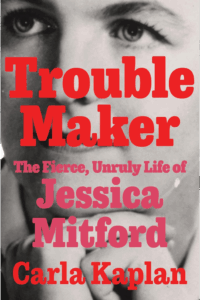
“How could lives so intertwined take such wildly different paths? The question has propelled historians and tabloid journalists alike for decades, to the point that, in her own lifetime, Decca would often joke about the relentlessness of the ‘Mitford industry.’ This year alone has delivered a scripted series (Outrageous, on BritBox) and a graphic biography (Mimi Pond’s Do Admit! The Mitford Sisters and Me), but perhaps the most significant contribution is Troublemaker: The Fierce, Unruly Life of Jessica Mitford, by Carla Kaplan, a professor of literature at Northeastern University. Though Decca’s life has been studied before (notably in Mary S. Lovell’s magisterial 2001 group biography, The Sisters: The Saga of the Mitford Family), Kaplan is devoted to Decca alone, and to separating her crusading accomplishments from the sins of the flock.
It is, as Kaplan notes, an apt time for such a book to emerge, particularly from an American historian. Decca lived in the U.S. from the thirties onward and became a full citizen in 1944; she was an unwavering leftist who fought against the tides of fascism her entire life. In the book’s introduction, Kaplan does a bit of perfunctory hand-wringing about the state of the country, arguing that Decca is a model for how to generate empathy in a time of polarization…Fortunately, Kaplan quickly dispenses with this generic figure of resistance and dives into what made Decca’s radicalism so singular. Decca first developed her leftist ideals not while observing the world but while hidden away from it; she learned about the suffering of the working classes from mail-order socialist literature, which she read eagerly, whiling about in the sprawling family manse. Her politics grew out of puckish sass—a need to trouble the authority of her conservative parents—as much as out of an essential righteousness. Even as she became more educated in her beliefs, escaping, as she wrote, the ‘private Mitford cosmic joke,’ she never abandoned the family appetite for impudence. It was what made her such a dogged journalist and such a scrappy fighter—and it’s what allowed her to bite, with a grin, nearly every hand that fed her, even those that shared her own blood.”
–Rachel Syme on Carla Kaplan’s Troublemaker: The Fierce, Unruly Life of Jessica Mitford (The New Yorker)

Book Marks
Visit Book Marks, Lit Hub's home for book reviews, at https://bookmarks.reviews/ or on social media at @bookmarksreads.