5 Book Reviews You Need to Read This Week
“An ideal celebrity memoir with the added bonus of being written by someone who can actually write.”
Our favorite criticism of the week includes Scaachi Koul on Lena Dunham’s Famesick, Leora Tanenbaum on Rosa Campbell’s The Woman That Taught the World to Orgasm And Then Disappeared, Jennifer Szalai on Quinn Slobodian and Ben Tarnoff’s Muskism, Zack Hatfield on Gwendoline Riley’s The Palm House, and Dan Jones on Antony Beevor’s Rasputin.
Brought to you by Book Marks, Lit Hub’s home for book reviews.
*
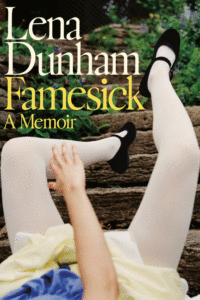
“Famesick is an ideal celebrity memoir with the added bonus of being written by someone who can actually write. Both the memoir and Dunham remain lightly enamored with celebrity, name-dropping just enough…to keep you drooling for more. But it’s also a shocking and funny read, clear-eyed and contextualized, a testament to what made her so interesting in the first place and why her work has always been so compelling. But most importantly, Famesick is an attestation to the value of slowing down, going home, and shutting the fuck up so you have something to say again.
If you’ve hated Dunham this whole time and resented her success, well, good news: Famesick will tell you just how awful all that success made her feel.
…
Dunham is still happy to tell you pretty much everything, with two small exceptions. Even now, she refuses the nepo baby label, arguing that her parents are obscure New York City artists and not television bigwigs who shuffled their untalented daughter to the HBO offices. True, but not entirely honest: When Dunham needed representation in her mid-20s after she pitched Girls, her mother called an old friend to ask for help. The friend was an original founder of United Talent Agency, one of the big three talent agencies in the country. Dunham is unavoidably connected, a city kid with access to people with real connections. Her former babysitter? Zac Posen.
The other gap is from 2017, when one of the writers of Girls was accused of sexually assaulting a 17-year-old girl. Konner and Dunham released a statement defending him, calling the accusations ‘one of the 3 percent of assault cases that are misreported every year. It is a true shame to add to that number, as outside of Hollywood women still struggle to be believed.’ Dunham writes now that, at the time, she was high, hiding an opioid and benzodiazepine addiction, allowing Konner and the other grown-ups in the room to draft much of that response. On this, Dunham is roiling with regret, so deep in her shame that she can’t even tell you what it is she did; you’ll have to Google it yourself.
…
Dunham never fully disappeared; she was always making something, always quietly industrious, and always chipping away at herself here and there in the process. But she has learned to give us less of herself, to keep the pieces for her own use instead of our projection. In leaving, she made more room to come back with a firmer sense of self, less shaken by a sometimes-vicious and sometimes-honest public, and more capable of giving herself the silence that lets her make good art. In returning, she gives us another chance to exercise some compassion, some restraint, and a bit of understanding that we helped make her sick too.”
–Scaachi Koul on Lena Dunham’s Famesick (Slate)
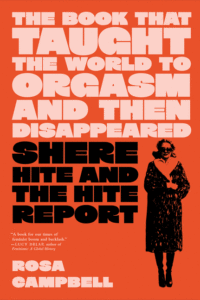
“In Campbell’s narrative, women who experience sexual pleasure owe it all to Shere Hite: ‘Without The Hite Report, there would be no understanding, now common sense, that great sex means pleasure for all involved,’ she writes … [The] problem is that Campbell’s assertion is neither wholly accurate nor fair. Quite ironically, Campbell erases—’disappears’—the pioneering work of Hite’s feminist predecessors and contemporaries.
…
Don’t get me wrong—Hite’s work was staggeringly important and influential. Men as well as women snapped up her books, and the number of copies sold is incredible. She was brave and tenacious and insatiably curious. She absolutely deserves credit for helping to change the dominant conversation about female sexual pleasure and for encouraging women to speak up about their most intimate behaviors. But a feminist historian should have firmly situated Hite’s work as part of a larger movement and cultural wave, where it belongs. By omitting or downgrading the contributions of Hite’s predecessors, Campbell burnishes Hite’s importance, which has the ancillary consequence of achieving the same result for Campbell herself. Indeed, throughout The Book That Taught the World to Orgasm and Then Disappeared, Campbell glamorizes herself, along with her subject.
…
There is something uncomfortable about this level of infatuation in a serious work of historical recovery. It goes beyond admiration for a subject into a kind of merger fantasy that makes it hard to trust Campbell’s critical judgment—and that may help explain why she can’t bring herself to situate Hite within a broader feminist movement rather than above it.”
–Leora Tanenbaum on Rosa Campbell’s The Woman That Taught the World to Orgasm And Then Disappeared (Liber)
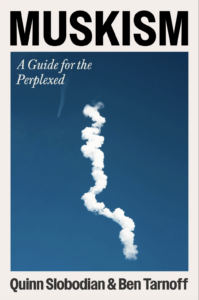
“Begins with a simple proposition. We live in a bewildering moment defined by a bewildering man: Elon Musk.
Not that the book’s authors, Quinn Slobodian and Ben Tarnoff, believe there’s much to be gained by peering into Musk’s soul. Muskism, like Fordism, is not an individual but a system … Musk is the entrepreneur who sells electric cars and satellite service (among other things). Muskism characterizes a new, technologically driven political economy that dismantles state institutions with one hand while promoting self-reliance, or the fantasy of it, with the other.
The ensuing cycle is virtuous for Musk and vicious for almost everyone else. If your self-reliance requires a Tesla charger or Starlink access, you have to plug into infrastructures that Musk owns. Other tech billionaires may want consumers to become entirely reliant on their products, but Musk has been operating on a different scale, helping to sell the idea that the public good is so degraded that consumers can count only on him. Slobodian, a historian, and Tarnoff, a technology writer, note that one of Muskism’s defining traits is this paradox of autonomy and dependency.
…
Another tenet of Muskism is what the authors call ‘financial fabulism.’ This is the mix of soothsaying and realism that entrepreneurs like Musk deploy to raise money for their companies. The idea is to be memorable and inspire confidence. Acquiring Twitter has allowed Musk to further erode the power of traditional media while drawing ‘investors deeper into his reality.’ Even when Musk posts statements that seem asinine or completely unhinged, the authors argue that he is merging with an ecosystem that selects for attention-getting shenanigans — another kind of ‘symbiosis.’
…
It’s a measure of Musk’s cosmic wealth that the unlikely phenomenon of Muskism has gotten this far. Unlike Trumpism, which is inextricably entwined with one man, Muskism — with its uncanny mix of ruthless state power and juvenile memes — is already bigger than its namesake.”
–Jennifer Szalai on Quinn Slobodian and Ben Tarnoff’s Muskism (The New York Times)

“‘Never open a book with weather,’ counseled Elmore Leonard in his famous list of advice for writers (it’s rule number one). Riley, among the best contemporary novelists working today, gets a pass. Her eighth book is a lot like her others: dreary bars; awkward parties; a stoic, rudderless female narrator from the Wirral with a bad mother and a worse father. This one is a delicate and autumnal novel, pared-back yet bristling with quiet tangents, about the mysteries of friendship and what it means to find yourself becoming history. To Laura and Putnam, every street corner seems to evoke a memory from lost youth; even the weather is past tense. Their London is a defective snow globe, aswirl with sepia clouds.
…
Riley’s protagonists bear some resemblance to Faye, the cipher-like narrator of Rachel Cusk’s ‘Outline’ trilogy (2014–18), a saga mostly told through encounters with various strangers. Both writers conjure gimlet-eyed women who keep the reader at arm’s length, and who find themselves captive audiences to people who talk at them, rather than to them. Both writers are considered connoisseurs of ‘cruelty.’ But whereas Cusk’s chatterboxes hold forth in unbroken monologues, Riley’s characters tend to reveal themselves in throwaway scraps of speech, in verbal tics and petulant repetitions
…
A person’s life, as Riley’s prickly realism insists, does not conform to narrative logic, and our pasts—like the ruins of postwar London, or the touristed Old Town of 1990s Dubrovnik—often fail to instruct or map neatly onto our present. Does The Palm House supply a model for elegant survival? Probably not. Riley does, however, give her struggling characters something new, perhaps the cruelest thing she can think of: a happy ending.”
–Zack Hatfield on Gwendoline Riley’s The Palm House (4Columns)
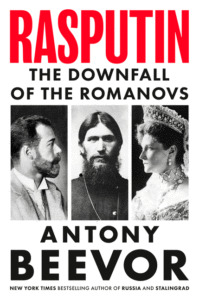
“The story of Rasputin — trickster, womaniser, spiritual hypnotist, destroyer of worlds — feels as familiar as his photograph. In the 110 years since his death he has become a quasi-legendary figure: a Russian Rumpelstiltskin, with his long hair, filthy beard and piercing eyes suggesting an animal libido. Like all stock villains, his cartoon infamy — immortalised in that Boney M song — can make it difficult to address the real historical figure beneath.
In Antony Beevor, however, Rasputin has met his match. Beevor is one of our finest narrative historians, with sharp judgment, a sweet pen and a deep understanding of the world in which he works.
…
Rather than trying to make sense of Rasputin the man — a task as hopeless as trying to catch smoke — Beevor uses him to illuminate the tragic blundering by which he nudged the Romanov dynasty into their graves and Russia into the arms of Bolshevism. He also uses Rasputin to ask two deep historical questions: to what extent can one man change the course of history? And: what happens when a man becomes a myth?
…
Rasputin’s creeping ubiquity in royal life became a serious problem. The more assured he became of the Tsar’s favour, the more brazen his behaviour grew. He was frequently seen out drunk, whoring, fighting and ranting. His spiritual healing methods often involved having women strip naked, to play a game where he resisted the sin of having sex with them, or both gave in to temptation. He boasted of his influence over the royal family, and tried to interfere with policy or have ministers he disliked dismissed.
…
In 1917 the Romanovs were deposed and the following summer the whole family was murdered. Was it Rasputin’s fault? Were they his patsies? Or was he the unwitting vehicle for the self-inflicted moral and political death of the last Russian tsars? These are the matters that pulse beneath Beevor’s beautifully written, clear-eyed biography of a very Russian tragedy. Rasputin is a meditation on history as well as a masterclass in smooth, judicious prose.
But it is also a reminder that history can always happen again. For here is a horribly compelling account of a cynical, manipulative outsider-insider, a morally nauseating sexual predator who made it his business to befriend the rich and powerful, used his connections for ill purpose, and died a controversial death — and whose acquaintance with one of the most powerful men on Earth indirectly contributed to a war. Just imagine living in a world like that.”
–Dan Jones on Antony Beevor’s Rasputin (The Sunday Times)

Book Marks
Visit Book Marks, Lit Hub's home for book reviews, at https://bookmarks.reviews/ or on social media at @bookmarksreads.