5 Book Reviews You Need to Read This Week
“A reverse Lolita tale that dares you to flinch, squeal and/or chuck your book out the window.”
Our quintet of quality reviews this week includes Brittany Newell on Jennette McCurdy’s Half His Age, Walton Muyumba on Heather Ann Thompson’s Fear and Fury, Hamilton Cain on Jeanette Winterson’s One Aladdin Two Lamps, Dwight Garner on Julian Barnes’ Departure(s), and James Cahill 0n Bryan Washington’s Palaver.
Brought to you by Book Marks, Lit Hub’s home for book reviews.
*
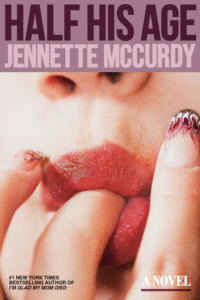
“Half His Age is McCurdy’s first novel, a reverse Lolita tale that dares you to flinch, squeal and/or chuck your book out the window, but ultimately rewards the fearless reader. Though it’s a classic bildungsroman, the reading experience felt more like watching a slasher flick, with me shaking my head and shouting to an empty room: ‘Don’t answer his text! Don’t go to his house! Don’t get your period in his closet!!!’ This is a bold and unapologetic novel for edge-seekers, doom-scrollers, latchkey kids, horn-dogs and all those who love hard.
“What McCurdy does frightfully well is invoke the particular psychosis of teenage girls, the lunacy that would lead a big-boobed wisecracker like Waldo to fall for a sad sack like Mr. Korgy. At the beginning of the novel, I found myself tormented by Waldo’s pursuit of him, by her porn-star cosplay as they boinked in his car … Then again, what is teen girldom if not a manic vacillation between pretend wannabe Jezebel and heat-seeking little animal? I think of that line from The Virgin Suicides uttered by a suicidal tween: ‘Obviously, Doctor … you’ve never been a 13-year-old girl.’ It is this longing, this instability, this hunger to be touched that McCurdy captures so vividly in Waldo. Half His Age becomes a slow burn, edging the reader as we beg Waldo’s prefrontal cortex to develop or, at the very least, for her to see what we see: This dude’s a loser.
…
“Besides the obvious Nabokovian echoes (underage girl/old schmuck), I was reminded of Bret Easton Ellis’s American Psycho while reading. McCurdy brings exacting attention to material things in her book … Sex is, of course, another way we try to be made real, witnessed into fleshliness when we feel like hot air … This is what Half His Age is ultimately about, scandal and sex scenes aside: the dead end of longing, whereby you ask people or things for the love they can’t give you, and how lonely this mismatch can feel.”
–Brittany Newell on Jennette McCurdy’s Half His Age (The New York Times Book Review)

“Fear and Fury moves toward this scene of conflagration slowly, offering portraits of Goetz, New York City and the Bronx, and the Reagan Revolution to reverse the policies of Franklin Roosevelt’s New Deal and Lyndon Johnson’s Great Society. Thompson argues that these reversals were also attacks on the advancements of the civil rights movement. Claiming that Blacks and Latinos were gaining social and economic footing in American life at the expense of white people, Reagan conservatism attracted democrats and republicans alike under the umbrella of white rage.
…
“Importantly, Thompson rejects stereotyping the teens as thuggish stickup kids. Instead, she crafts social, personal, and familial narratives to humanize them. This is especially necessary for Cabey, who, after his interaction with Bernie Goetz, would never be able to fend for himself again.
…
“While the other three would eventually regain physical ability and seek restitution for Goetz’s assault, Darrell Cabey was left paralyzed from the waist down and suffered a prolonged cardiac arrest and coma that damaged his brain and cognitive abilities. One of the most brutal aspects of this book is reading quotations of the hate mail that families of the teens received. Thompson draws lines of intersection from these awful missives to other instances of nightmarish anti-Black violence in the city: the 1983 police killing of Michael Stewart; the October 1984 police killing of Eleanor Bumpurs; the 1989 murder of Yusef Hawkins in Bensonhurst, Queens; and the 1989 case of the Central Park Five.
…
“Though she has painted a sharply accurate contextual picture of 1980s America and shown readers how to see that decade as the seed bed for our current national difficulties, Thompson’s argument that Reagan-era politics ignited white rage seems slightly askew. As Carol Anderson’s White Rage (2016), Brando Simeo Starkey’s Their Accomplices Wore Robes (2025), and Thompson’s own Blood in the Water argue, white rage is a dangerous virus, older than the nation itself, endemic to the US body politic, and always on the verge of breaking out, taking us down, or disappearing us altogether.”
–Walton Muyumba on Heather Ann Thompson’s Fear and Fury: The Reagan Eighties, the Bernie Goetz Shootings, and the Rebirth of White Rage (The Boston Globe)
“To paraphrase the writer Pankaj Mishra, we live in an age of partisan fury stoked by the blue flames (and blue checks) of social media. Online mobs are just a click away, stirring the pot on X and Substack, even in the comments on breaking news. Opinion journalism may be the most influential literary form in the United States, and novelists and poets have taken to mimicking political speech to engage with readers and grow their audiences.
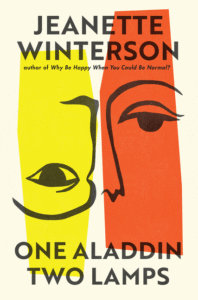
There’s ample polemic in Jeanette Winterson’s genre-bending One Aladdin Two Lamps, channeling her anger at patriarchy in a reimagining of One Thousand and One Nights, which she refers to simply as Nights. Hers is a disquieting book, awash in Jenny Holzer-like slogans, memories of a strict evangelical childhood, stories jigsawed together and sudden, breathtaking insights, all framed by the myth of Shahrazad (known in the West as Scheherazade). Shahrazad, you’ll recall, cheated death by beguiling her husband, the Persian king Shahryar, who had enacted revenge on a deceitful wife by marrying and bedding a series of virgins, then beheading them at dawn. A brilliant storyteller, Shahrazad spun tales all night with cliff-hangers that ensured her survival until the next evening. Shahryar was intrigued. So is Winterson; for her, Shahrazad is a model of feminist genius.
…
One Aladdin Two Lamps contains spectacular genies of its own, particularly when the author follows her intuition. Again and again Winterson surprises us. Her Nights unfold as a series of opinion pieces, with Shahrazad (and Winterson) as columnists advocating for social justice. She links class commentary to Nights, with storytelling a prized commodity not confined to elites but open to all, from every walk of life, an embarrassment of riches.
…
“One Aladdin Two Lamps works best as an interrogation of narrative, from layered plots to fanciful characters to fractured chronologies, the way words harmonize in sentences, answering the question Winterson poses: ‘What If?’ She reminds us that stories not only shape-shift formally; they transfigure us as we move through the world—unseen, organic processes, like cells replaced in our bodies. Winterson insists on airing her grievances, yet it’s her textual acumen that impresses. ‘Reading deeply is not time wasted,’ she notes. ‘Reading is time set apart to get closer to ourselves.’”
–Hamilton Cain on Jeanette Winterson’s One Aladdin Two Lamps (The Washington Post)
“If I were king, or Zohran Mamdani, I’d require that every restaurant in New York City have a lemon table. Julian Barnes wrote about the idea in a short story, ‘The Silence,’ published in 2004. Lemons, he explained, are a symbol of mortality; a lemon table is one where it is ‘permissible—indeed, obligatory—to talk about death.’ In his work, Barnes has presided over such a plain wooden table from the start.
…
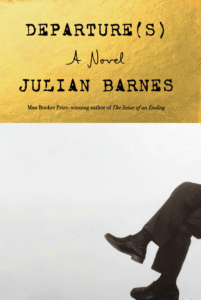
“This briny English writer, author of Flaubert’s Parrot (1984) and a winner of the Booker Prize, for The Sense of an Ending (2011), now has a rare form of blood cancer, treatable but exhausting and uncurable. His new book, Departure(s), he says, is his last. He’s here to write about his illness and to lay some final logs on the fire. This is a slim and stark testament. Barnes’s prose is largely stripped bare—it resembles a tall ship that, in the face of a storm, has taken down and stored its sails and rigging to better endure punishment. Departure(s) brims with wisdom reluctantly acquired. Barnes’s powers of observation and comment may have diminished, but his appetite for playfulness and detail, for bedrock human stuff, remains unslakable…
…
“Peel the dust jacket off Departure(s) and what’s left is a slim, black volume, like a hymnal. Where there was fire, there are now mostly ashes. Every book is, in its way, about memory, but Barnes makes a special effort to interrogate this place where ‘degradation and embellishment overlap.’ There is a good deal about Barnes’s touchstone writer, Proust, and the repercussions of his madeleine … As a culture, we’ve grown cynical at the notion that we are witnessing the ‘last’ of anything—the last tour, the last film and the last episode so rarely are. Still, here’s hoping that Barnes is not yet finished writing. I’d like to meet him, again, at whatever lemon table is available. It was Ali Smith, in her novel Summer, who said it: ‘Whatever age you are, you still die young.’”
–Dwight Garner on Julian Barnes’ Departure(s) (The New York Times)
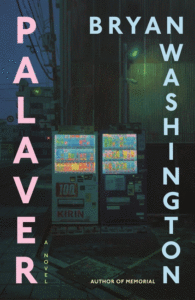
“he title of Bryan Washington’s third novel, Palaver, invokes a historical situation in which two groups without a common language—Portuguese traders and West African natives, say—would enter into a lengthy discussion, fumbling their way towards a negotiation. In this slow-burn story of estrangement and reconciliation, the negotiation is a familial one, the fault lines emotional rather than linguistic.
…
“Washington writes in a realist mode, with an acute attention to the look and feel of a street, a shop window, a meal. His prose is taut and rhythmic, and he excels at capturing both the minute particulars of a given bar or apartment or district, and the numbing vastness of the city. All the same, his decision not to assign names to his principal characters, while initially lending the novel an air of universality, lapses into what feels like a formula for its own sake. The omission seems all the odder as other, named characters begin to populate the narrative. There are subtler blanks besides. One rarely gains a sense of what people look like (beyond the son’s bulky physique and shambling movements, in which the mother ‘caught a flash of her brother’). The characters’ statements to one another are pared-down and pointed, less like naturalistic dialogue than the lines of a stylized stage play.
…
“Palaver often feels insistently unmomentous, its exchanges and episodes like so many missed beats. The pain suffered by the son hovers like a dark spot, giant yet shape-shifting—and never quite revealing itself. (We finally glean the source of his buried trauma, yet his move to Tokyo seems to have a deeper, existential dimension.) Over and over, something of import seems about to happen, before the scene folds in on itself. At times, there is a subtle force to the anticlimax: the son remembers how he went to visit his brother in the penitentiary, sitting there for twenty minutes without the brother showing up. At others, the episode tails off; dialogue subsides into silence, as though by default.
Yet, like the laying of a mosaic, the fragments slowly delineate a larger picture. The stasis of the story’s first half begins, at last, to shift. As the son falls out of an old relationship and into a new one, his moodiness acquires a new pathos—seemingly a symptom of the sheer pain of living rather than a response to any single misfortune. And as her friendship with the bistro owner deepens, the mother grows from being a gnomic visitation into a woman with her own capacity for longing … Palaver, in the end, is the story of two people being re-revealed—both to each other and to themselves.”
–James Cahill on Bryan Washington’s Palaver (Times Literary Supplement)

Book Marks
Visit Book Marks, Lit Hub's home for book reviews, at https://bookmarks.reviews/ or on social media at @bookmarksreads.