3 Ways to Become a Better Reader
Hwang Bo-Reum on Little Ways to Cultivate Your Reading (and Writing) Life
Always Have a Book With You
I read somewhere that authors are voracious readers. I would imagine so. When I read, I also feel the urge to create something of my own. Likewise, I don’t think I’ve ever come across a writer who doesn’t read. Come to think of it, reading and writing are one and the same.
Off the top of my head, I can already think of three similarities. First, unlike TV or video games, you don’t get instant gratification. That’s why you rarely hear of people who get into writing or reading overnight. It takes time. The more we do it, the deeper the joy. Such happiness isn’t a passing shower, but a steady drizzle.
Second, many people talk about wanting to write or read, but not many actually do it. In Wild Mind: Living the Writer’s Life, writer and Zen practitioner Natalie Goldberg talks about how most people spend their entire lives circling around the idea of wanting to write but the difficulty puts them off . And her advice is: just do it. The same applies to reading. Instead of stopping at the thought, turn it into action. Do it.
All you need is a book.
Third, you can read or write anywhere. Of course, some places are more conducive than others, but technically, anywhere is possible. That solves the problem in the second point. All you need is a book. And if you’re writing, a notepad and pen. Even the memo app on your phone will work.
Bring a book and notepad everywhere with you. That way, you can read and write anytime, whenever you are bored or waiting for someone. It takes a while for the habit to settle in, but one day you’ll find yourself feeling oddly unsettled without them.
Having a smartphone and a book with me all the time means I can write and read whenever I want. I like to bring a page-turner out because it keeps me glancing at my bag every now and then, and that makes me extra motivated to read whenever I have a moment. One such book is The Unsocial Sociability by Japanese philosopher Yoshimichi Nakajima.
Nakajima criticizes the unique collectivism of Japanese society. In The Unsocial Sociability, Nakajima references Immanuel Kant’s theories to explore how to extract oneself from societal dependence yet not be completely isolated. The book title itself is a nod to Kant’s theory that it is in human nature to form social connections yet strive for individualism. To those struggling to form social connections, Nakajima has the following advice:
You just need one single bond…A person you can truly trust, a person that rejoices in your existence. If there’s one such person in your life, you’ll be able to keep going.
Just for this moment, allow me to take the liberty to divide people into those who carry a book with them all the time, and those who don’t. People who read, who open their eyes and ears to the words of others, and those who don’t. I hope to always be in the former group. It’s time to head out, and as usual, I’ll be picking my companion for the day.
Bed, Night and Lights
When I’m going on holiday, I always pack a couple of books in my luggage. I do it without fail, despite knowing that I’m not going to follow through my plans of sitting somewhere, soaking in the local vibes and reading leisurely. When I went for a nine-day trip to the Czech Republic, Hungary and Austria, I brought along five books, including the Korean editions of Éloge de la marche by David Le Breton, Like Water for Chocolate by Laura Esquivel and Die Glut by Sándor Márai.
I imagine myself relaxing with a book, just like in a scene from a movie or poster. A beautiful woman reading—was it Do You Like Brahms?—under a parasol at the beach in Bali, or a middle-aged man sitting in an alleyway café near the Eiffel Tower, propping Identity by Milan Kundera on his lap and nursing a cup of coffee as he reads. I imagine him reading over his spectacles; the image feels incomplete otherwise.
How romantic. A person deep in concentration on a book exudes a special energy. A vibe. A certain look in their eyes. As if quiet, intimate changes are blooming in them, and I find that so beautiful. I want to experience that for myself.
Instead of trying to fit myself into a stereotypical image, I’m going to find beauty in my everyday life.
But each time I’m on a holiday, I never end up staying in a single spot for long. I sit down at a café, but less than thirty minutes later I get restless. I stuff the book in my bag and go exploring again, even if it’s just walking down the street. It’s great that I’m soaking in the local vibes, but at the same time, I get a little upset at myself.
I guess I’ll need at least a month or two in Europe for the sights of Prague, Budapest and Vienna to feel like everyday life. Only then will I be able to settle down into a routine and read at a café. But on a short, nine-day holiday, my attention drifts to everything else except the book in my hands.
Or maybe I’m just romanticizing this whole thing. I should stop wallowing in my “failure.”
But that doesn’t mean I’m going to give up. Instead of trying to fit myself into a stereotypical image, I’m going to find beauty in my everyday life.
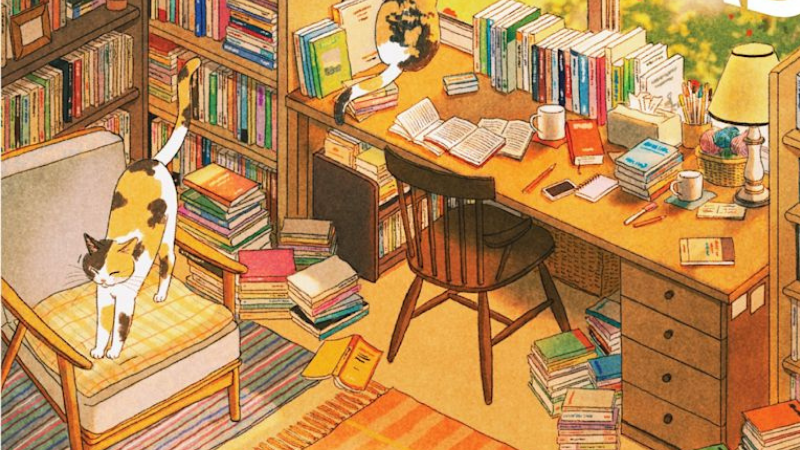
And I do. In my bedroom, at night, accompanied by the warm glow of the bedside lamp. Forget the expensive air ticket, all it cost was a 70,000-won light. In the evening, I wait for the sun to set and, when the sky darkens, I switch on the light. I settle snugly in bed, sinking into my pillows as I flip open a book. Right in my own room, I’ve found the romantic moment I was looking for. I’ve become one with the prose.
I’m now reading Jung Hyeyoon’s Bed and Books. Isn’t that such a romantic title? Every night, I spend some time in its pages, and in that time, I set aside all my responsibilities, societal expectations, and fully embrace my inner romantic. Under the warm glow of the lamp, I smile and turn the page. Whether it’s fatigue, anxiety, worry, anticipation, or anything else, tomorrow, as always, I’m going to replace them all with a book.
Lying in bed with a book and the glow from the bedside lamp, I feel as though I could travel anywhere—any country, city, town, or café. Every night, I get to enjoy my romantic moment. Perhaps I’ve become an inspiration for someone else, just like the woman in Bali and the middle-aged man in Paris were for me, but in this moment, what’s truly important isn’t the vibes, but the fact that I’m reading.
You Don’t Always Have to Finish It
The one book that I’ve attempted to read multiple times only to give up again and again is Umberto Eco’s The Name of the Rose. The long citations in the introduction were enough to put me off, not to mention the words in several languages left untranslated. My eyes simply glazed over the names of people, places and whatnot.
An older female friend—I call her Eonnie—had recommended me the book, and when I told her about giving up, she encouraged me to keep going. “Just get past the first hundred pages and you won’t be able to put it down.” Her words seemed to cast a spell on me and I would pick up the book over and over (only to give up several pages in).
But because everyone around me was raving about the book and the author, I refused to give up so easily. Finally, I got past the hundred-page mark, and just as Eonnie had said, the book was unputdownable. I grew so fond of the Franciscan friar William that for a while, he was my dream guy.
“Just get past the first hundred pages.”
The next time Eonnie said the same thing about a book, it was Walden by Henry David Thoreau. When she told me the book was about living in harmony with nature, I was intrigued, but the hundred-page hurdle proved to be a challenge. When I finally did it, Thoreau and his words took root in my mind, and I still find myself thinking about them every now and then.
Of course, there are also many books that I simply never return to. If I’m no longer curious about what happens next, I won’t hesitate to close a book. No lingering regrets whatsoever. Books and people are the same. Just like how some individuals can connect with us more deeply than others, the same applies to books. Instead of trying to salvage a failing relationship, I’d be better off finding a book I can vibe with.
Fate works in curious ways. A book that you had struggled to get into could end up becoming one of your all-time favorites.
I know some people hate the idea of giving up midway. But by insisting on finishing a book you no longer want to read, you’re taking time away from the books you’re truly interested in. When reading is reduced to a dreaded chore, many people end up distancing themselves from books altogether.
Perseverance is great, but if you find your interest in a book waning, it might not be the right book for you at that point. That said, things change, and so do you, your interests and what you want to read. Who knows? It might be the perfect book next time.
Fate works in curious ways. A book that you had struggled to get into could end up becoming one of your all-time favorites. Walden was that book for me. Each time I reread it, I discover new quotes that I’d overlooked previously, making it a new experience all over again.
In 1845, Thoreau moved to the woods around Walden Pond in Concord, Massachusetts. There he built a cabin, and for the next two years and two months he lived in seclusion, distilling life to its essence. Reading about his life inspired me to think about how I could also escape from the rat race to truly live a life I wanted.
I went to the woods because I wished to live deliberately, to front only the essential facts of life, and see if I could not learn what it had to teach, and not, when I came to die, discover that I had not lived. I did not wish to live what was not life, living is so dear; nor did I wish to practice resignation, unless it was quite necessary. I wanted to live deep and suck out all the marrow of life, to live so sturdily and Spartan-like as to put to rout all that was not life, to cut a broad swath and shave close, to drive life into a corner, and reduce it to its lowest terms.
I respect Thoreau for looking beyond the superficial things in life in search for his ideal way of living, and so I eagerly recommended his books to my friends.
“Sounds great, but that sounds almost like fantasy to me right now. I can’t relate at all,” said a friend.
I replied, “It’s OK. Who knows? It might be the right book next time.”
__________________________________
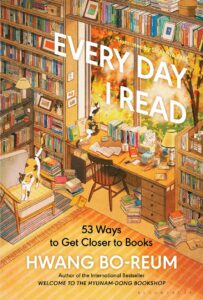
From Every Day I Read: 53 Ways to Get Closer to Books by Hwang Bo-Reum, translated to English by Shanna Tan, on sale December 2nd from Bloomsbury Publishing. Copyright © 2025 by Hwang Bo-Reum. All rights reserved.

Hwang Bo-Reum
Hwang Bo-reum is the author of the international bestseller Welcome to the Hyunam-dong Bookshop and the essay collection Every Day I Read.