Paris. November 2024
Eva called to say she had lost it.
She meant her cat who had gone missing. Eva was my new friend in Paris. We liked not knowing much about each other because there was so much to find out. When I left Paris for a month at the end of July, she had sent a postcard to my London address.
Summer kisses from me and it.
I had to think about who it was but then remembered it was the name of her cat. On the other side of the card Eva had drawn it in a tracksuit and lime-green running shoes holding a flaming torch in the 2024 Paris Olympics. The postcard was addressed to my first name only.
*
We went through all the possibilities of where it might have got to and knocked on the door of every neighbour in her road. Eva lived in a studio in the Rue des Trois Portes, a two-minute walk to the Seine and the Notre-Dame cathedral of Paris. Before it disappeared, she kept her front door ajar on a chain so that no one could barge in when her cat padded down the stairs to the courtyard. Her husband lived in Seattle, America. She had lost him. The cat. It slept on her bed and Eva said its purring sounds were her equivalent of the Christmas lights that would soon be threaded through the trees in our neighbourhood. A week before it went missing, our mutual friend, Fanny, who worked in finance, had renamed Eva’s cat Bob. Fanny wore a belt strapped across her narrow hips, her eyes clear and bright, jewels on her nails, a cigarette often tucked into her belt.
‘I’m sorry, Eva,’ Fanny said. ‘It is doing my head in. From now on it is Bob. We know where we are with Bob.’
‘Where are we then?’ Eva wanted to know.
‘I don’t exactly know,’ she replied. ‘In France Bob would be Rob.’
Fanny seemed barely with us. She was living some kind of parallel life in the erotic altitudes with her most cherished lover, Lucia, one of her three lovers in the month of November. She was the only one in our friendship group who was French. Every day Fanny reminded me to ride my bicycle on the right-hand side of the road, not on the left, also to buy a helmet because I rode on those e-bikes that are hired on a phone. On behalf of her clients, Fanny was keeping a close eye on the American elections which were to take place on 5 November 2024.
*
Eva had trimmed her fringe in the mirror that morning. It was straight, symmetrical, just above her eyebrows. She had inherited her Spanish mother’s black hair and her Danish father’s blue eyes. Everyone went Awww when they looked into Eva’s eyes. She had discovered her favourite cologne (notes of thyme and cedar wood) in a hardware shop on the Rue des Écoles, laid out in its tall retro bottle on the counter alongside limescale remover, cutlery sets and tubes of tile cement. Fanny believes that Eva’s blue eyes have to fight fight fight with the world’s fantasy of endless girlhood and submission, but she’s not sure the industrial cologne is going to help her in this endeavour – though it will see off mosquitoes.
I call her Eva the Fifth because she speaks five languages: Danish, Spanish, French, German and English. She regrets her German is not so fluent, even though she studied at a leading art school in Berlin, so insists I change her title to Eva the Fourth.
*
As far as Eva was concerned her cat was God in every language.
Bob was love. Black fur. White belly, white paws. Right ear smaller than the left. Much smaller. The size of the smallest human toe. Fanny, who was raised Catholic, suggested that God is a judging presence and Bob was not, but Eva confirmed that her cat definitely judged her.
The whole drama, which was a tragedy for Eva, was a relief from writing my essay on Gertrude Stein, about whom I knew too much and nothing at all. Stein had put so much in my way. In the way of understanding. She didn’t believe in it. Sometimes, when I read her baffling and beguiling writing I wanted to smack it in the chops. She longed for readers to find her, yet there was a part of her that could not bear to be found. She was ashamed of her bestselling autobiography because it was so understandable. When I look at photographs of her, I cannot get into her eyes. Sometimes I had to remind myself of the basic facts, so lost was I in the swirl of information about her.
*
Gertrude Stein was born in 1874, Allegheny, Pennsylvania, America. Daughter of German Jewish immigrants. Her father, Daniel Stein, born in Bavaria, arrived in America in 1841 at the age of eighteen to start a clothing business with his brother Solomon. Her mother, Amelia Keyser, daughter of earlier immigrants from Bavaria, was born in America. Daniel would become a wealthy businessman. His youngest child, Gertrude Stein, would become a legend, a leading figure of literary modernism, possibly the only female avant-garde writer in the world to have her name up in lights in Times Square. Writer of novels, plays, poetry, essays, libretti, and collector of the most daring art of the early twentieth century, she also wrote ‘word portraits’ which she hoped resembled the radical visions of Cézanne, Matisse and Picasso. She would be photographed by Man Ray and Cecil Beaton, Picasso would paint her portrait, she would live in France from the age of twenty-nine and die there at the age of seventy-two. Yet Gertrude Stein struggled to be published and only stepped into fame and gloire when she was nearly sixty. She was good friends with a collaborator in the Vichy regime during World War II. Ernest Hemingway described her as having ‘immigrant hair’.
I had lost it. Who was Gertrude Stein?
Immigrant hair. What do words mean?
__________________________________
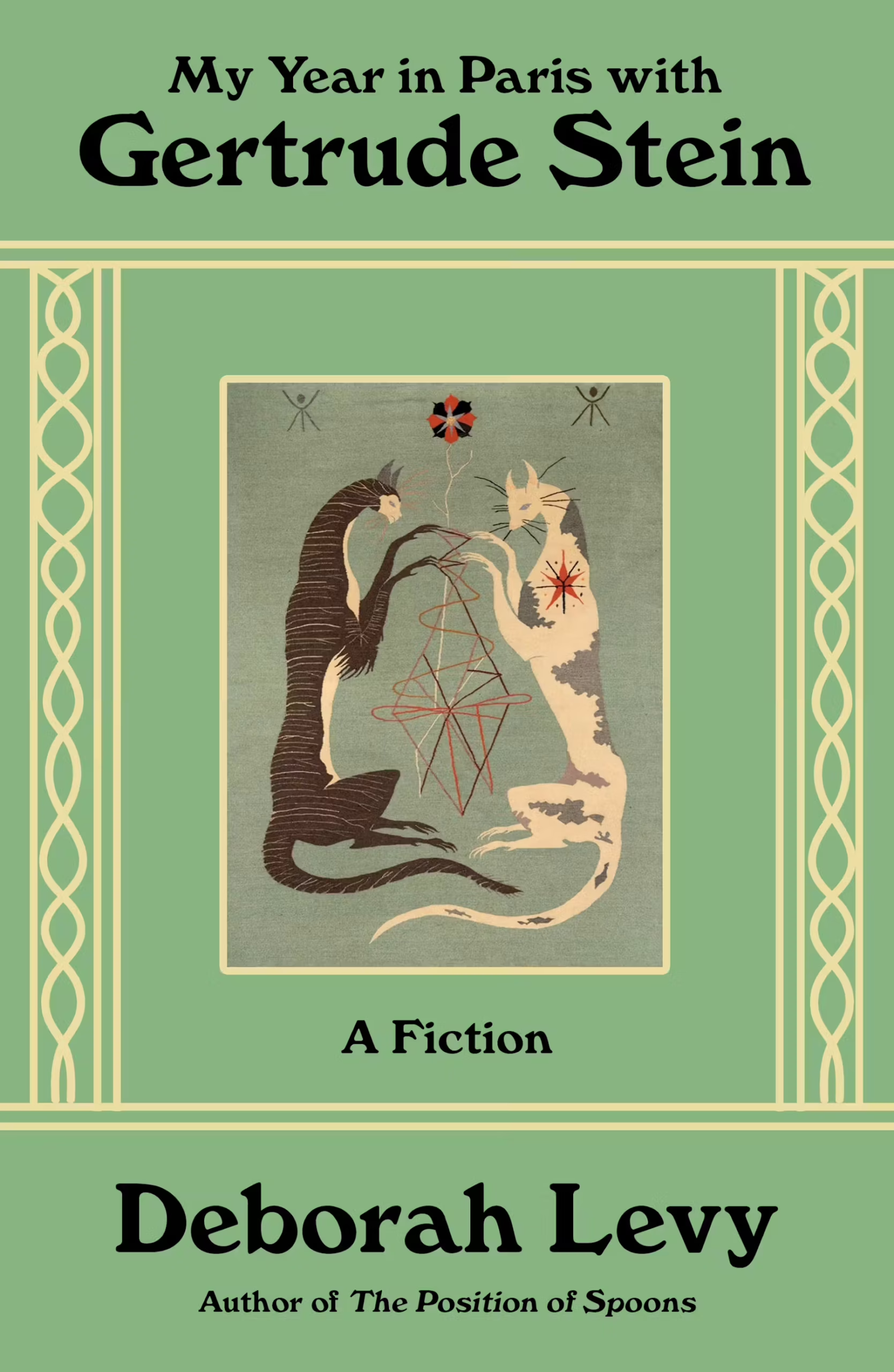
From My Year in Paris with Gertrude Stein by Deborah Levy. Used with permission of the publisher, Farrar, Straus, and Giroux. Copyright © 2026 by Deborah Levy.