Writing Underwater: What Diving Taught Me About Trauma and Creativity
Emeline Atwood on Fear, Recovery and Writing Fiction Based on Lived Experience
Waking up to a home invasion has to be one of the scariest things—opening your eyes, and there’s someone there. A stranger in the doorway. A long-haired man in a backpack, standing over your bed with a machete. The front door wide open and the dog with her hair raised, not even barking, just stunned and staring at a fellow resembling Santa Claus standing in front of the couch with his pants down. What happens next?
These nightmares of men, often with knives, in backpacks or top hats, suddenly inside, have gotten worse since we bought this place last fall. As opposed to past apartments, we sleep on the first floor now, and our house has so many windows that, at three in the morning, nowhere is safe to look—faces could appear anywhere, in the most innocuous shadows drifting behind the panes; there’s so much glass for someone to shatter. Convince me otherwise, but sleeping is always an unsafe thing to do. Even at home, even in your own bed, even with a dog—who’s on watch? The fact that home invasion happens at all vindicates our archaic survival instincts: bedtime anxiety, sleep dread. All very reasonable I think, not at all vestigial. Complacency kills.
I also have a fear of flying, and it also only started developing in the past eight years. Before that, I enjoyed turbulence. I used to roll my eyes at the weaklings whimpering during take-off. Luckily, I’ve been able to explain this fear easily, tracking it back to that last Wednesday in November, my senior year of college, when my grandfather, who lived with us growing up, crashed his Cessna on the way to our family’s Thanksgiving in Vermont. He died upon impact, deep in the trees outside Pittsford.
I’ve since gripped the forearms of many strangers. I’ve made my boyfriend bleed. A mother once held my hand for the entire ninety-minute flight, rubbing my arm and squeezing my shoulder as her child in the window seat played happily on an iPad; but I couldn’t stop crying. When I can manage, I let these people know about Pop, to help explain myself. Unfortunately, my fear has only gotten worse over the years, which I chalk up to getting older: I really want to experience my whole life. It’d be such a bummer to die. I’ve started taking lorazepam.
Scuba-diving and writing are not so dissimilar. When diving, I can be in my body, and also in another body. Writing is the same: you’re in your body, and also in another.
Only recently did I realize that I might be misattributing this fear. I remembered that I had in fact flown several times in the year after my granddad’s death and been fine: to Mexico in March for spring break, then to Europe in May to backpack with friends, then to Australia in September to embark on my postgraduate traveling fellowship, which was to take place at a workaway just outside Gold Coast, in a town called Elanora. I know I didn’t panic on any of those flights because I remember my first attack vividly: it happened minutes after take-off, on the flight I took from Cairns to Koh Samui three weeks after I’d been raped.
I had just completed my Open Water PADI scuba certification and was headed to Thailand to do my divemaster training. The panic attack was so unusual that when it was happening I really believed everyone around me was also freaking out about the plane going down, and only as the panic subsided, thanks to the flight attendants and the seven-year-old boy sitting next to me who offered me his last chicken nugget, did I realize that everyone’s agitation, all their craning around, hadn’t been due to the plane failing but due to the girl, in Row 26, Seat E, who was having a meltdown.
*
There’s nothing quite like waking up to a home invasion. On October 5, 2018, I wrote in a note on my phone: “A strange thing happened last night. I haven’t drank anything since being here, but last night I was in the middle of the Justin Torres novel and that guy who’d arrived offered me a glass of wine. Next thing I know, hours later maybe, I was vomiting and he was having sex with me. He was slapping me in the face and slapping me on the butt and I was saying no no no. Then I fell asleep. When I woke up again, I wanted to leave right away. I was so sad I thought I might throw myself off the cliff.
Every time I tried to leave the bed, he yanked me down and I actually feel grateful to him because he was keeping me from going off the cliff. I was twitching in the bed like a leaf I was so frightened. He was laughing at something. When I finally got away, I went to the bathroom and looked in the mirror and it was the ugliest thing I’d ever seen. At first, I was thinking I would tell Allie and Livvie, but now I think I’ll tell no one ever. I don’t know what to do. I could tell my mom, but that makes me want to die. Also, it’s raining right now. A bird is growling at me. I think I feel bad for the guy.”
I didn’t know it then—well, maybe I did—but that note was the first thing I ever wrote of my book, A Real Animal. I think I’d like this essay to be about the intersection between writing, rape and scuba-diving, even though I know I just spent too much time talking about nightmares, invasions and planes. The first sentence of this essay probably should be, “After being raped, I spent a year underwater,” or better: “I went scuba-diving for the first time four days after being raped.” A less shocking start could be: “At seventy-three feet deep, hovering over pale pink anemones, the first line of my novel came to me: As the leopard, I had no memory of ever having been anything other.”
I hadn’t remembered those anemones until last weekend, when for the first time I started reading through the notes I took during that period of my life, all taken in the notes app on my phone but now printed out in a fat stack on our coffee table. Until revisiting these notes, I hadn’t realized just how many real details from my time in Australia ended up in Chapter One, which was always the hardest for me to read and revise. In a note from October 11th, 2018, I wrote, “Whenever I write about this, I am going to write it in a straight line.” At the end of that note, I write, “There are a few things I need to tell you”—and then the note stops there. There isn’t even a period. But let’s try the straight line. I’ll back up.
In April of my senior year of college, I won a post-graduate arts fellowship called The Sheldon. The requirement for this fellowship was “purposeful travel” in pursuit of “personal or intellectual project work or activities.” Vague, yes. Liberating indeed, and now—I find—infuriating. You applied by submitting a proposal, then interviewing in front of a committee. My proposal was that I wanted to write a book about my grandfather, who—as you now know—had just died. A pilot, world explorer, veteran, cowboy, scuba-diver, my Pop had lived an adventurous life, and I wanted to follow in his footsteps, travel to some of the places he’d been and do some of the things he’d done. The committee was skeptical of this. The guidelines warned not to propose travel to several countries as that “defeats the purpose of cultural immersion and is less feasible given the limited monetary award.”
The interview was a little humiliating; I teared up as I became aware of how silly and unspecific my proposal was, Pop’s death still fresh and painful. They were right: I didn’t have much of a plan. All I wanted was to travel and write. The reason I was applying was less about writing a book about Pop and more about following the advice of a trusted professor, who’d said the best thing I could do for my poetry after graduating was live in another country, work with my hands, and be out in the land. And yet, somehow, I won the fellowship.
I remember exactly where I was when I wrote that note that starts, “A strange thing happened last night.” I was floating up the road. I couldn’t feel my feet. A woman walking her dog had chirped out kindly, “Where’re you off to this morning?” It was a different woman though, whom I’ll call Celeste, who found me an hour or so later on the sidewalk, across from a park. I was lying on top of my backpack, covered in snot. She asked if I wanted to come inside her place, just there, on the corner. She was in a bathrobe, clutching a tea mug and seemed nervous to be talking to me. She described her place as “nice and safe, unless there’s a tsunami.” Above the kitchenette were frilly floral curtains which I described in my notes as “a yucky yellow.” I remember her sitting me down at her folding table, which was too big for the space, grabbing my hand and telling me over and over again, “You are a sacred being.” She made us eggs with feta. Still not knowing what exactly had happened to me, she asked at one point, “So, tell me. What is the story of Emmie?”
Until reading my notes, I had forgotten that before we went to the hospital, Celeste had brought me to a small urgent care clinic two blocks away where she knew the doctor, a kind, gentle man in his late sixties whom I’ll call Ronnie who touched my shoulder and started crying in the middle of our visit. Ronnie told Celeste, who was in the room too, that she needed to take me to the hospital so I could get a proper kit done.
The hospital was a mile down the road, so we walked, and on the way, Celeste plucked from a bush an orange geranium for me to put in my pocket. At the hospital, I met a social worker named Serafina. Suddenly scared, I explained several times that I didn’t want them taking any swabs of me because I didn’t want him to find out who or where I was, but Serafina helped them take the swabs anyway. Last weekend, I contacted this hospital in Coolangatta for the first time, just to see if they still had any record of me, but apparently, in Queensland, they destroy forensic exams after twenty-four months if no police report has been filed. Why did I call the hospital only now, eight years later? I wanted to make sure I could back all this up for you. Yes, I have my notes to reference, but my notes can never be trusted.
I’ve never journaled as a way to truthfully record my life, only as a way to collect that which can later turn into fiction. This has always been the case, ever since I was little: I write down daydreams, nightmares and fantasies, images ripe for poetry, details that are good taking-off points for story. That day after the rape was full of spectacular details; I must have had an awareness that something valuable had just happened to me, that I now knew more than I had before about something critical, and I had to get it down, this new feeling—which to me only ever means recording what parts of the world I sense the most as a feeling is happening—what sounds are loudest, smells strongest, speech weirdest, all the senses awakening, particularly the endangered ones we don’t use enough on normal days.
The smells, the smells. I remember the smells from the workaway so well, as if I’d been there months not weeks: the cumin in the spice cabinet, the mulch, the sewage tank, the sweet dew sparkling atop the tents at dawn, the green tarp damp on the bottoms of my feet, and the raw nutty grain we poured into bird feeders each morning, the sound of it avalanching out of the bag, the weight and flop of the sacks. There were nice people there: a twenty-eight-year-old girl from the Czech Republic who seemed so old to me then, who wore this sharp rose perfume, who messaged me the next day, asking where I’d gone. She was concerned. I blocked her.
I thought it had been Celeste’s idea for me to go to Cairns. She was very excited about me seeing the stars there. But now, I see that I was the one who told Celeste I had plans to learn how to dive. Why did I say this? Maybe it was because of Pop after all—he had been a diver—or because that Czech girl had put the idea in my head. My mom wanted me to fly straight home, but I told her I couldn’t yet—it was suddenly very important to me that I come home scuba-certified. I can’t remember how I got to Cairns. The next thing I wrote in my notes I was already there: “Everyone here is skinny, veiny and pale. Cigarette smokers in dark clothes. I got myself an ice cream cone today and the guy made it so big it fell all over my hands. That felt very unfair.” I signed up for the scuba class through a street agent I found on the corner named Simon. At the time, he had the lightest blue eyes I’d ever seen. Now, my fiancé does.
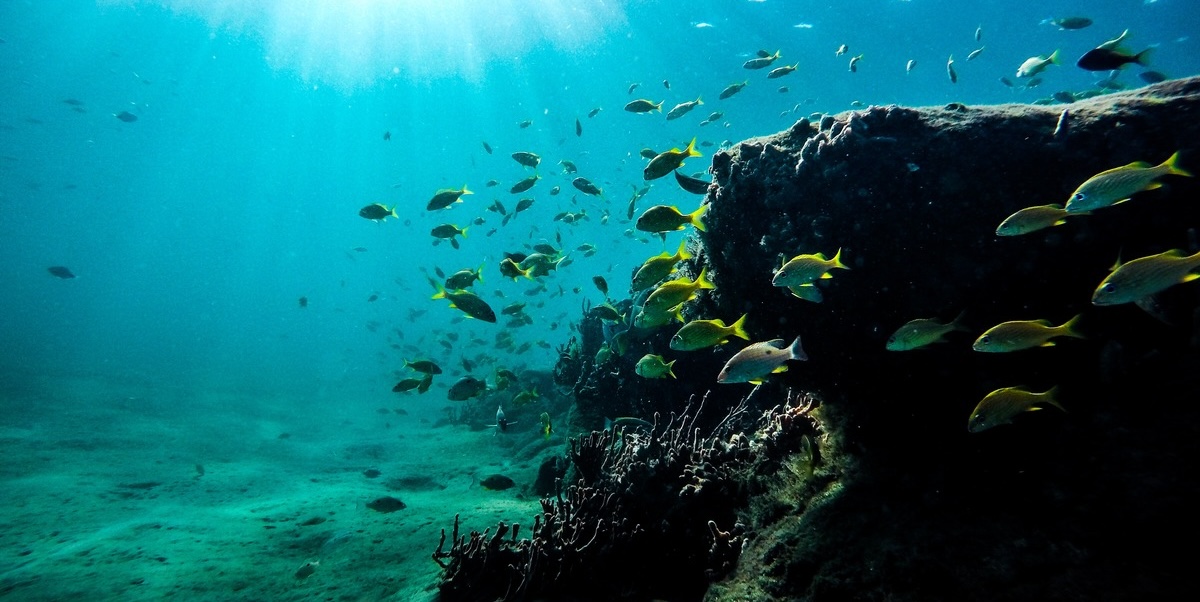
Thus began my year underwater—I didn’t move back to the states until the following summer. The Open Water course in Cairns included three days at sea on a live-a-board vessel that slept thirty: six staff, eight students like me, and the rest certified divers on vacation. I was so scared to do my first open water dive I got a migraine the hour before and stowed away in my cabin in hopes of just skipping out on it all. But when my instructor came down and knocked on my door, telling me it was time to get my ass in the water, I acquiesced, and it was the most amazing thing in the world. “It’s like flying, diving,” I wrote on October 12th. “I could become a diver. I could see that. I could get really, really good at this. I could do this forever.” I was transfixed by all of it, the endless ocean, the wingspans of reef on the water, mint green from above, tragically bleached from beneath, the seabirds with whom I suddenly felt an immense kinship. I could imagine now, better than ever, what it felt like to take off, to be up there, the feeling of air under your wings, lifting you up against gravity. How had I lived this long so out of tune with my breath?
Underwater, when you fill with air, you ascend. When you exhale, you sink. As you go down deeper, your breath becomes the single biggest sound. I’d never heard myself before, like that. Diving made me feel capable of transformation, and of other miraculous things. Underwater, I understood that I was going to be okay. I remember standing on the bow by myself that first night and watching the entire sunset from start to finish, listening to the sound of the sea slapping the buoy ceaselessly, dunking it over and over again. I remember beginning to feel panic, watching the buoy sputter up and sink, sputter up and sink, my panic subsiding only when I reminded myself, “It’s used to this. It’s fine.” Later, at the stern, I watched the bright light skins of sharks flash under the surface as they used the boat light to hunt and I remember feeling so envious of the night divers giant-striding off the back deck into the stormy churning water, their torches soon turning the surface of the black sea green. It was like the northern lights had fallen out of the sky. Everything about diving felt essential to me. How did more people not know about this? I thought. Why wasn’t everyone else also wanting to dive all the time?
That Friday morning as the captain turned us back toward the marina, I remember sitting on the top deck, feeling stricken. And then, miraculously, our lead divemaster came up to announce that another Pro-Dive boat was about to pass us on its way out and had an open cabin; if anyone was keen, they could send two of us over in a dinghy to join that group for three more days of diving, at a discounted rate of three hundred bucks. I ended up taking them up on that offer four times in a row. For two weeks I stayed out at sea on those boats. I made good friends with the crew. I really didn’t want to go back to land.
My two weeks at sea ended only when I wound up back on a boat with my instructor, who was out with a new class. He looked shocked to see me. He sat me down on the second night and told me to get off these boats, save my money, and go to Thailand if I wanted to keep diving. I could do my divemaster there for cheap, live there cheap, and dive all the time. That’s what he’d done when he was my age. That’s how he got into this career. So that’s what I did.
*
This year, I’ve had to face, for the first time, this question from strangers: What is your book about? Tell me about your book. Maybe part of why I’ve found it so difficult to talk about my book is my long-held reluctance to admit there’s anything “autobiographical” in it. Don’t people like to disparage debut novelists for so often leaning on the autobiographical?—as if drawing upon one’s life is juvenile, easy, the mark of a small imagination. Unfortunately, my reluctance to embrace the ways my own experiences have informed the work has, for too long, rendered me incapable of talking about the book intelligently, and likely eclipsed my own understanding of it. Can’t the book be informed by my own life and still, please, not be about me? I’ve never considered myself the subject of this book—which is why I don’t want anyone to read it as autobiographical—although when I raised this to a friend recently, he countered, “Everyone is the subject of their own books.”
When I told him and another friend about calling the hospital in Coolangatta to make sure I had proof, they were aghast: “Would anyone ever ask you for evidence?”—to which I replied, “Everyone asks.” Isn’t that what most people wonder when they read fiction? How real is this? Is this true? Is that? But my friends, also writers, were up in arms: “Not everyone! No, they don’t!” Finally, I had to check: should this essay exist if my book talks about similar things? “I’m sick of us asking whether something should exist when it already does,” said my friends. What would I do without them?
My resistance to autobiography also contains in it my resistance to engage in any kind of conversation around whether writing is, or is not, therapy. It’s a dull debate and there are much more important things to talk about right now, like how writing can, or cannot, help us face all the permanent disappearances, these extinctions, happening around us all the time. Additionally, writing this book was not a catharsis for me—diving maybe more so. I always prefer to think of my life experiences as existing to serve the work, not of the work as serving me. But my god, what does that even mean? What does it mean to turn one’s life only ever into fiction? Maybe I do have a small imagination. “But how do you even measure an imagination?” countered my friend, yet again. Well, allow me to toss an answer into this rhetorical void: measure it in terms of depth, not proximity. Measure it not in terms of how far you are from reality, how much appears out of thin air—a dragon on a swing set, for example—but in terms of how submerged you are in the imagined, how embodied is your alternative, imagination as incarnation.
People often describe my novel as visceral, and that particular description has made me understand Lucy, my protagonist, better: she is not a protagonist trying to numb herself out of pain; she’s someone who wants to feel things. And one of the agonies she suffers in the wake of rape is the way it threatens to cut her off from her body. She desperately wants the experience of having a body back. Yes, at times, she’s running away, but I don’t think she’s ever trying to run away from her body. Becoming a leopard, I think, is not an escape for Lucy, but a way back in. Same with me, with regards to scuba-diving. We are water bodies after all, Robert MacFarlane reminds us. We were swimmers before we were walkers. Diving is a form of return.
Scuba-diving and writing are not so dissimilar. When diving, I can be in my body, and also in another body. Writing is the same: you’re in your body, and also in another. You are you, and also Lucy. You are a body breathing underwater, and also a body which cannot. The sound of breath in your ear when diving sounds a lot like sleeping: you become the version of hyper-conscious that happens at the splitting edge of consciousness.
That year underwater I saw my small, personal crisis—will my body ever be the same?—reflected in the realer, astronomically larger crisis of the reefs, the sick bleached ones approaching a point of no return, the dead brown ones already gone. Devastated by this constant encounter with permanent damage, I felt an important pressure to remember as much as I could about the way it all looked. Today, I feel scared to return to those reefs I once knew so well, whom I visited every day for months—what do they look like now? But, of course, I must return. We must all continue to face the feeling of being about to lose everything. We must keep waking up. It’s important to not just sleep peacefully, but to also sleep fitfully. Complacency kills, and we have to remember our bodies. Our body is our accountability to ourselves and to the world. Yes, my book is visceral: I want you to read it and feel anything.
We all become so vulnerable underwater, so stripped down, so nascent, just bumbling bodies of breath and skin and nerves.
Thailand is where I started writing the book. It’s also where I applied to my MFA. On the big blue boat one morning in February, heading out to the deep reef pinnacle we called Chumphon, I found out I’d been accepted, and would soon move to Texas. I was staring at the wake when I got the call. I stretched my divemaster internship over many months, then became a divemaster, then did my instructor training, then became an instructor. That year alternated between moments of panic and recklessness, and moments of delirious gratitude and acceptance. Underwater I remember so often having this feeling of: I’m so grateful to be me. I’m so grateful to be a person who can travel the world and still, one day, return home, who can move on my feet and also swim at a hundred feet deep. But then, back on land, in my tiny apartment with its balcony that hung over the jungle, I’d curl up in a corner on the cold pink floor, squeezing my knees to my chest, trying to suffocate an ugliness out of me. I remember the tangy smell of that apartment so well, and the thunderous bellow of frogs after rain.
There are many magical things about diving: if you panic at depth, it’s safer to be held down than to go up. As an instructor, you must grab onto whatever you can of panicking students—their SPGs, their ankles—as they try to beat their way to the surface; gripping their fins, I’d splay out, yanking first my dump valve then theirs, anything to keep them from ascending. I was able to hold down men nearly three times my size because I had buoyancy control and they did not. Underwater, I was unflappable. I love how, when you start diving, you are enamored by only the big things—turtles, whale sharks, manta rays—and then, as you dive more, four or five times a day let’s say, you start to realize what matters most is being up close, seeing the small stuff—the nudibranchs and shrimps, the gobies and blennies and frogfish—the small things which indicate everything.
But after a while, I burnt out. After months of instructing nonstop, you start to see the shadowy counterparts of the skills you teach. You witness the why behind the skill; you hear stories from the other shops close by. Eventually, the holding of so much accountability, the responsibility of watching over so many bodies, became too much for me to bear. When diving is your full-time job, your body tires out, from all the countless CESAs, from the many 4 AM mornings, from never really ever fully off-gassing. Complacency becomes a risk.
By the time I moved to Central Texas, I felt I was never going to dive again. The infatuation, the obsession, had gone. I even had this sad thought: I don’t need to be near the ocean anymore. So remained the case for years. During these years, I was also trying to finish my other book, which is about scuba instructors, and I could not. It was hard to write about diving when diving was no longer interesting to me. At some point, I had the thought that getting back in the water might help me finish that other impossible novel, but I just couldn’t do it.
Then, last December, when I was driving to the Domain to return a pair of shoes, I received a call from an old student; she wanted to tell me that the experience she had in my class years ago, of panicking from a partially flooded mask, had been life-changing; it had snapped her out of a debilitating depression. This memory had just come up for her in therapy. I don’t think she was calling to thank me—what she was talking about didn’t really have anything to do with me. But she ended the call by saying she remembers the way my eyes looked in my mask so vividly, as I held her down, her knee clamped between my knees, my hands gripping her shoulders, my eyes fixed on hers as I waited for the panic to vanish from her pupils. I wore heavy black eyeliner back then, even when diving. My mask has a bright turquoise frame. She said that the experience saved her in more than one way, because it was in that moment of sheer terror, water up her nose, forty feet deep in the sea, that she realized she didn’t want to die. After we hung up, I pulled the car over and called all three of the dive shops operating in and around Austin to ask if they were hiring.
Lake Travis is not at all like Chumphon or the Great Barrier Reef. It’s dark and murky and cold, and full of sunken objects. My first time in the lake, when we descended over the sunken Cessna at fifty-four feet, we moved through a thermal layer, the temperature dropping rapidly, and in my five-millimeter wetsuit, I couldn’t stop shivering, which made me burn through my air. The dive lasted only thirty minutes because of me. Today, I know the lake better. Luckily, it’s rained a lot this summer—a blessing—so the lake’s only ten feet shy of full, which means we can step into the water right off the cement steps, and the orange striped buoy that had been beached for months hovers now over eighteen feet, offering us another place to descend with the students.
Students used to exasperate me; they exasperated all of us. Instructors get grumpy: we all resented their bad buoyancy, how they mucked up the vis, how once underwater they’d forget everything we briefed on shore, how hopelessly attached they’d get to you, continuously reaching out, calling. Over PDBs (post-dive-beers), we made fun of the people who thought they could learn to dive even though they’d never learned to swim. Today, I don’t recognize any of that in me at all. For some reason, tiny random things about my students keep almost bringing me to tears. Their nervous eyes, their blank stares, their reasons why they’re learning to dive. We all become so vulnerable underwater, so stripped down, so nascent, just bumbling bodies of breath and skin and nerves. We all look so silly in our masks. I feel very attached to my students. I care about each of them so much.
Diving feels different today. I’m different. I’m older, all better, I’ve healed. I have new fears. There’s this blue tarp you’re supposed to roll over the pool at night if you’re the last to leave the shop. Another instructor told me how much he hates doing that when he’s here alone, because if you slip and fall on it, it’ll close over you and you’ll drown. This haunts me now, of course. Last month, when I was demonstrating the remove-and-replace mask skill in the shallow end, my alternate started free-flowing and blasted my regulator right out of my mouth. I accidentally floated up to the surface due to the force of it, which thankfully was just two feet above me. If we’d been in the deep end, however, and that had happened, and I had floated up, my lungs could’ve exploded. This has haunted me too. And yes, I also still startle awake to the late-night cackles of the ice machine, to the soft ding of the dishwasher being done, to the wind. What is behind these fears? To attribute any of my current anxieties to any single experience, I think, would be a mistake. What is my book about? For a while, I said it was about what it’s like to exist in a traumatized body. Now, as the book’s publication is imminent, it seems to me to be more about what it’s like to coexist, in any body, with other bodies, in a traumatized world. Beautiful creatures are disappearing around us all the time; we’re barely sensing it.
This past Sunday, I sat with a student whom I’ll call Flynn at the picnic table while the others headed back to the shop to clean their gear. He’d been my best student, but he’d gotten very disoriented on our last dive, understandably—the visibility had been horrid, no more than three feet. At the picnic table, Flynn told me he was concerned about DCS, decompression sickness, because he’d botched the safety stop—he couldn’t stay down, kept floating up. I reassured him that he didn’t have DCS, for many reasons, and that he was most likely just dehydrated, but I said I’d sit with him until he no longer felt nauseous and faint. As we sat, I told him about how sick I’d felt after my first time diving. When I got off the boat, the world wouldn’t stop spinning and I walked around Cairns, convinced I was dying. On my way to the airport, I called my instructor, crying, and he calmed me down, telling me it was just land sickness—I’d been out at sea for two weeks after all; my body was simply readjusting.
Flynn and I sat together for an hour. We drank a lot of water. We watched the turkey vultures plunge one at a time out of view behind the orchids, then float back up and plunge again. Later, driving home, crossing over I-35 at 12th, five green parakeets soared over the highway, bright tiny bursts of magnificence, and landed in the soft sparkling leaves of a paloverde tree. I wanted to pull over. I wanted to watch them forever. I didn’t even want to blink—but then I did, and when I opened my eyes, they had turned into blossoms.
____________________________
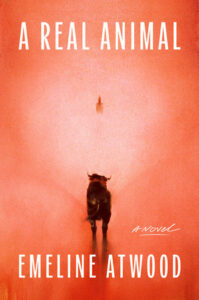
A Real Animal by Emeline Atwood is available from Catapult.

Emeline Atwood
Emeline Atwood graduated from the Michener Center for Writers in 2023. She writes fiction and poetry and is a recipient of the Thomas T. Hoopes Prize, the Begley Fiction Prize, the Hatch Poetry Prize, and the Le Baron Russell Briggs Fiction Prize. She lives in Austin.