Writing Through Loss: On Crafting Nonfiction That Tackles America’s Opioid Crisis
Nadia Bowers and Stephanie Wittels Wachs Discuss Their Shared Stories of Losing Loved Ones to Addiction
Nadia and I both lost our siblings to overdose in 2015. She was 7 months pregnant when her sister died. I had a 13-month-old baby when my brother died. We both navigated new motherhood and profound grief simultaneously. And now we’ve both written books about it that are being released by the same publisher a month apart. So in many ways, we are living parallel lives.
–Stephanie Wittels Wachs
*
Nadia Bowers: Both your first book, Everything is Horrible and Wonderful (2018) and your new book, Last Day, deal with the opioid crisis. Can you tell me a little about what drove you to write the first book—which is incredibly personal about your brother’s death—and the journey to the second one?
Stephanie Wittels Wachs: When my brother died of a heroin overdose in February 2015, I was swallowed whole by an acute grief that annihilated every aspect of my life. Harris was a comedian’s comedian. He was a writer on NBC’s Parks and Rec, in which he also played the recurring role of Harris, the animal control guy. He coined the term “humblebrag.” He was easy to love and loved by many. But more than that, he was my lifelong sidekick and only sibling. In the aftermath of his death, I had a hard time putting my feet on the floor and standing upright. I felt like I was quite literally going to sink into a black hole and never crawl back out, which was tricky because, at the time, I had a 13-month-old baby. So I started writing as an act of survival. I turned these disjointed fragments in my Notes app into a book in nine months, and I really do credit the writing with pulling me out of that big black hole.
That same year, this woman Jessica Cordova Kramer who I’d never met heard me on Nora McInerny’s podcast Terrible, Thanks for Asking. She lived across the country and had lost her little brother, Stefano, to an overdose a few months earlier. In describing what it felt like to hear the episode, Jess said, “I swear to God, it was the first time I felt joy. The first time I was able to acknowledge that this is just how life is. People die, and sometimes your brother dies of a heroin overdose. I just had this moment of like, ‘Okay, I think I can live through this. This didn’t just happen to me. It happened to someone else.’” Long story short, she tracked me down and pitched an idea: a podcast about the opioid crisis from the family’s perspective. At the center of it was a question that plagues everyone who’s lost a loved one to an overdose: What could I have done differently?
As I started to look at my sister’s life and find more compassion for the parts of it that were difficult, I couldn’t just do it for her. If I was looking at her as a human being, I had to do it for everyone.
We called the podcast Last Day. The idea was that we would start with someone’s last day and rewind the tape to see what we could have done to change the ending. We were desperate to figure out how we could have saved our brothers, a question that was simultaneously very simple and incredibly complex. I hosted the show and started talking to doctors, experts, survivors, people in long-term recovery, other families who’d experienced something similar. No stone was left unturned. Twenty-five blood, sweat, and tear-stained episodes later, we had a revolutionary understanding of opioid use disorder and how to save lives.
My second book, Last Day: How to Stop Losing Our Loved Ones to The Opioid Crisis is an adaptation of the podcast but more than that, it’s the book I wish someone had handed me when my brother was in the thick of it.. I want this second book to be an evidence-based resource for people who are desperate for answers. I hope they’ll highlight it, annotate it, dog ear it, and then pass it along to the next person who needs it.
Your book Dear Dealer began as letters written to your late sister Sasha’s drug dealer; did you have any idea that the first letter you wrote would eventually become something bigger? At what point were you compelled to turn your one sided correspondence into a memoir?
NB: I, like you, became a mother right at the time Sasha died. I felt that all the anger and grief inside me didn’t have a place in a nursery. And I genuinely was filled with so much love, this expansive new kind of love, that all other feelings were elbowed out to the edges of my life. But I knew they needed acknowledgement. I felt a split happening in me, so getting things out on paper felt like a necessity for my mental health. I picked up a pen almost immediately after Sasha died, and at the same time, I began thinking about this dealer. This person whom I felt I was now linked. He had changed Sasha’s life, and now mine, forever. And the thought that he (I determined that this person was likely a “he”) could just walk away with no recourse made me feel an anger that felt like madness.
Then the idea of an open letter occurred to me. Maybe I’d try to place it in a local New Haven paper. I was really trying to reach out to this person. Send a flare. So, by 2018, from what I had written, I wrote my first letter. It was an absolute dream when This American Life picked it up and I was able to send all my feelings out over the airwaves.
At the end of the piece, Ira Glass says, “That was Nadia Bowers. She’s writing a memoir about her sister.” And he was right. I knew I had more to say, that this was just the beginning. But I had no idea what it would look like. I also knew that more time needed to go by. Her death was still too close, and no one wanted the memoir I would have written at that time. I knew I was going to have to do some real excavating of not just her life but my own.
Letters became this way in for me. I struggled with a more traditional memoir structure, unsure if I had the right to speak publicly about these things. The “me-ness” of a memoir. The dealer, in a sense, gave me permission. He was the catalyst. And I just let myself write to him, generating close to 700 pages ultimately. There was some experimenting with the memoir being all letters, one big letter, or placed interstitially among narrative, but there were always going to be the letters.
What is something you learned writing this second book that surprised you? Maybe something that you thought you knew but was turned on its head?
SWW: Dude, the “me-ness of a memoir” makes me feel so seen! I had this exact same struggle. Like, how self-indulgent can I possibly be?! I also love that, for both of us, writing was a thing we’d do in our Notes app while the babies slept. Parallel lives.
I think the thing that surprised me most is that I was able to end the book on a note of hope. That was certainly a surprising plot twist. Feeling hope amidst an ongoing opioid crisis sounds like the stuff of fiction and wasn’t on the horizon when we created the podcast in 2019. At that point, drug-related deaths due to opioids kept climbing. In 2015, the year Harris and Sasha died, the U.S. logged 33,091 opioid-related overdose deaths. In 2019, when we launched the show, it climbed to 49,860. And by 2023, it had ballooned to 79,358.
So when I woke up to a bunch of texts on September 18, 2024 linking me to an NPR headline that read “U.S. Overdose Deaths Plummet, Saving Thousands of Lives,” I was stunned. The article quoted Dr. Nora Volkow, head of NIDA, saying “This is exciting. This looks real. This looks very, very real.” Exciting? About opioid deaths in America? Never thought I’d see the day. The CDC was reporting an unprecedented decline in drug deaths of roughly 10.6 percent. The Opioid Data Lab at UNC (the most rigorous and comprehensive data source I found) put it at a 15 to 20 percent decrease in nonfatal overdoses and a 10 percent decrease in fatal overdoses from 2023 to 2024. In some states, declines hit twenty, thirty percent.
But the most “exciting” part of it is the why. It wasn’t the War on Drugs. It wasn’t law enforcement or border seizures. It was harm reduction. Dr. Nora Volkow, head of NIDA, told me the lion’s share of the credit goes to widespread distribution of naloxone (or Narcan). Getting it into communities, making it available over the counter, making it accessible in college towns and public libraries. That’s what ultimately moved the needle.
Once, when I interviewed my mom for the podcast, she said, “I feel like Harris became a heroin addict at the wrong time.” And I kind of agree with her now. The idea that we now know concretely, based on data, what prevents overdose and saves lives? It kind of blows my mind.
I’m curious how you feel about the dealer today? Did writing the book bring you closure in any real way? Do you feel like you’ve come to terms with what happened to your sister?
NB: It’s such a heartbreak to know all the things we do now. I also think much of my willingness to learn came from losing Sasha. That’s a lot of the drive for both of us, right? That other families don’t have to pay the price of losing someone in order to learn.
Something I didn’t see coming is how I would feel about the dealer by the end of the book. I’ll try not to give too many spoilers, but I’ll say that where I start with how I feel about him is not where I end up. As I was excavating the past, I was living the present day timeline, and I truly did not know how the book would end. I was very aware of trying not to feel the pressure of a “bow.” I don’t like bows. On shoes. In writing. I could see a bow-y version where the lesson is forgiveness and that is where I’d have to land. Sure, it was possible, but I didn’t want it to be an obligation.
I do feel like this entire process was just more of the same in terms of who I am at my core. The system is broken, and I apparently think I’m Erin Brockovitch.
But essentially, as I started to look at my sister’s life and find more compassion for the parts of it that were difficult, I couldn’t just do it for her. If I was looking at her as a human being, I had to do it for everyone. I didn’t know this person, but they had a whole life that brought them to the day in which they gave my sister fentanyl. And I don’t think anyone involved in selling or using these drugs is having much fun, you know? In sociology there’s something called strain theory, the idea that there is a correlation between what a society expects of us as “successful” people, the reality (that we don’t like to admit to here) of the unequal opportunities for people achieve that, and deviance. I don’t have food insecurity. I have a home. Health insurance. Community with a deep bench. All these things help me “play by the rules.” I can’t not recognize that.
In a larger context, I think the dealer became a metaphor for the things we are “dealt” that shape us. The ones known to us, like family, and the ones we don’t see coming. When I imagine meeting him, it feels very different in my body now than it did eleven years ago.
I think the book has brought me acceptance. There’s an idea in Buddhism that most (all?) of human suffering comes from resisting what is. Sasha is gone, and for a long time, I was railing against that. But I get it now, and my sense of understanding has forward movement. I have this book now. It will live outside of me, and I can be in relationship with it. We can keep the conversation going. I’ll keep learning from it, and it’s free to go where it wants. Sasha was a devoted clinical social worker. I see this book as, I hope, continuing her work out in the world. I’m not sure there is ever closure, and that’s a good thing.
And now I want to ask you that same question about closure. Do you feel you have it? Are you maybe feeling okay two books on this harrowing subject. We good now?
Also, people have asked me if writing my book was cathartic, and I really rejected that word for a long time. Did you? Like, how dare any good feeling come from doing this. But of course, it has been. You have built a huge community, helped people speak the hard things out loud. How has that changed your sense of yourself in the world? And do you feel this has been cathartic?
SWW: Yes, I can resolutely say, WE GOOD NOW. My next book will be pure fiction/all smut. I mean, truly, I’ve long felt like there was some tear in the multiverse, and I inadvertently fell through a portal. Like, this stuff is just so innately serious and I am so innately unserious.
BUT I also have (and have always had) some sort of deranged pull to fix things that are broken and/or make no sense. When my daughter was born, we discovered she had permanent hearing loss and that hearing aids would be necessary during all waking hours for her entire life. Then we found out that said hearing aids would not be covered by insurance (in fact, they were considered “cosmetic”), and they would cost $6,000 out of pocket every three to five years. I was furious, naturally, and took that rage all the way to the Texas legislature. (We lived in Texas at the time—it was so hot). Basically, me and two other moms fought to get hearing aids covered for kids and, in 2017, that bill was signed into law.
I share this anecdote because it feels similar to the work I’ve done around the opioid crisis since my brother died. This thing happened to someone I love and I needed to do something about it. The community and all the stuff that’s grown out of it is a thing I honestly still can’t fully comprehend but for which I am incredibly grateful all the same.
In terms of catharsis, yes, my first book was very much that. It was an emotional purge that came together in about nine months, and I did feel a sense of relief once it was out of my system. This book, on the other hand, was not a purge. There’s something about catharsis that feels inherently messy. This was not messy. This was meticulously researched and fact-checked and steeped in dogged investigation and examination. My brother’s death and your sister’s death were preventable. Overdose is preventable. Substance use disorders are treatable. I didn’t know that at the time, and that genuinely sucks, but it felt insane to have learned all of this life-saving information over the course of making the podcast and not organize it into a how-to book for people like us before our siblings died. So I’m not sure if this answers your question, but I do feel like this entire process was just more of the same in terms of who I am at my core. The system is broken, and I apparently think I’m Erin Brockovitch.
Someone at a book launch event last week asked what I thought Harris would say about all of this, and my response is that he’d say: “Steph, stop. It’s enough.”
*
Nadia Bowers, author of the memoir, Dear Dealer, is an actor, writer, and voice-over artist. She has a BA in sociology and French from Dartmouth College and an MFA in acting from NYU’s Graduate Acting Program. Nadia works in theater, television, and film. She lives in Brooklyn, New York, with her husband, actor Corey Stoll, and their son.
Stephanie Wittels Wachs, author of Last Day: How to Stop Losing Our Loved Ones to the Opioid Crisis, is CEO and cofounder of Lemonada Media, an award-winning podcast network on a mission to “make life suck less.” She co-created and hosts Last Day, Lemonada’s Webby, Gracie, and Third Coast Award-winning flagship show. Its first season focused on the opioid crisis, which took the life of her brother, writer-producer-comedian Harris Wittels (Parks and Recreation, Master of None). Wittels Wachs is the author of two books, Everything Is Horrible and Wonderful: A Tragicomic Memoir of Genius, Heroin, Love, and Loss and Last Day: How to Stop Losing Our Loved Ones to the Opioid Crisis. She’s also a well-known anime voice actor. Wittels Wachs serves as an executive producer across Lemonada’s slate of chart-topping podcasts, including Wiser Than Me with Julia Louis-Dreyfus, which was named Apple’s Best Podcast of the Year in 2023. She lives on California’s central coast with her husband, their two kids, two dogs, and an ungodly amount of houseplants. Find her on Instagram @wittelstephanie.
_______________________________
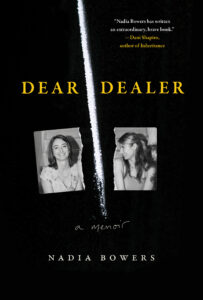
Dear Dealer by Nadia Bowers is available from Gallery Books, an imprint of Simon & Schuster.
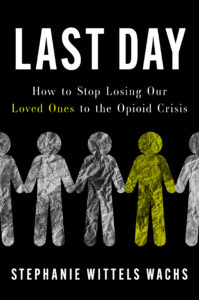
Last Day: How to Stop Losing Our Loved Ones to the Opioid Crisis by Stephanie Wittels Wachs is available from Gallery/Lemonada Books, an imprint of Simon and Schuster.

Nadia Bowers and Stephanie Wittels Wachs
Nadia Bowers is an actor, writer, and voice-over artist. She has a BA in sociology and French from Dartmouth College and an MFA in acting from NYU’s Graduate Acting Program. Nadia works in theater, television, and film. She lives in Brooklyn, New York, with her husband, actor Corey Stoll, and their son.
Stephanie Wittels Wachs is cofounder and CEO of Lemonada Media, an award-winning podcast network on a mission to “make life suck less.” She created and hosts Last Day, Lemonada’s Webby, Gracie, and Third Coast Award–winning flagship show. Its first season focused on the opioid crisis, which took the life of her brother, writer-producer-comedian Harris Wittels (Parks and Recreation, Master of None). Wittels Wachs is also the author of the bestselling memoir Everything Is Horrible and Wonderful: A Tragicomic Memoir of Genius, Heroin, Love, and Loss, which Kirkus Reviews hailed as a “a powerful debut.” Wittels Wachs serves as an executive producer across Lemonada’s slate of chart-topping podcasts, including Wiser Than Me with Julia Louis-Dreyfus, which was named Apple’s Best Podcast of the Year. She lives on California’s central coast with her husband, two kids, two dogs, and an ungodly amount of houseplants.