Why Writing Feels So Hard (and How to Make it Easier)
April Dávila on the Neuroscience Behind Writer’s Block and What We Can Do to Conquer It
Let’s be honest about something: the fact that writing is hard has nothing to do with how talented you are, how many ideas you have, or how much you want to have finished your novel. Writing is hard because your human brain, the one that’s been running and updating the biological human survival software for roughly 200,000 years, is genuinely convinced that putting words on a page might kill you.
This is not a metaphor.
Every time you sit down to write, you’re doing something your brain registers as socially risky. Translating private thoughts into language means exposing yourself to judgment and for most of human history, judgment wasn’t just uncomfortable, it was dangerous. Research done by Naomi I. Eisenberger in 2004 explored how our brains evolved to fear social pain. Getting rejected by the group meant you didn’t eat. Being humiliated in front of the clan meant you might not make it through winter.
Your nervous system remembers all of this, even now, as you try to write your next chapter. The brain’s job is to keep you alive, so it does what it does best: it spots the threat and steers you away from it.
Which is why, the moment you sit down to write a difficult scene, you suddenly realize you need to reorganize your sock drawer, or walk the dog, or replace your windshield wipers. Anything but write.
Undirected mental energy can (ideally) be a source of creativity, but left to its own devices, the mind does not naturally drift toward gratitude and wonder. It gravitates toward threat.
Now consider that sitting down to write requires a great deal of focus, so you’re also working against your brain’s natural tendency to daydream, ruminate, and spiral. The regions of the brain involved in this kind of mental goofing off are called the Default Mode Network, a term coined by Marcus Raichle. For writers, undirected mental energy can (ideally) be a source of creativity, but left to its own devices, the mind does not naturally drift toward gratitude and wonder. It gravitates toward threat. Which brings us to one more biological reality that makes writing hard: negativity bias.
Your brain is specifically wired to give more weight to the bad stuff than the good. Social psychologist Roy F. Baumeister talked about this in his paper “Bad is Stronger than Good.” An ancestor who forgot about the beautiful flowers by the lake? Fine. An ancestor who forgot about the lion down by the lake? Well, they’re likely not an ancestor, as they probably didn’t live long enough to reproduce. Giving our attention to the potentially painful or fatal has helped us, as a species, to survive as long as we have.
What’s more, it’s not just external negative factors that our brain hangs onto. We have a remarkable ability to remember and re-live emotional pain. A study done by Zhansheng Chen in 2008 showed that social pain is remembered more intensely than physical pain. This explains why you can remember the time you fractured your arm without actually reliving the throbbing discomfort, but if you reminisce on a broken heart, there might still be tears. All of which circles us back around to the reality that our brain sees writing as quietly dangerous.
So here we all are, sitting down to write with brains that are actively scanning for danger, absolutely certain that the sentence we just typed is terrible, and pretty sure it will be the end of us.
None of this is pathology. It’s all just part of being human.
Here’s the good news: once you understand why your brain responds to writing the way it does, you can train your mind to work with you, not against you. With a little practice you can learn to recognize your subconscious responses to perceived threats, consciously remind yourself that you can do hard things, then get on with the writing. So how do we do that?
As a writing coach, the practice I invite all of my clients to try is called Insight Meditation, and before you dismiss this as woo and click away, hear me out. It’s a remarkably simple practice and it will make a world of difference in your writing life. All you have to do is sit comfortably, close your eyes if you’d like, and choose something to rest your attention on (your breath, the sounds in the room, a mental countdown from ten to zero). We call this the anchor. Then you just notice when your mind wanders, which it will, constantly. When you realize that it’s wandered, you let the thought go and come back to your anchor. That’s it. That’s the whole practice. (If you’d like some support in giving this a try, you can check out a free collection of meditations I’ve created just for writers at ScribblingBuddha.com.)
Every time you dismiss a distraction and return to your anchor, you’re building the mental “muscle” of focus. Scientists are still researching the specific connection between focus and creative flow, but anecdotally, nurturing focus seems to be the first step in dropping into that wonderful, coveted mental state where the words come easily, the hours disappear, and your inner critic goes quiet. Even though it can sometimes feel like magic, flow is a predictable response to the right conditions. It’s science.
Back in 1990, Hungarian-American psychologist Mihaly Csikszentmihalyi wrote the book Flow: The Psychology of Optimal Experience in which he talked about his research around the experience of “flow.” He used that word precisely because it came up over and over again when he spoke to artists, athletes and other people engaged in demanding, creative work. What he found was that flow happened when the skill level of the individual was perfectly balanced with the difficulty of the task at hand. When the artist or athlete was highly focused on meeting the challenge, time seemed to stretch. They reported that they knew exactly what to do next at any given moment and that they felt a great sense of calm and ease, even while doing something that was demonstrably difficult.
In his continued research, and specifically in his work with Jeanne Nakamura in 2002, Csikszentmihalyi theorized that the human brain has finite processing power of about 120 bits per second. That’s literally about a million times slower than the computer you’re reading this on. And your puny human processing power gets used up quickly. You use about half of it just listening to someone talk.
Mindfulness doesn’t eliminate fear or self-doubt, I want to be honest about that. What it does is change your relationship to those experiences.
Now consider that focusing on a challenging task (like writing) aggressively sucks up processing power and as it does, your brain simply doesn’t have the ability to do all the things it usually does behind the scenes. Keeping track of time is one of the first things to go. Your brain knows that’s not super important, so as excess processing power runs low, your inner clock winds down for a bit. Pretty quickly after that, you run out of neural processing power to maintain the internal yapping of your inner critic. Get focused enough and the part of your brain that is in charge of keeping track of the boundaries of your physical body start to diminish, which leads to a sense of expansiveness and connectedness. This degradation of more complex brain functions is what neuroscientists call transient hypofrontality, a phrase coined by Dr. Arne Dietrich. (You can watch his TEDx talk about it here.)
You may have experienced transient hypofrontality through the use of a drug like LSD or psilocybin. With chemical assistance the brain can slam pretty hard into transient hypofrontality, which makes you pretty useless for anything but staring at the stars in awe. But a less aggressive dip into this mental state (through the practice of meditation, for instance), can land you into a more gentle (and instantly reversible) altered state of mind wherein much of the activity of the prefrontal cortex is temporarily offline, but you can still follow a thought. In this state, you experience the benefits of decreased self-criticism and increased creativity (aka flow).
The best part? You can train yourself to nurture this state of mind and drop into a state of creative flow at will. Not occasionally, not when the conditions align, but reliably, on purpose, every time you sit down to write. It’s as simple as sitting still for 10 minutes, right before you begin your writing.
When you practice mindfulness meditation before writing, then move directly from your meditation into your work, you carry that heightened state of focus right to the page. Errant thoughts will still arise (the laundry, the email, the certainty that your opening scene is a disaster) but in a mindful state, those thoughts are observable. You can notice them, recognize them for what they are (your brain doing its overprotective thing), and let them go. Then keep writing.
Over time, this practice changes something fundamental. Mindfulness doesn’t eliminate fear or self-doubt, I want to be honest about that. What it does is change your relationship to those experiences. The urge to abandon your work starts to feel less like a command and more like background noise. The inner critic becomes less like an authority figure and more like that one colleague who sends too many emails. You don’t have to respond.
I can’t promise this practice will make writing effortless, but I can say with certainty that if you establish a regular meditation practice, you will write more and suffer less.
You will begin to see that you can feel doubt and keep writing. You can feel vulnerability and keep writing. You can feel fear and keep writing. The goal isn’t to reach some mythological place where you’re above it all. Every serious writer I know has to negotiate with resistance from time to time, but when you can recognize the resistance as ordinary, as the utterly common human response to doing something challenging, and write anyway? Well, that changes everything.
____________________________
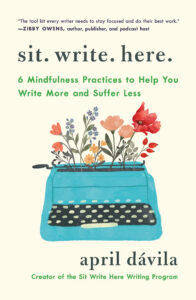
Sit Write Here: 6 Mindfulness Practices to Help You Write More and Suffer Less by April Dávila is available from St. Martin’s Essentials, an imprint of St. Martin’s Publishing Group, a division of Macmillan.

April Dávila
April Dávila is an award-winning author, speaker, and writing coach. Publishers Weekly called her debut novel, 142 Ostriches, a “vivid, uplifting debut” and the book went on to win the WILLA Award for Women Writing the West. Writer’s Digest listed her blog (at aprildavila.com) as one of the Best 101 Websites for Writers and she is the creator of the Sit Write Here writing coaching program, helping writers quiet their inner critics, overcome writer’s block, and edit more effectively. Her new book, Sit Write Here: 6 Mindfulness Practices to Help you Write More and Suffer Less is out this summer from St. Martin’s Essentials.