Where Does the Will To Live Come From... in Humans and Nonhumans Alike?
Melanie Challenger on the Mysteries of Sentient Agency
The English word “agency” comes from the Latin agere, meaning “to do” or “to drive,” and goes back to the Proto-Indo-European root *ag-, meaning “to lead or move.” In the 1600s, there was a shift in its sense. The word drew on ideas from alchemy, where the agent was the active substance that spun gold from the mundane. People also began to use it to describe the negotiator in matters of influence. Thus, agency as a concept gained a greater liveliness, from passive effect to active incitement. So, too, did the word communicate power.
So, here’s the thing. When it comes to the purposeful actions of living beings, we are also asking political and moral questions about the ability to influence or direct our own actions and the actions of others. This is in no small measure because for us humans, who are so sensitive to estimations of authority and might, a lot hangs on whether we believe another can take an active role in affecting something.
But the sense changes in the word are also reflections of our recurring desire to look for a special force or external driver beyond the body itself.
Many living beings have ingrained means of detecting agency that can lead them astray, but what they’re looking for are entities that have their own goals.
Aristotle was not immune to such considerations. In his Metaphysics, he pondered whether there is an ultimate cause beyond psyche, most especially in that which moves the heavens themselves: “There is something which is always moved with an unceasing motion, and this is moved by the Unmoved Mover.” Many have interpreted this mysterious entity as Aristotle’s God—an ultimate agent, the original originator of action. His occasional use of the term theos suggests as much.
Yet, what fascinates is that Aristotle’s God isn’t a typical divine being who summons and shepherds. Instead, his deity might be better understood as a personification of the source of energeia—the furthest horizon of fulfilment towards which all potential forms in the universe strive. This is not a creation event per se, but an eternal principle of motion and change.
Perhaps there’s a modern analogy for this in the search for a unifying field or constant behind all forces in physics. Indeed, paradoxically, Aristotle’s obscure word reemerged in science as “energy,” though with a strictly quantitative meaning somewhat different to his metaphysical one.
Nevertheless, for centuries, debate has persisted over the agency of organisms. If there is a goal of some kind, who generates the goal in the first place? And if the goal has meaning, where can the meaning be found? What makes the frog leap from one side of the bank to the other, or makes you pick up this book and read it? Who or what or where is the agent?
If we take these questions seriously, we have no choice but to enter some extremely tricky territory. One useful starting place is to look at how we detect an agent in physical terms.
Researchers who specialize in “agent detection” have located specific regions of the brain, such as the ventral temporal cortex, and brain processes like the “action observation network” that become active when an animal is establishing the source of an action. But animals don’t appear to be interested in all forms of action, such as the tumble of a boulder or the wind in a tunnel. What seems to be going on is that animals recognize an action, and then seek its cause, but the causes that most matter are those that are synonymous with biological life. In other words, the priority among agent-detecting organisms of many kinds seems to be to separate those forces of change that are alive from those that are non-living. Put simply, life is seeking life.
That the methods sometimes fail isn’t proof that the category of life is too narrow but rather that what emerges from evolutionary processes as organisms’ bodies alter through time is often what’s good enough rather than ideal. Yet what we can see is that if an animal can figure out that the lifelike object isn’t another animal, it no longer holds the same interest.
The distinction is important because it hinges on purpose. When discriminating a living agent, many animals, particularly mammals, observe their behavior to figure out another being’s intentions and anticipate future actions. Are they a threat? Are they relaxed or aggressive? What will they do next?
Part of this involves mapping their actions onto our own—given what they’re doing, what might we do? This isn’t just because living agents are less predictable than, say, a waterfall, but because their purpose-driven nature means their range of possible choices is far broader than that of an object moved solely by external forces.
Take an antelope: we can’t be certain they won’t suddenly change course, come straight at us, or dart down another path. A life-form is constantly reassessing the situation and adjusting their actions accordingly. Anticipating what matters to another being—their motivations and limitations—can help in predicting what they might do. This is crucial for animals, especially those that hunt or are hunted.
My childhood cat, Phoebe, once reacted to the vacuum cleaner as if it were living. This entity moved, made noises, and seemed to eat things from the floor. In other words, it appeared to possess some of the qualities of life. And Phoebe followed it at a safe distance, eyeing it suspiciously. When the machine was still, she edged up to it and sniffed, at first with trepidation. But, once she established it wasn’t living, she wandered away again, uninterested. She never made that category error again.
It didn’t matter to Phoebe that the vacuum cleaner displayed some of the features of life. Phoebe was seeking the entity who was determining the events—not something causing an effect but someone with reasons to do so. When Phoebe realized that the vacuum cleaner was attached to me and I was the one driving the machine, she lost interest. Cleaning the room was my goal, not the vacuum cleaner’s.
And so, many living beings have ingrained means of detecting agency that can lead them astray, but what they’re looking for are entities that have their own goals. This doesn’t mean that they’re looking for a creature with a brain. Rather, they’re looking for a body with purpose.
When there’s a lack of clarity or there is unpredictability in the environment, we tend to see agency in a wider array of phenomena.
But it’s different for us humans. We are very focused on what’s going on in our brains, where conscious intentions coalesce. For a highly social creature like us, it pays to know in advance what another might be planning. Identifying the values and goals of others is critical to humans. This has shaped how we interpret the world. We do not only scan for life; we examine behavior and form for signs of mental agency. Paradoxically, this seems to have left us with a tendency to over-detect both life and agency, as researcher Jiangang Liu and colleagues described in a 2014 paper. We see faces everywhere—for example, in the shape of an oncoming car, in a fire hydrant, in the clouds. This is not simple pattern recognition. The same research tradition shows that such perceptions involve judgements about intention and expression, and not just visual similarity. And this tendency appears to intensify under conditions of uncertainty.
When there’s a lack of clarity or there is unpredictability in the environment, we tend to see agency in a wider array of phenomena, including lightning storms and even a rubber tyre rolling down the hill.
In their 2010 study on animism, the neuropsychologist Patricia Helvenston and archaeologist Derek Hodgson argued that several ancestral adaptations for discriminating between living and non-living forms led to a “pre-adapted cognition that tended to constantly scan, in a subconscious way, the environment for the presence of living things.”
Other studies have revealed that the extension of agency to non-living entities or materials increases in “conditions of high uncertainty.” Anthropologist Nurit Bird-David notes that perceiving and then building ways of being around social relationships between humans, non-humans, and the wider environment can offer effective methods of navigating that which is inherently changeable and potentially threatening.
This is supported by experimental work on Western industrial societies by psychologist Vernon Padgett and economist Dale Jorgenson. In their survey, eras when European societies have faced greater insecurity, such as times of economic stress, have correlated with an uptick in the belief in non-physical, spiritual or magical influences. The current expansion in the West of what is taken to count as “life” or “agency” likely has a range of causes, including a widespread spiritual vacuum, increased beliefs in individual pre-eminence, and the exaggerated promises of artificial intelligence. But it is also reasonable to speculate that the recent trend has something to do with the frailties of a world in the shadow of a looming environmental crisis.
In any case, what we should take from this research is the awareness that humans (and other social mammals) may be highly predisposed towards signs of mental agency.
___________________________
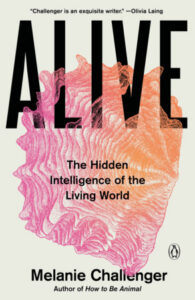
From Alive: The Hidden Intelligence of the Living World by Melanie Challenger. Copyright © 2026. Available from Penguin Books, an imprint of Penguin Publishing Group, a division of Penguin Random House, LLC.

Melanie Challenger
Melanie Challenger writes, researches, and broadcasts on the history of ideas, the history and philosophy of science, and the relationship between humans and the living world. She is the author of How to Be Animal: What it Means to Be Human, among other works, and host of the podcast The Psychosphere. She is also an award-winning poet and librettist for opera and oratorios, and a National Geographic Explorer. Melanie is internationally active in bioethics, co-director of Animals in the Room, and Vice President of the RSPCA.