When Biography Goes Delulu: Writing the Life of Superstar Astrologer Linda Goodman
“The hazy, contradictory landscape of Goodman’s life was the truth of her existence.”
It is February 2026. I am scrolling Reddit’s “isthisAI” forum, where users post photographs and videos and ask for help determining their validity. In one post, a photograph shows an iguana perched on a woman’s head as she peruses a Walmart deli cheese case. The original poster writes, “Is this picture that my uncle swears he took at Walmart, ai or real? I cannot figure it out.” In response, users debate the reptiles’ greenness, asking whether they really are that bright. Others note that the cheese brand names are visible in the photograph: President Brie. Athenos Feta. For them, this confirms that the photograph is real—AI couldn’t replicate such brands. Some argue that the photograph is simply a low-quality picture; this is what makes it seem artificial despite being real. And so on.
I scroll through post after post. There is an astronaut in a sunflower field. A child bouncing a basketball on a driveway of sheer ice. A bear in a zoo scoops up a seagull that fell into its enclosure’s pool, seemingly rescuing the bird. I am fascinated by the careful attention users pay to the images, by the discussions of Photoshop versus AI, by the information supplied by users that confirms or denies the seemingly outrageous realities suggested by the photographs (one user replies to the iguana post with a photograph of their own reptile to confirm that, yes, they really can be that vibrantly green).
Goodman became more complex through the contemplation of her fragile archive and its splintering possibilities, even if much of the information would elude a fact-checker or fall into the realm of make-believe.
I have been looking at this forum for weeks. I find a kind of strange solace in reading the posts; they are an echo of my own experience as a writer. The process of discerning the truth from illusion was an unexpected yet crucial task in researching and writing my book, Follow the Signs: Searching for Linda Goodman, America’s Forgotten Astrology Queen, a hybrid biography that combines the story of Goodman’s life alongside my quest to create an authentic portrait of her.
Despite writing about an astrologer (a profession that by its very nature deals with the metaphorical, rather than scientific, nature of the planets), I hadn’t anticipated that questions of illusion and truth would be the compelling force in writing Goodman’s life story. I began, as many biographers do, by looking to the history of biography for clues about what challenges would motivate my process. Namely, perhaps naively, I anticipated that my research process would be much like Leon Edel outlines in his 1957 guide to biography, the aptly titled Literary Biography. In which he identifies the key problem of the biographer as being simply too much material to sort through. He writes of great stacks of papers and the distress at such a monstrosity of information from which a biographer must create an authentic portrait, “How can one make a life out of six cardboard boxes full of tailor’s bills, love letters and old picture postcards?”
I fantasized about finding such a stash of documents about Goodman. But, like many biographers and researchers come to realize, who and what we choose to archive and remember is often dictated by hierarchies or prejudices of race, class, gender, and ability. Which is also to say that remembrance is muddied by the same injustices we experience in our lives beyond the archive. As such, many biographers in recent decades have looked to scholars such as Sadiya Hartman and her conception of “critical fabulation” (as in coined in her essay 2008 “Venus in Two Acts”) wherein we have the ability to conjure what might have been of the lives that have not been memorialized by the archive in place of having no remembrance at all.
Yet, in writing about Goodman’s life, her story presented an entirely different conundrum. What does a biographer do when you not only have a scant archive to work from (which, despite her mass fame and privilege, was the case in Goodman’s life) but the archive you have found cannot be verified as truthful? Or, in some cases with Goodman, might lie within the realm of fantasy, delusion, and conjecture? Where what might have been is not even certain?
I knew that Goodman had written about esoteric topics, such as Twin Flames, and had occasionally mentioned leprechauns in her books, but I believed that, having been a fan of her work since my teenage years, such ideas were more metaphorical or theoretical than an accepted fact in her life considering that I myself had been able to admire her work without believing in such concepts. Yet, in one of the first interviews I did, I realized I had misjudged the complexity of my biographical subject.
I met a source who believed Goodman (despite having died in 1995 from diabetes, a fact outlined in her New York Times obituary) was at least four hundred years old and still alive (she did write a book about immortality after all, 1987’s Star Signs). This source also provided a video recording of Goodman claiming she was 400 years old and born in Atlantis (Plato’s fictional island). Convinced this source was simply unreliable, I began searching the Linda Land message board, a fan site, where, contrary to what I had hoped, other users also seemed to think she was immortal and expounded on theories about how she had achieved it. I then looked to Star Signs itself, where, indeed, she has a chapter about how to achieve immortality written with complete earnestness.
Panicked, I went to her 1,000-plus-page autobiography, 1989’s Gooberz, hoping to find factual information about Goodman’s life. I reasoned that it was an autobiography. I anticipated that Goodman must’ve chronicled the realities of her life in such a text. As I began to read the book, I felt hopeful that I would find some verifiable truth in the text; she begins in her West Virginia hometown and speaks of her childhood. Such details seemed akin to those in other autobiographies I had read by figures who did not believe in leprechauns or Twin Flames. Yet, after documenting her first marriage, Gooberz launches into a fantastical retelling of a romance between Linda and a character named “Goober,” recounts several astrally projected conversations with her sheep dog, and has a long discussion of the Osiris myth. There is no mention of Linda’s children, her path towards being an astrologer, her second husband, diabetes, or any other information outlined in her obituaries (one of the only verifiable sources I could find).
Once I began to assemble a timeline of Linda’s life, I saw she had supposedly searched for a lover, who, in some sources, she claimed had “disappeared” under mysterious circumstances, and other sources reported they had merely broken up as couples do, no mystery or dangerous circumstances to blame. I found articles about her hope to uncover the Osiris’ penis (as in, the mythical Egyptian god) underneath the Hollywood Cross in California. I also interviewed a man who reported several conspiracy theories Goodman had about her daughter’s untimely death (including that her daughter had been kidnapped by the CIA despite there being clear evidence pointing towards her daughter’s suicide). The more research I gathered, the foggier Goodman seemed.
Overwhelmed, one day, I lay out every article, interview, or text I had been able to find about Goodman on the floor of my living room and realized I did not have the material for a factual biographical portrait. The woman I had chosen to write a biography of defied the genre’s tenets. I had a collection of cursory obituaries, conspiracy theories, contradictions, possible delusions, Egyptian myths, and heresy. Among the information, I felt there had to be some essence of who Goodman was—but I was uncertain how to decipher fact from fiction to find such an essence.
It is easy to discount Goodman’s existence (and my experience writing about her) as that of an outlier. Yet, fantasy, fibbing, and fiction are part of the human experience.
Contrary to what Edel might’ve suggested, I decided to include it all—every anecdote, article, and contradiction—with the disclosure of where, how, and from whom I learned such information. Even if my archive was unverifiable or incongruous, the hazy, contradictory landscape of Goodman’s life was the truth of her existence. In this, I had to, contrary to what biography may demand of writers, decenter myself as the expert on her life. I had to, instead, lay out the evidence I had found on the page and narrate, as on the Reddit forum, how to weigh and consider each artifact. Rather than a biography that closes off the possibility of how to see their subject, pointing the reader in a clear direction, I decided to dwell on the possibilities of Goodman’s motives. I narrated multiple likelihoods and invited mystery into my analysis by posing unanswered questions.
There were moments when I felt as though I was failing at the genre of biography. What did I really know about Goodman? Not much, it often seemed. Yet, these acts of transparent inquiry led to a kind of unexpected redemption: Goodman became more complex through the contemplation of her fragile archive and its splintering possibilities, even if much of the information would elude a fact-checker or fall into the realm of make-believe.
It is easy to discount Goodman’s existence (and my experience writing about her) as that of an outlier. Yet, fantasy, fibbing, and fiction are part of the human experience. It happens to me often. When swiping on a dating app, I find myself wooed by futures with partners I have never met. The thrill of a crush pushes me into delusion, a fantasy that meeting them in real life (or never at all) will inevitably squash. I often imagine what my life would be like if my mother had not died when I was twenty-four, who she would be, who I would be. I try to imagine her face now at seventy, how the wither of her palms would feel when holding her hand.
When I was briefly married, I lied to myself and others each day, proclaiming my happiness until the lie turned too sour for me to speak. I agree with Zadie Smith when she writes in her 2019 article “Fascinated to Presume” that “…a self can never be known perfectly or in its entirety.” We are often mysteries to ourselves, unable to recognize who we were ten years ago and often grappling to achieve greater self-awareness in the present. Human existence is as much about the here-and-now as it is about our want to escape it. Fantasy is not taboo but a fundamental part of living as we envision futures unavailable to us, giving us something to soothe the present moment or reach for in anticipation.
Biography, as a subgenre of creative nonfiction, is a form concerned with the truth of someone’s existence. For some subjects, that means combing an archive. For others, it may mean imagining the spaces that history has not recognized as worthwhile. For some, it may mean refusing to settle upon an accepted narrative. It may mean some combination of these avenues. While Goodman’s paradoxes and fantasies posed challenges to me as her biographer, with the advent of AI slop and ChatGPT, our courtship with illusion (and possibly delusion) is here to stay. The stories we tell must increasingly contend with this new, often foggy, landscape. Our task now is to apply the same discernment we wield on Reddit and Instagram to the stories we tell about ourselves and others, and to be willing to position ourselves as inquirers weighing the evidence rather than experts in our ever-expanding delulu moment.
____________________________
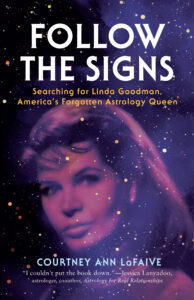
Follow the Signs: Searching for Linda Goodman, America’s Forgotten Astrology Queen by Courtney Ann LaFaive is available from University of Iowa Press.
Courtney Ann LaFaive
Courtney Ann LaFaive is assistant professor of English at the University of North Dakota. She is author of Daughter in Retrograde. LaFaive lives in Grand Forks, North Dakota.