What’s in a Book’s Name? One Writer’s Journey to Finding the Perfect Title
Brook Wilensky-Lanford on the Long, Difficult (Yet Fun) Process of Titling Her New Book, A God-Shaped Nation
For me, coming up with titles is always a team effort. Titling my first book, a quirky history of people who look for the Garden of Eden on Earth, had me stumped, until my friend the writer Josh Garrett-Davis suggested “Paradise Lust.” True, there were other books by that title, but you can’t copyright a title, and besides, no one was likely to confuse my book with softcore romantasy set in Thailand. Paradise Lust (Grove Press, 2011) said a lot about the attitude the book took towards its history: cheeky, but also accurate—the book was literally about people “lusting” after paradise. So when it came time to title my second book, a one-volume history of religion in the United States from “first contact” through the Trump era which Grove had commissioned in 2016, I knew I would need some help—I just had no idea how much.
For nine years, the book lived in my head and my computer as “God and Country.” I thought the title did the same thing as Paradise Lust had: cheekily twisted a commonly known phrase while retaining its accuracy. Sure, I always got puzzled looks when I told anybody I was writing something called “God and Country”—one friend indignantly told me that phrase was the motto of both the Marines and Yale—but I was in denial.
In mid-June 2024, my editor gently broke it to me that “God and Country” would not fly; it was far too common a phrase in the titles of other books about religion, making mine impossible to distinguish with a quick web search; a death knell for booksellers and marketers. Still: I loved my title and had no idea what could replace it. Thus ensued a monthlong title quest. It took place in an email thread with my agent and two Grove editors; in an epic Facebook thread with 80 of my oldest friends; across all the evening conversations on my weeklong family vacation.
It soon became clear that the problems with finding the perfect title mirrored the problems of putting a book about religion out in the American marketplace to begin with.
It soon became clear that the problems with finding the perfect title mirrored the problems of putting a book about religion out in the American marketplace to begin with. That is: readers come to the subject pre-divided. Not only did the title have to stand out in a Google search, it had to invite readers in—from the devout to the atheist and everywhere in between—rather than push them away.
Of course, I had a more specific audience in mind when I wrote this book. I was writing a history of religion for people who did not care about religion per se. Those were my people: when, as a college sophomore in the mid-90s I had announced to my parents that I was going to major in religion, not English, my ex-Jewish feminist mom sounded concerned: did I want to become a priest?
However, in the nine years it had taken me to research and write the book, I had also up and left New York and moved to Chapel Hill, North Carolina, to get a Ph.D. in Religious Studies. And in the process I had developed some non-negotiables. For example: the ivory tower had taught me that religion is not about belief. It’s about action, practice, ritual, community, food, clothing, music. It was important to me to reflect that shift in the book and in its title. The problem: that “belief” and “faith” are in pretty much every common phrase about religion that might be recognizable to my readers.
Quotations from famous Americans were proposed. Adjectives in subtitles were considered (Narrative? Too abstract. People’s? Too Zinn-specific. Human? Too obvious. Spirited? Sounds like cocktails.) We also thought about “From _____ to _____ formulations,” but the only alliterative combinations we could come up with weren’t terribly catchy: “from Columbus to COVID.” My friends assuaged my growing anxiety by suggesting progressively goofier titles: Congress Shall Make No Law; Sweet Baby Jesus; It Seemed Like a Good Idea at the Time. Some were even complete with subtitles: God’s Country: No One Else Would Want it; Hallelujah: What’s It to Ya? At one point I even sent my editors a serious, detailed pitch for “Bless This Mess: A Human History of Religion in America.”
All of this might seem a lot to go through for a few short words, but since those words are the first impression of the book, and have to be intriguing all on their own, the effort was well worthwhile.
But finally, willies out of my system, my team and I landed on two options that we could all live with: “State of Faith” and “A God-Shaped Nation.” Of the two, the choice finally seemed obvious. Where “State of Faith” felt too generic, too religious, and even too Christian; a “God-Shaped Nation” seemed just weird enough. There is no other book called “A God-Shaped Nation,” and the existing books with the word “God-Shaped” in the title are not history, and thus less easily confused. The title felt neither too pro- or too anti-religious. The subtitle, which was originally picked to avoid repeating the article “A”, was also helpful in signaling scope and perspective. Five Hundred Years of Religion in America means this is not just another history going back to 1776, and this is not a book that equates religion with Christianity.
It also met my “Paradise Lust” standard of double-entendre. Yes, I was playing with the term “a god-shaped hole,” a paraphrase of the French mathematician-philosopher Blaise Pascal, who was indeed trying to describe a “deep abyss” within humans that could only be filled by the Christian god, no matter how hard we might try to fill it with worldly alternatives.
But to me the idea of something being god-shaped always seemed slightly absurd: how could anyone definitively know the shape of God? And which God was that, anyway? To me, god-shaped was a Rorschach test: you saw in it what you needed to see. That hole took up as little or as much space as you wanted it to in your life. I was relieved to discover in my title search that there are also a couple of songs and albums called “A God-Shaped Hole,” and their range in genres ranging from Christian Contemporary to psychedelic rock reflect that Rohrbach sensibility.
The title could indeed be read as a “God has shaped the nation” as Puritans and evangelicals have long believed. But it could also mean that the nation is a vessel into which people project their ideas of God. In short: is it a nation shaped BY God or a nation shaped LIKE God, whatever that might be? The latter happens to be closer to my own perspective, and hopefully that comes through the book. All of this might seem a lot to go through for a few short words, but since those words are the first impression of the book, and have to be intriguing all on their own, the effort was well worthwhile—enough, hopefully, to invite readers to pick up the book and make their own decision.
__________________________________
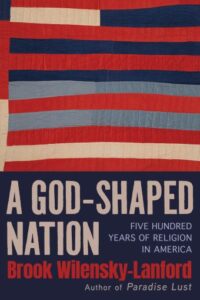
A God-Shaped Nation: Five Hundred Years of Religion in America by Brook Wilensky-Lanford is available from Atlantic Monthly Press, an imprint of Grove Atlantic.

Brook Wilensky-Lanford
Brook Wilensky-Lanford is a religion writer, editor, and teacher. The author of Paradise Lust: Searching for the Garden of Eden, a New York Times Book Review Editors’ Choice, and former managing editor of Killing the Buddha, her work has been published in The New York Times, The Guardian, The New Republic, and elsewhere. Currently the Associate Director of Sacred Writes Public Scholarship, she holds an MFA in Nonfiction Writing from Columbia University and a PhD in Religion in the Americas from the University of North Carolina at Chapel Hill, where she lives.