What Romance Novels Taught Me About Writing Literary Fiction
Rowan Beaird on How Reading Romance Rewired Her Writing Brain
In August of 2021, I couldn’t read. I’d just had a miscarriage—my second within six months—and every time I picked up a novel, my attention would splinter, the words disconnecting from one another, nearly incomprehensible. I complained about this to a friend. “I don’t know what to do,” I said. “It’s like my brain has changed. I can’t even reread books I love.”
She asked what I was reading. I was attempting the new Ishiguro.
“Have you tried…romance?” she asked.
For my entire adult life, I consumed almost exclusively literary fiction. As an English Literature major, my idea of a light read was P.G. Wodehouse. To me, books were (are!) sustenance, so much more than entertainment; many hold the weight of religious texts. Especially as a writer, I read books not just to learn about other lives and worlds, but also to learn how to write. I didn’t think I was being judgmental by excluding other genres, I just read for a very specific purpose—one I assumed romance could not fulfill.
But I was desperate, and so we walked over to one of my favorite Chicago bookstores, Women and Children First, and my friend bought me a starter romance book: Beach Read by Emily Henry. I had been reading the first 20 pages of Klara and the Sun for two weeks, but I finished Henry’s novel within 24 hours.
Months before, I’d quite arrogantly thought I wouldn’t have much to learn from them, but they’d taught me a tremendous amount.
First off, it’s a banger of a book—smart, funny, empathetic—and, given that it’s about two writers in the Midwest, basically engineered in a lab for me. But more than that, for someone who was experiencing such a profound loss of control, this book gave me precisely what I needed: certainty. What I sought again and again as I consumed dozens of romance novels in the weeks to come was the knowledge that no matter what happened, the couple would wind up together. I knew they’d meet within the first 20 pages. Resist the attraction or fight soon after. Kiss by the halfway point. Sleep with each other three quarters in. Be pulled apart before the final act.
When I got pregnant with my daughter that October, I kept asking the doctor if they could just tell me everything would be alright, but no one can promise you that, except in the pages of these novels.
During my pregnancy, I was getting my first novel, The Divorcées, ready for submission, but I’d also started to write something new. For years, I’d wanted to set a novel over the course of a wedding weekend, and so I began to sketch out a remote island the guests would be ferried to, the histories of the bride and groom, their desires and secrets. When I write, I have books I obsessively reread; they act as North Stars. For this nascent idea that would eventually become my sophomore novel, Tenderness, I kept opening Susan Minot’s Evening and James Wright’s The Branch Will Not Break, but then I’d think about all of the romance books I’d read. Months before, I’d quite arrogantly thought I wouldn’t have much to learn from them, but they’d taught me a tremendous amount.
First, don’t be frightened of cliches. Literary fiction writers live in fear that someone will say their writing is cliche, that they’re following a formula. To say something is original is an incredible compliment, but I think that can frighten us away from basic building blocks of drama. For Tenderness, I’d started to craft a character who was the bride’s best friend from college, but I worried it was too predictable for him to be in love with her. Reflecting on the romance novels I read, I realized that I often craved the predictability of the setup: the character returning to her hometown, the introduction of the extremely attractive professional rival. It did not matter that I’d read them before. What was important was the texture and nuance of these set-ups—how the writer made them their own.
Literary fiction writers often decry the idea of writing for the marketplace, and I still agree with that in many ways—write your weird book, the book only you can write—but I’ve also started to think of my novels more as a conversation with readers.
Second: sex scenes are excellent opportunities to learn about characters. It’s rare for a literary fiction writer to craft an exceptional sex scene. It’s not that literary fiction avoids the subject, but it’s often a site of trauma, or mentioned in exposition, or the sex scene itself fades to black as one character is removing their belt. There are of course excellent literary sex writers—Jennifer Egan and Brandon Taylor immediately come to mind—but we praise them because they’re the exceptions, not the rule. Romance writers understand that sex isn’t just a culmination of desire (though on its own, this is reason enough to depict it!), it’s also an opportunity to understand characters, and if a book contains romance, like Tenderness, you’re telling an incomplete story if you always skip over these moments.
Third: even if your ultimate goal is to subvert them, you have to understand audience expectations. When I was younger, I never wrote to be published, it was simply how I processed the world. As I began to take writing workshops, I responded to comments and criticisms, but I thought of that as a way to refine my craft, not necessarily as a way to better satisfy my readers (even the idea of readers was new to me). Literary fiction writers often decry the idea of writing for the marketplace, and I still agree with that in many ways—write your weird book, the book only you can write—but I’ve also started to think of my novels more as a conversation with readers. With Tenderness, I thought deeply about what my audience would expect from a wedding book and a love triangle, understanding that if I chose not to include predictable scenes or confrontations, I’d need a very good reason for these decisions.
After giving birth to my daughter, I tracked the books I read during maternity leave in my notebook. It’s a good reflection of what I read now: Patricia Lockwood and Ali Hazelwood, Katie Kitamura and Talia Hibbert. After finishing Tenderness, I sketched out an idea for a romance novel, but in the same way it took me years (decades!) to learn how to write literary fiction, it would take years for me to be able to write a compelling book in that genre. For now, I’m still a student, learning everything from them I can.
__________________________________
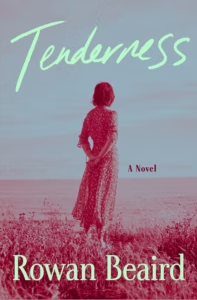
Tenderness by Rowan Beaird is available from Flatiron Books.

Rowan Beaird
Rowan Beaird is a fiction writer whose work has appeared in The Kenyon Review, The Southern Review, and The Common, among others. She is the recipient of the Ploughshares Emerging Writer Award, and her work has been nominated for a Pushcart. She has received scholarships from the Bread Loaf Writers’ Conference and StoryStudio, and she currently works at the School of the Art Institute of Chicago. The Divorcées is her debut novel.