What is Home? On Food, Family and the Promise of Queer Domesticity
Krys Malcolm Belc Considers Cooking For Comfort in Childhood and Adulthood
I begin by trying to remember the first white woman who taught me to cook. As a teenager, I watched Sara Moulton because she was so smart about food. She often made accessible dishes on her shows, especially on Sara’s Secrets, but her experience in restaurants and as a recipe editor and editor for Gourmet empowered her to explain why she did the things she did, as well as what was important to spend time and money on. I didn’t shop for a family, and I only earned money here and there—first as a babysitter, and then as a teacher at the tae kwon do studio where I studied—so I couldn’t go out and buy the things she named as she set up her mise en place, a phrase I learned from food television. When I walked to the grocery store between tae kwon do classes, I bought snacks: watermelon cubes in plastic containers, single-serving yogurts, boxes of six granola bars to keep in my backpack. But I was learning. I now knew how to mince a shallot, how to debone a chicken. By studying the way Moulton cooked her family-friendly dishes for Cooking Live and Sara’s Secrets, I was preparing for a future I hadn’t yet begun to imagine.
The house I grew up in was impossibly loud: my mother was loud, my five siblings were loud, the dogs, a series of golden and Labrador retrievers, were loud. First we were in a very small home, the downstairs of a duplex in which our bodies were always on top of one another, sitting in front of the window AC in the living room eating Firecracker Popsicles while our mother cooked yet another meal for the family, and then we were in a much larger, more echoey home, our mother’s yelling reverberating off every wall. My mother treated food television as background fodder, something that was only half paid attention to. I learned from her that while you do the work of the home, you listen to the work of the home. Your life becomes a script you have to follow continuously in order to keep it working.
*
What was the adulthood I imagined? I hoped it wouldn’t be this, this middle-aged drudgery my mother was in. There was a physical separation between her and any neighbor, between her and any other adult person. My parents lived in a wooded, bucolic suburb next to marshland. There weren’t sidewalks, and if someone didn’t live in a house we could get to by cutting through forests, we didn’t hang out with them. I didn’t understand why my parents had chosen this isolated place for our childhoods. I couldn’t envision adulthood beyond my first job, figured maybe I’d just pop, like a balloon that had hit a tree branch. I didn’t know any families I thought of as queer families growing up. I don’t think I ever heard that word.
If you’d told me at sixteen that in my thirties I’d mostly want to be at home, it would have sounded absurd. Home was the biggest trap of all.
When I was thirteen, I won a writing contest and went to some workshops in New York, where, for the first time, I had freedom to wander on my own around a place with sidewalks. Putting one foot in front of another as I tried to navigate the blocks around the art gallery where the workshop would take place, I imagined what it would be like to be eighteen or twenty-three or twenty-nine. The edges were blurry, because I wasn’t usually surrounded by people. Adult me sat on a couch. She sat at a desk. She was lonely, so she got a terrier. But when I was my mother’s age, what could I be?
*
Like many teenagers, for all kinds of reasons, I felt trapped at home. I was grounded a lot, more than any of my friends, because my parents were stricter than theirs and because I’ve always had a smart mouth. If you’d told me at sixteen that in my thirties I’d mostly want to be at home, it would have sounded absurd. Home was the biggest trap of all.
Historian of queer domesticity Stephen Vider writes, in his book The Queerness of Home, that while the home is not innately freeing, people of various identities and backgrounds have found emancipatory potential within the constraints.
Vider’s work complicates even my own impulse to dismiss domestic life as purely a series of conformities, a way of shrinking myself into an expected narrative. Vider looks at the ways queers experimented with the idea of the domestic sphere in the decades after World War II, analyzing, among many other things, what the meaning of home could be in a queer context. Though we could take it in new directions, and though many did, we were still in some ways bound by the ideas of family and home that existed outside queer community.
Social inclusion, within the family, the community, and the nation, Vider writes, all depend on performing domesticity correctly, that is, following the scripts of the white, middle-class, heterosexual home.
*
The script was that every morning my mother got up and turned on the coffeepot, that she made breakfast for the kids who were too little to make it themselves, that while we all went somewhere—us to school, my father to work—she cleaned the house up and down, did the laundry, bought the groceries, took my father’s suits to the dry cleaner, and then she picked us up from school, took us to sports, made us all dinner, and cleaned up after the nightly disaster that was six children eating and doing homework and showering and going off to bed. My mother loved babies and toddlers, the work of that, the breastfeeding and soothing and rocking, and I’m not saying she didn’t love us once we were older, but we exhausted and exasperated her, anyone could see that. Every August, my mother brought the six of us to a stuffy strip mall for new sneakers we would bring home in boxes, place in our closets, and avoid wearing till the first day of school. One by one, we would sit on a bench and get measured, and after our turn was up and we’d lifted our sole off the long metal foot-shaped ruler, we’d act bad, I mean horrible, running though she’d reminded us, Don’t run!, asking for shoes that were more expensive than the budget we’d been assigned, fistfighting over who was going to get what. I can’t remember my father ever taking us to do something so existentially mundane and terrible as back-to-school shoe shopping.
*
His script took place outside the house. He went to work: long hours, trips abroad. He coached T-ball and basketball. When he was home, he installed things, or organized things, or delegated the organizing of things out to us. And okay, none of that is easy, but none of it is daily, either, other than the paid work. I didn’t want to be a stay-at-home mom, but I’m not sure, if someone had offered me a replica of my father’s life, I’d have wanted that either.
Though we could take it in new directions, and though many did, we were still in some ways bound by the ideas of family and home that existed outside queer community.
I didn’t like the way my parents’ power dynamics played out. They fought over money and who was more tired or deserved or didn’t deserve leisure. My mother’s main power was in her voice, because the family money was hers but also not. Their relationship felt equal in some senses, but what my mother would do in an emergency was never clear to me. It seemed distinctly scary and unromantic in a gendered kind of a way. There was and is a sense of love, but love tied up in so much else.
In recent decades, Vider notes, families like my parents’ have become steadily less common, with fewer houses comprised of married cishet couples, with increasing numbers of Americans, including many older people, living alone. Still, Vider notes, the dream is there, and the vision of the romantic couple has continued to hold sway in popular culture and the law as the surest path to personal happiness and national belonging.
*
When you watch a celebrity television chef, you mostly watch them alone.
*
Just like I liked watching the women on television, I liked watching my mother make the actual meals that fed our family, every single breakfast and lunch and dinner, except for occasional delivered pizza or trips to Chili’s or Macaroni Grill, or Friendly’s when my dad was out of town.
One of my mother’s favorite shows was Rachael Ray’s 30 Minute Meals, which aired the year I was in the eighth grade. The show featured a frenzied series of actions: Ray literally ran back and forth from her cupboard to grab bags of pasta or grains, furiously patted meat dry with paper towels, opened giant cans, her forearms straining with the speed of it all. And the whole time, she talked, in an almost pressured way, about what she was doing.
I liked that my mother, who grew up in a home with no good cooks and not enough money, also chattered the entire time she prepared food. She talked at us about people who lived on our cul-de-sac in stiff colonial houses like ours; she caught up with friends and family with the cordless phone tucked under her chin; sometimes, she talked quietly to herself, narrating the steps of whatever she was making. Making meals every day for so many people had made a cook out of her. My mother poured vegetable oil and vinegar and a packet of dressing mix into a glass bottle and shook it vigorously. She took off her rings to mix meat and breadcrumbs and spices in a big bowl. She roasted potatoes in a giant baking dish. She cut red onions into bits with a steak knife. She breaded chicken cutlet after chicken cutlet after chicken cutlet and the whole time, she talked incessantly, at me, at anyone in the room, at the dog, sometimes at nobody.
_______________________________
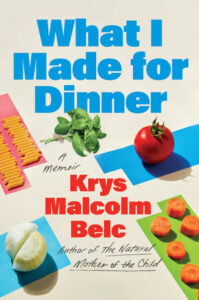
Excerpted from What I Made for Dinner: A Memoir by Krys Malcolm Belc. Copyright © 2026 by Krys Malcolm Belc. Reprinted by permission of Catapult. Sections of this essay appeared in an earlier essay published in beestung magazine.

Krys Malcolm Belc
Krys Malcolm Belc is the author of The Natural Mother of the Child: A Memoir of Nonbinary Parenthood, and of the flash nonfiction chapbook In Transit. His recent essays have been featured in The Kenyon Review, Electric Literature, The Arkansas International, and elsewhere. Krys is the memoir editor of Split Lip Magazine. He lives in Saint Paul, Minnesota and is the current Edelstein-Keller Writer-in-Residence at the University of Minnesota, Twin Cities.