What Happens When the War on Drugs Turns Into a Wellness Fad
Kojo Karam on the Industrialization of Psychedelics
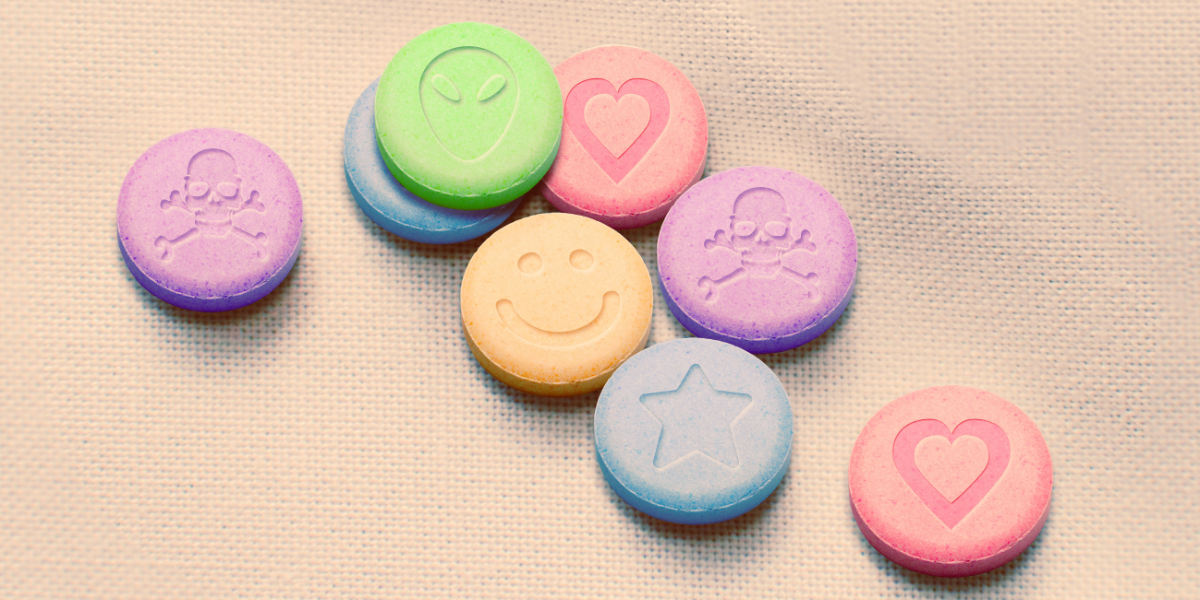
Around the year 2000 Nick Wallis was sat at a card table at the back of an abandoned docklands shed in Melbourne surrounded by lasers, strobe lighting and loud, thumping bass music. As he sat there, strangers in kaleidoscopic outfits with neon wristbands would walk up to the table and hand him a bag of pills.
With the beat reverberating off the walls, Nick would pull out one of the tiny pills, hold it steady between his fingers and scrape some dust off it into a shallow dish. Then he would drip some clear reagent liquid on to it. In an instant there was a bloom of colour. If the mixture turned deep violet, almost black, then the powder contained MDMA, the chemical name for the party drug ecstasy. If it flared orange or green, or perhaps even failed to change colour at all, then Nick had to warn whoever had given him the pills that they had actually bought something else entirely and the drugs they were about to take could seriously harm them.
“This was a non-funded, back-of-the-dance-floor project,” he explained when we met in Melbourne a couple of decades later. “We would approach parties with an offer to do sort of brief intervention education work, operating our care space at their events.”
At the time Nick was part of RaveSafe, a collective of volunteer activists who came together in 1995 to promote safer drug use practices at the biggest raves in Melbourne. They started by printing information leaflets for partygoers, telling them how to minimise the risks that came from their drug use. Then they began “trip-sitting,” roving the dance floor, look- ing for people badly affected by the drugs they had taken who could be shepherded to a peaceful corner of the party and looked after. RaveSafe even began working with the organisers of dance parties to ensure that best practice was being followed as they planned the rave. Were there free water stations that were easily accessible? Were there cool-down areas and quiet spaces for people feeling overwhelmed? What about security staff ? Were they trained on how to calm down people who might be overly intoxicated, or would they escalate the crisis?
And then, almost without warning, the door swung open, not just in this country but all over the world.
Eventually, RaveSafe volunteers, including Nick, started delivering drug-checking services directly to partygoers. For all the headlines in the nineties warning of how the dangerous new drug ecstasy was killing kids in nightclubs all over the world, the technology to tell if someone was about to take a dangerous, tainted pill was readily available the whole time. If the concern was around children dying then why would we not want to inform them if they were about to take something that might harm them? However, the idea that Australia’s teenagers were now being offered free pill testing at raves was enough to spark a moral panic among the nation’s politicians and tabloid papers.
Critics argued that safety practices like these only encouraged drug use and sent out the wrong message at a time when we were meant to be moving to a drug-free world. A paper from the Australian government at this time even advocated for the prohibition of the test kits themselves. People shouldn’t even be able to access the equipment that would tell them whether a drug was safe or not. Ecstasy-fuelled raves were the enemy of a decent, well-functioning society and anything associated with them, even test equipment that could make them safer, represented a subversive danger that needed to be punished.
There was a bit of media hysteria surrounding the term “rave” that made people believe that raves were super bad, Nick recalled. “Various promoters started not wanting to have RaveSafe at their event.” During this time, when RaveSafe were being demonised by some of the most powerful people in Australia for offering pragmatic MDMA checking at raves, it would have been tough for Nick to imagine the picture a generation later when, on 1 July 2023, Australia became the first sovereign nation state to legalise the use of psychedelics as treatment for persistent mental health conditions by changing its medical regulations to open up private psychedelic-assisted therapy.
Australia’s national regulatory authority for medicines, the Therapeutic Goods Administration (TGA), rescheduled both MDMA and psilocybin, the psychoactive ingredient within magic mushrooms, to Schedule 8 of the Poisons Standard. This meant that both drugs could now be used as medical treatment. Authorised doctors were now legally allowed to prescribe MDMA for patients struggling with PTSD and psilocybin for patients suffering with treatment-resistant depression.
At the same time the 2010s hype around legal cannabis began to fade, psychedelics emerged in the 2020s as the new miracle drug.
When we met at his office in Brunswick, a relaxed suburb of Melbourne – think vintage clothes stores and artisan bakeries; Shoreditch, London or Williamsburg, New York – Nick was now the long-time project officer at DanceWize (what RaveSafe had rebranded itself as in order to escape the bad publicity) as well as the co-founder of the Australian Psychedelic Society. He had a gregarious personality and greeted me with a smile so broad it seemed to swallow up the rest of his face. As he introduced me to his DanceWize colleagues and regaled me with tales of the battles they fought for drug policy reform in Melbourne over the years, it was striking to hear just how quickly things had changed in such a short period of time. “We were still fighting just to get any psychedelic research,” Nick told me. “All the universities were against even research happening here.”
For years, activists in Australia pushing for a different approach to psychedelic drugs like ecstasy or magic mushrooms were banging against a locked door. And then, almost without warning, the door swung open, not just in this country but all over the world.
When Nick was drug testing MDMA pills at the back of raves at the turn of the millennium, if you got on a stage as a politician, a health-care professional or a business executive and defended psychedelics, you would have been laughed out of your job, dismissed as a quack and maybe even placed under police surveillance. From the hippies in the sixties to the ravers in the nineties, it became the norm to insist that if you took psychedelic drugs then you would lose your mind and go crazy. Yet today scientists, CEOs, even conservative leaders who used to champion the War on Drugs, are now publicly exploring whether these same drugs might actually hold the key to healing our minds and addressing our entrenched global mental health crisis. At the same time the 2010s hype around legal cannabis began to fade, psychedelics emerged in the 2020s as the new miracle drug.
Today, everyone from the Economist to the New York Times has heralded the coming psychedelics renaissance, as hallucinogens begin to gain greater cultural, medical and commercial acceptability. Scientists are now falling over each other to do clinical research into psychedelics, with results suggesting that these drugs can help the treatment of not only of PTSD and depression, as they have been legalised for in Australia, but also anxiety disorders, suicidal ideation, anorexia, obsessive compulsive disorders and dementia. They are even being cited as the drugs that can cure addiction to other drugs.
One might imagine that the speed of change around the scientific, cultural and now legal status of psychedelics would give Nick a sense of vindication. Yet for him and his colleagues at DanceWize, there is trepidation about the new world into which psychedelics are being pulled. “Legalisation is regulation . . . and regulation is business,” he stated. He wanted the law to change. Just not necessarily like this.
As other jurisdictions across the world consider following Australia and legalising psychedelic-assisted therapy, questions continue to hang over the topic. Are these drugs really safe to use? Could they really lead to us living healthier psychological lives? How will they be produced, accessed and ingested? And perhaps most importantly, if we are rewriting the rules on drugs, who will those rules work for? Who will own and control the future of psychedelics?
In much the same way as talk of a green rush followed the first legal changes around medicinal and recreational cannabis, the idea that now is the time to get in on the ground floor with psychedelics has been spreading across the world. Today, acronyms that used to only be written out on police reports and counter-narcotics surveillance lists – LSD, MDMA, DMT – now appear in pitch decks prepared by hedge funds and private wealth offices under the subheading “early stage investment opportunity.”
Drug development companies that work on psychedelics are being flooded with cash, for example Reunion Neuroscience were able to attract $103 million from investors to develop psychedelic treatment aimed at helping women struggling with postpartum depression. Lykos Therapeutics raised $100 million to support the company’s development of MDMA-assisted therapy for post-traumatic stress disorder. Where we used to hear about how psychedelics would turn you into a spaced-out loser, now there are articles in Bloomberg and the Financial Times profiling bankers, lawyers or coders who insist that small amounts of LSDor psilocybin mushrooms, mixed in with their morning coffee, can enhance performance, improve mental health and sharpen productivity. Even fashion and beauty magazines like Vogue and Marie Claire run articles describing psychedelic retreats as “the future of wellness travel” and telling us how microdosing with psychedelics can help women who suffer with severe premenstrual syndrome.
With such exciting claims, it is no surprise that the global regulated psychedelic drugs market is now projected to turn into a multi-billion industry over the coming decades. However, as Boey explained in relation to the commercialisation of cannabis, there are challenges alongside the opportunities.
At the moment, the main source of money that is flooding into psychedelic research and treatment is coming from the private sector, including many of the wealthiest people in the world. Australia’s richest person, Gina Rinehart, and fellow billionaire Andrew Forrest have both invested millions into biotech companies that are focused on developing medical cannabis and psychedelic treatments. The 2023 rescheduling of psychedelics showed that this was a smart investment. On the day that the change in the law was announced, stocks of biotech companies associated with psychedelics spiked by around 30 per cent. The Canadian company Optimi Health Corp, headed by the heir to the yoga brand Lululemon, soon secured a licence to start exporting psychedelics to Australia.
“They’re the ones who will make the money,” Nick explained as I looked at walls plastered with the DIY posters RaveSafe/DanceWize had produced over the years to push for better drug policies. “They will be the holders of a licence to import and sell.”
The race to corner the market in legal psychedelic therapy treatments, even before they are legally allowed in most jurisdictions in the world, is intense. If these drugs receive the necessary licenses, investors imagine, they will be marketed as the new “miracle” mental health medicine in a world that is in the grip of mental health crisis. In the same way Ozempic’s profits derive from the fact that the drug was released into a world where obesity levels were at record heights, legal psychedelic drugs stand to gain exceptional market value because they are arriving just in time to treat a world lonelier, sadder and more traumatised than ever before.
As our understanding of trauma has developed over recent decades, we can appreciate how experiencing painful events in our lives can lock us into negative thought patterns that we struggle to move beyond, even years afterwards.
We are currently seeing an explosion of mental illness across the world. In a 2017 report the WHO estimated that the number of people living with depression had increased by 18.4 per cent between 2005 and 2015. And this was even before the isolation, fear and economic insecurity of the Covid-19 pandemic resulted in a further 25 per cent increase in depression and anxiety disorders in 2020 alone.
Now, it calculates that nearly a billion people globally (including 14 per cent of the world’s adolescents) are living with some form of mental illness. 14 Depression, anxi- ety, ADHD, OCD, bipolar disorder, eating disorders and other mental health issues are exploding right across the planet. In part this may be due to increased awareness about the importance of mental health and less stigmatisation regarding seeking out help if you are struggling. Schools now teach children about the importance of emotional well-being and workplaces offer confidential counselling services for overstressed employees. But these initiatives do not reduce the problem. We have easy access to anything we could want but are more miserable than ever – overeating, overspending and overworking.
As Peter said back in Glasgow: we are all addicts – to money, to sex, to likes on Instagram. Something about the way we are living our modern lives is causing so many of us to feel exhausted, unfocused, apprehensive and out of control. And into this traumatised world has come talk of a psychedelic renaissance, with drugs once associated with hippie deadbeats now being rebranded as cutting-edge mental health wonder drugs. In the words of Rick Doblin, one of the leading advocates of this reform, psychedelics are now being marketed as the pathway to a world of “net-zero trauma.”
As our understanding of trauma has developed over recent decades, we can appreciate how experiencing painful events in our lives can lock us into negative thought patterns that we struggle to move beyond, even years afterwards. Now science is suggesting that psychedelics may offer a pathway to breaking these thought patterns – to reconfiguring our relationship to ourselves and helping us move beyond our own pathologies. The idea that the key to curing our troubled minds may be a bunch of plants and fungi that we have suppressed for the past few years brings our relationship to these plants full circle. Archaeology and ethnobotany indicate that humans have used a variety of psychedelic plants since before written records began; there is evidence of humans using psilocybin mushrooms dating back as far as 6000 bce in the Sahara.
However, unlike the “big three” targets of drug prohibition, psychedelics were not easily industrialised by European colonial companies during the Age of Empire. Cultural context, unpredictable physical effects and the limited shelf life of products like peyote or ayahuasca brew made it difficult for Europeans to turn them into commodities in the same way they did other psychoactive substances like coffee, tobacco and, of course, cannabis, coca and opium.
This meant that by the mid-twentieth century, when the laws prohibiting the “big three” had been etched in stone, psychedelics were largely flying under the radar. These plants were not originally among the main targets of the War on Drugs.
However, that would change in the 1960s when the countercultural movement became the new enemy of all upstanding, tax-paying citizens. Women were burning their bras, Black people were marching for their rights and teenagers across the world were explicitly rejecting the values that their parents held so dear. Psychedelics became the drugs most people associated with this spirit of rebellion. To the older generation, it seemed that the young had suddenly all gone mad. And soon they had the perfect chemical scapegoats to blame for all this instability.
The story of how this change in the reputation of psychedelics came about is encapsulated in the story of a Melbourne-based yoga teacher. She embodies the reason why many people came to fear these drugs and will still approach them with fear and caution, no matter what the clinical research about their rewards might say. To understand why the idea of psychedelics helping to heal our minds sounds so radical, we have to remember how people came to believe the opposite of this idea for so long.
__________________________________
From The Next Fix. Used with the permission of the publisher, Verso Books. Copyright © 2026 by Kojo Koram

Kojo Koram
Kojo Koram is an author and Professor, teaching at the School of Law at Loughborough University. Born in Accra, Ghana and raised on Merseyside, he is now based in London. In addition to his academic writing, he has written for the New Statesman, the Guardian and the New York Times. He is the author of Uncommon Wealth: Britain and the Aftermath of Empire (John Murray 2022). Uncommon Wealth won the English PEN Hessell-Tiltman Prize, was shortlisted for the Orwell Prize for Political Writing and the Bread and Roses Award for Radical Publishing and was chosen as a Guardian book of the year. His latest book is The Next Fix: The Winners and Losers in the Future of Drugs.