What Fascination With UFOs Reveals About Conspiratorial Thinking in America
Adam Kirsch Explores the Intersection of Belief in Aliens and Lack of Trust in Institutions and Experts
A detective story is supposed to end with the mystery being solved: Sherlock Holmes or Hercule Poirot is always able to follow the clues and figure out what really happened. This is impossible with a UFO mystery, because there are no actual clues to follow. Instead, catharsis is achieved when the rip in the fabric of reality caused by the UFO sighting is repaired, allowing the world to make sense again.
To rescue an experience from the “far and alien world” of the inexplicable, it is necessary to find a place for it in the story of our life and our picture of the world. And meaning, like language, is a social creation. The meaning of an experience comes into being when a community of people agrees that it has that meaning, just as sounds become words only when a community of speakers agrees on the meaning of those words. Thus it is crucial for a UFO experiencer to find a place where their experiences aren’t dismissed but respected and valued.
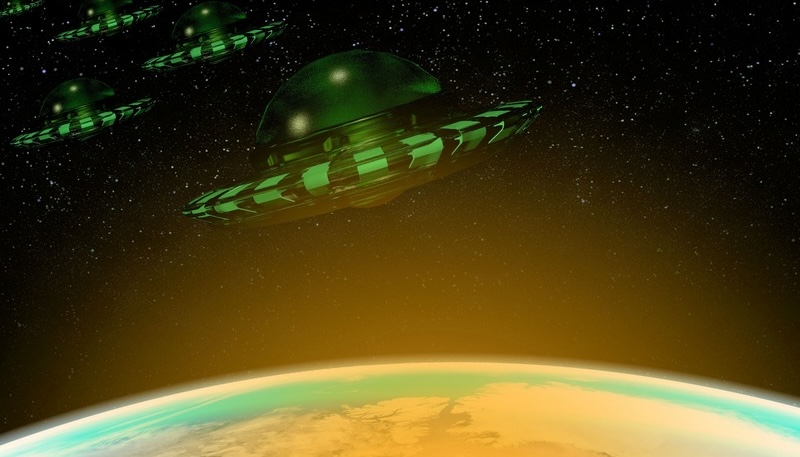
When Captain Ray Bowyer was piloting an airliner over the English Channel in 2007 and spotted a “brilliant yellow light,” he first thought it was a reflection from greenhouses on the island of Guernsey. But when he saw it through binoculars, he saw it had a shape like “a thin cigar, or a CD viewed on edge with a slight incline.” Then “a second identical shape appeared beyond the first.” The two shapes had “sparkling blues, greens, and other hues strobing up and down about once every second or so.” To estimate their size, he compared it to the apparent size of cities he was used to seeing from the air, and concluded that they must be “up to a mile long.” The idea that two mile-long spaceships could appear in one of the most densely populated parts of the globe and only be noticed by a single pilot is, of course, hard to believe. The only category in which such a machine could belong is UFOs, so that is what Bowyer deduced he saw.
An insane person is terrifyingly alone with his hallucinations; an alien abductee belongs to a supportive, if marginal, community that regards his experiences as real and important.
For Bowyer, the story of his 2007 UFO sighting reached a happy ending when he learned about “a new world to me that I didn’t know existed,” he writes in Leslie Kean’s book UFOs: Generals, Pilots and Government Officials Go on the Record, a collection of first-person accounts of UFO encounters. “I’ve come to know a very unusual group of people who are fascinated with the subject of UFOs—an eclectic bunch of dedicated believers and dreamers, writers, skeptics, filmmakers, witnesses, psychotherapists, former military officials, and all hues in between.”
It’s possible to enter such an “unusual group” without meeting its members in person. D. W. Pasulka, a professor of religious studies who writes sympathetically about UFO belief, observes in her 2019 book, American Cosmic, that every UFO witness she interviewed had a “book encounter,” when they serendipitously read a book that taught them to interpret what they had seen as an alien craft or being. What the book actually says about UFOs isn’t that important: For one of Pasulka’s interviewees, it was Carl Sagan’s Cosmos; for another, John Mack’s Abduction. What mattered was simply that “at some point after their experiences, which sometimes persisted over half a lifetime, they were given, came upon, or in some perceived miraculous way were directed to read a book that put their experiences into perspective and seemed to explain them,” Pasulka writes.
For many people over the last forty years, that book has been Whitley Strieber’s Communion. A bestseller in 1987, it was largely responsible for popularizing the idea of alien abduction, and for creating our standard image of extraterrestrials with “gray, humanoid faces and glittering, deep-set eyes”—the image now used as the alien emoji. What makes Communion so powerful for readers troubled by their own experiences is Strieber’s description of the saving power of interpretation. After a lifetime of being tormented by memories he could not explain, he found a way to turn them into a meaningful narrative by retroactively interpreting them as alien abductions.
“One of the central struggles of my own life involves trying to determine which of my stories reflect real events and which are too distorted to trust,” he writes in the introduction. “I have spent my life trying to sort through what I feel sure happened to me, what may have happened, and what in my narrative I feel is suspect.” Over the course of the book, Strieber concludes with the help of a hypnotist that he has encountered aliens five times in his life, beginning in childhood, and that he was repeatedly taken aboard an alien spaceship where he was subjected to brutal experiments. On one occasion, he writes, he was anally probed with an “enormous and extremely ugly object, gray and scaly, with a sort of network of wires on the end. It was at least a foot long, narrow, and triangular in structure.”
Strieber knows that most people will not believe his story, but he argues that this is merely a defensive reaction: “The possibility that strange beings are coming out of the unknown to rape us and steal our sexual material and our embryos is simply too horrifying to face.” He himself was tortured by doubts about the reality of his memories, until he was given the key to interpreting them by an artist and UFO believer named Budd Hopkins.
Strieber recalls being so desperate that when someone happened to mention Hopkins’s interest in abduction stories, he looked Hopkins up in the phone book and went to his apartment, where he proceeded to pour out his memories for the first time. “As I sat there in that man’s living room, listening to him tell me that I wasn’t alone, that others had gone through very much the same thing, the tears rolled down my cheeks, and I went from wanting to hide it all to wanting to understand it,” Strieber writes.
Being convinced that hostile aliens can snatch up human beings and torture them at will might not sound very comforting. But for Strieber, it is easier to cope with such a threat than with the suspicion that he is insane. An insane person is terrifyingly alone with his hallucinations; an alien abductee belongs to a supportive, if marginal, community that regards his experiences as real and important.
By the same token, nothing is more insulting and infuriating than being told you are mistaken about your own experiences. Children are used to having their misunderstandings pointed out, but the essence of adulthood is the ability to make independent judgments about what is true and right. When those judgments are rejected by authority figures on the basis of superior expertise, it’s not just our knowledge that is challenged; it’s our autonomy, our right to our own interpretation of reality.
In arguing about aliens, people are not fighting for survival, profit, or power. Rather, they are posing the kind of fundamental questions that philosophy addresses.
Contests between official expertise and popular intuition are particularly fraught in a democracy, where we are used to the idea that authority is derived from the consent of the public. When government officials tell ordinary citizens that their interpretation of reality is wrong—that there are no mystery drones, that the Pentagon is not hiding alien spaceships—this basic democratic principle is challenged. This was a constant subtext in the House UFO hearing, where elected officials of both parties agreed that the main question wasn’t whether or not UFOs exist, but whether the government and military have the right to tell the public that they don’t. “We need to tell the folks at the Pentagon they work for us, daggum it,” said Representative Burchett, accusing the Defense Department of concealing evidence that the Department says does not exist. “We do not work for them and that is exactly the point. We cannot trust a government that does not trust its people.”
As this language suggests, it’s no coincidence that UFOs went mainstream in an era of populist revolt across the Western world. The media and government about-face on UFOs began in late 2017, a year after the election of Donald Trump and the British vote to leave the European Union. The Office of the Director of National Intelligence’s “preliminary assessment” report on UAP sightings was released in the summer of 2021, just as COVID vaccines were being rolled out across the US. Each of those historic events constituted a struggle over the power to interpret reality and set the limits of legitimate discourse. And in politics and medicine, as with UFOs, much of the public chose to reject the judgment of experts.
For example, on June 21, 2016, two days before the Brexit vote, The Daily Telegraph published an open letter titled “Britain More Prosperous IN,” warning that leaving the EU would lead to higher inflation, lower economic growth, job losses, and cuts in public spending. The letter was signed by twelve Nobel Laureates in Economics and more than a hundred other economists, reflecting the overwhelming consensus in the profession; one survey found that 88 percent of economists opposed Brexit, while only 4 percent thought it might bring benefits. Yet when Britons went to the polls two days later, almost 52 percent voted Leave.
A similar populist backlash drove the American response to COVID-19. In 2020, as the pandemic paralyzed everyday life in the US, the share of Americans who said they would get a vaccine once it became available dropped sharply over the course of the year, from 72 percent in April to 48 percent in October. The decline reflected growing mistrust of public health experts who had fought the pandemic with unpopular measures like lockdowns, school closures, and mask mandates. President Trump fueled suspicion of vaccines whose development his own administration had funded through Operation Warp Speed, publicly musing that the COVID virus could be fought by disinfectants or by taking the antimalarial drug hydroxychloroquine.
On social media, people encouraged one another to turn to ivermectin, an anti-parasite medicine mainly used for deworming horses, as a cure for COVID. Doctors were baffled by the craze: “It’s hard to understand why people would turn down an FDA-approved COVID preventative in favor of a treatment that’s not only unapproved but has a large body of evidence showing it doesn’t work,” one pediatrician told NBC News in 2021.
It becomes easier to understand once we recognize a major driver of vaccine resistance is expertise resistance—refusal to listen to experts simply because they claim to be experts. In part this is a reaction to the way expert guidance sometimes turns out to be wrong or exaggerated. In the end, Brexit wasn’t as damaging for Britain as many economists warned in 2016. Long-term school closures did little to reduce the spread of COVID, while doing significant damage to student learning and mental health.
When it comes to vaccines, it’s a different story. There is no doubt that COVID vaccines were safe and effective, saving lives while helping to bring the pandemic to an end. Yet in May 2023, when they had been available for about two years, a Pew Research Center survey found that only 62 percent of the public believed that the benefits of COVID vaccines outweighed the risks. Such mistrust of medical authorities has become a potent political force, and anti-vaxxers who want to “Make America Healthy Again” were a key part of President Trump’s 2024 coalition. They were rewarded when Trump appointed Robert F. Kennedy Jr., one of the country’s most prominent vaccine skeptics, as secretary of health and human services.
The COVID vaccine debate recapitulated themes that have been familiar to UFO believers for decades. There is the suspicion that the government is hiding evidence, whether about the origin of the coronavirus or “nonhuman biologics”; the conviction that mainstream science is obstinately narrow-minded, if not actively corrupt; the belief that official lies are omnipresent, yet can be penetrated by anyone willing to do some online research.
So it makes perfect sense that these forms of expertise resistance tend to go together. A study published in 2022 by psychologists at Ohio State University found that COVID skepticism functioned as a “gateway drug” for other kinds of conspiracy theories. People who agreed in June 2020 with the statement “COVID-19 is intentionally presented as dangerous in order to mislead the public” were more likely to agree in later surveys that “some UFO sightings and rumors are planned or staged in order to distract the public from real alien contact.”
Of course, the stakes in these two issues are highly unequal. A parent’s refusal to vaccinate could lead to a child getting COVID or measles; a parent’s belief that UFOs exist does not heighten a child’s chances of being abducted by aliens. It is this purely theoretical quality that makes the debate over UFOs so instructive. In arguing about aliens, people are not fighting for survival, profit, or power. Rather, they are posing the kind of fundamental questions that philosophy addresses: What is real? How do we know? And who gets to decide?
_______________________________
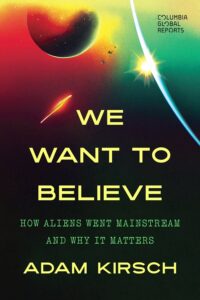
From We Want to Believe: How Aliens Went Mainstream and Why It Matters by Adam Kirsch. Copyright © 2026. Published by Columbia Global Reports.

Adam Kirsch
Adam Kirsch is a poet and literary critic who has written several collections of poems and books of criticism and biography, including The Global Novel and The Revolt Against Humanity, both published by Columbia Global Reports. He lives in New York City, where he is a senior editor at The Atlantic.