
What Barriers Do Women in Science Face When Trying to Publish?
Jennifer Rubin Grandis on Confronting Systemic Bias in Academic Publishing
I went to high school and college at the height of the women’s liberation movement, in the 1970s. We knew that sexism was a problem—but we were solving it.
My father, the center of our household, encouraged me to become a doctor. I was the eldest, and the golden child in our family. I did my best to please him, graduating at the top of my class and followed in his footsteps to become an academic.
I became a decorated Ear, Nose, and Throat surgeon and cancer researcher, recognized for making advancements in the field, and publishing my work in the most prestigious medical journals. My father promised me: if you were the best, you got ahead in life.
The ambitious young woman I was would be proud of the work I do today. But she’d have no idea of the outsized role gender would play in her professional life.
Sexism in science and medicine isn’t always obvious—but it’s not a level playing field.
Sometimes the obstacles that block women’s success can be hard to see. Still, once we recognize them, we know there are ways to remove them.
I’ve been studying sexism in academic medicine since 2019, and I’ve learned from countless interviewees that my experience as a woman in medicine is common. Women are rarely mentored well—in fact, when they ask for advice from senior faculty, they’re often discouraged from submitting their papers to high-impact journals, despite making just as many scientific discoveries as men. One woman I interviewed described how she wanted to submit a paper to the journal Nature, only to be told by her mentor that it was unrealistic, and she should not bother. And the most prestigious journals have few female editors and reviewers, limiting our ability to create our own networks and paths to publication. When women can’t publish, women can’t get grants. When women can’t get grants, we can’t get promoted and are denied access to the resources needed to do more of the important work we trained to—and want to do.
Publications are the basic currency of success in my field. The number of publications is considered every time we’re evaluated for a professional advancement or honor. The prestige—or “impact factor”—of the journals matters, as does the position of our name in the list of authors. (Even the most accomplished scientists fight over where their names appear in the authorship order and whether they are granted the designation of “senior” or “corresponding” author.) The competition for promotion and tenure, the awarding of grants, and admission to exclusive professional societies is intense.
The truth is hard to swallow: The gender gap in scientific publishing is real. Compared with men, women publish fewer papers, usually in lower-impact journals, experience longer peer-review times, and are less often credited with co-authorship on studies where they make contributions—the senior authors who decide on who merits co-authorship see the women as simply “doing their job” while men in similar roles are viewed as legitimate co-authors.
There are fewer female editors reviewing these papers in high-impact journals. Since publication affects everything from getting a job to being granted tenure, from being given lab resources to being admitted to prestigious societies, blocking women from publishing affects their entire careers.
When I published my first research paper as a medical student, I didn’t fully understand the forces at work. My beloved (male) mentor chose the journal we should send it to. He knew the editor and called him to advocate for our article. That’s how things continued while I was in medical school—I would meet weekly with my mentor, and he would critique what I had written, helping to shape the final manuscript. He wasn’t just teaching me how to produce scientific papers, though. As we worked together, I observed how he continuously leveraged his professional connections to advocate for the research coming out of his group. Still, he never explicitly discussed how he did this, and I didn’t know how he built his network. He didn’t offer to introduce me to his connections.
Once I was on my own—when I was no longer working directly with my mentor—I made a discovery that seemed to have significant implications for preventing and treating cancer. I wrote the paper and sent it to a prestigious journal; they considered but ultimately rejected it. I worked my way down a ranked list of journals, and finally published in a good-but-not-great one. The work was solid—it has stood the test of time and is often referred to as a basis for the development of drugs that have subsequently been approved by the FDA for the treatment of many cancers. Still, it wasn’t recognized by editors at prestigious journals—they had no connection to me, and I didn’t have an “in” to get it published there.
Why was it so hard to publish a paper that was based on excellent science? Not only was its reception disappointing, it also took a very long time (18 months!) from the first submission to finally being accepted by the journal where it was published. Having the idea, obtaining funding, and doing the work wasn’t necessarily the hardest part—getting a paper published seemed even more challenging.
I finally understood the difference between me and my male colleagues when I had a drastically different experience a few years later.
Women were fighting for these rights long before the women’s liberation movement. Decades later, we continue the fight. Our work is not done yet.
I collaborated on a project with a male colleague at an elite institution to determine the genetic characteristics of head and neck cancer. I had collected high-quality tumor specimens, while he had access to sequencing and analytic platforms to analyze the results. When the famous head of my colleague’s elite institution learned what we were doing, he joined the team and provided funds for the study. When we were ready to write up the results, this powerful man reached out to an equally influential man who was on the editorial board at a high-impact journal. They agreed that the work should be published there. It was a striking contrast to my previous experiences; this time, the paper was submitted, reviewed, and quickly accepted. The time from first submission to acceptance was less than two months. The “toll” I paid for this was sharing the senior author position with these men. While this diluted my role in publishing the piece, I understood it as the cost of ancillary membership in the scientific boys’ club.
With this particular experience, I felt as if they had let me into the locker room temporarily, just long enough to glean helpful publication tips for the future. The message: it is not only about the importance of the research—who you know is what really matters in getting the paper published.
Sometimes the obstacles that block women’s success can be hard to see. Still, once we recognize them, we know there are ways to remove them. We could ensure that women receive the same funding and research support as men; we could pay them equally; and we could take a closer look at whether merit is really the main criterion in scientific publishing.
Publication is the life blood of research. If you don’t publish, there is no evidence that you ever did the work—not to mention that career success demands it. Closing the gender gap in scientific publishing will help advance women scientists, and truth be told, help all of society with our unique perspectives. We can bring more attention to the lifesaving work women do—and encourage the next generation of bright, young science-minded girls to pursue careers in medicine—by disbanding the “scientific boys’ club.”
Women were fighting for these rights long before the women’s liberation movement. Decades later, we continue the fight. Our work is not done yet.
____________________________
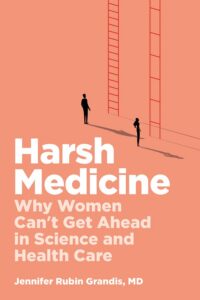
Harsh Medicine: Why Women Can’t Get Ahead in Science and Health Care by Jennifer Rubin Grandis is available from Johns Hopkins University Press.

Jennifer Rubin Grandis
Jennifer Rubin Grandis, MD, is a Distinguished Professor at the University of California, San Francisco, and an otolaryngologist specializing in head and neck cancer research.