Ways of Connecting: On Writing That Marries the Psychological, the Personal and the Political
Faraaz Mahomed Discusses His Debut Novel Mother/Land With Damon Galgut
Damon Galgut is the most generous-spirited, profoundly gifted and oddly approachable human. I am indebted in ways I can’t count for the critique, the encouragement, the consideration, the commiseration and the line edits (yes, he won the Booker Prize and then did line edits for me). I lose faith in humanity constantly, but saying thank you to Damon would be like sending a gift voucher after someone has altered your life and restored your faith in the species. They don’t have cards for those! Damon spoke to me about my debut novel, therapy, and motherlands.
–Faraaz Mahomed
*
Damon Galgut: You’re a psychologist and work in the field of mental health and human rights. What is the crossover, if any, between that world and your fiction?
Faraaz Mahomed: You’re one of the few people who have seen the travails of my first—as yet unpublished—novel. It’s about a therapist. You probably recall that it recounted in rather painful detail the inner workings of a therapy session and the existential question of what makes a life worth living. So I think the question of crossover is much more easily answered in that sense—after all, what is psychotherapy if not storytelling? (and thank you for the notes. I am still working on them!) With Mother/Land and my work on human rights, that too is really fairly easily gleaned from the perspective of the events of the book. Whether we’re talking about Rhodes Must Fall or Black Lives Matter, there’s no shortage of human rights content in my novel.
The arc involving the forced removals is of course a very political and socio-legal one, but it’s also a very personal one—my great-grandfather was dispossessed of his property as part of the Group Areas mess in South Africa, and I think that cosmic puzzle is obviously a precursor to my career/s in many ways, but its also what renders the vastness of a political or social wound personal. I don’t know if that answers the question for me personally, but I’ve seen that in the works of others—Abdulrazak Gurnah, Hisham Matar, Tsitsi Dangarembga—they find really personal ways of connecting with the political. It’s kind of inevitable. Add in the psychotherapist element and it’s all very ruminative, perhaps a little stark and brooding—but I hope that’s not all it is.
Writing has not made me more or less neurotic, although I do think that it has offered an outlet I didn’t have.
DG: Your novel is set in Cape Town and New York, a big gap of ocean and culture between them. Could you say something about that gap in your own life and how you reconcile the two sides?
FM: Well I’ve lived between Johannesburg and New York these past few years (although more settled in Joburg these days). There are aspects of Salim, the protagonist’s life and demeanor that are mine. He experiences a sense of displacement, an estrangement from his upbringing, a kind of diffusion of identity that comes with being split like that. Mine is a little more complex, having lost a sibling when I was younger and psychically working overtime to try to live both of those lives simultaneously. It’s very exhausting to tell you the truth—because it feels never fully formed in either place, and because there is a dearth in both places too. It can feel unsatisfying at times, and I think that’s what Salim struggles with—but what he also does is observe the patent similarities and the fact that these worlds, on their surfaces, are not really all that different.
I certainly observed that in my time in New York, and I certainly feel that what’s shared is not really a conscious history but a subcutaneous psyche. The divide as you call it is real in the sense of what it demands of one, but the peculiarity of seeing an I heart NY t-shirt in Fordsburg or hearing the athaan from the Great Mosque (reminiscent of my Muslim childhood in Johannesburg) playing at a pretzel stand in Manhattan—those are not divisions but actually points of intersection.
DG: You once described yourself as the most neurotic person you know and said you ran 10 kilometers a day. I’m curious: has writing made you less or more neurotic? (And did you ever run the marathon you wanted to?)
FM: Did I say that? I would not deny that. I am a millennial after all, and a writer and a therapist. I mean if one had to look up the word ‘neurotic’ in the dictionary, there I’d be. It has a very specific meaning in the psychoanalytic tradition as you probably know—A neurotic is someone who is at the other end of the spectrum to a psychotic. It suggests a very well-defined (potentially very rigid) psychic construction. In that sense, I am definitely not a very well-constructed neurotic because I veer into the psychotic pretty regularly (and proudly so!) But in the common vernacular of what neurosis means—someone whose life is put upon them, who feels weighted by the everyday, who struggles with unadulterated joy—that is me in a nutshell. Writing has not made me more or less neurotic, although I do think that it has offered an outlet I didn’t have (or is it the case that I became a writer because I needed the outlet? I feel like I’m in Q&A with Lena Dunham now).
The short answer is that I am no less neurotic than if I was just trying to figure out if someone at a party liked me or if I had made the right choices in my career. But writing has a special way of altering that neurosis, because it gives us the text, the language to not simply feel it uncontained but to let it reside elsewhere. As for my running, I run regularly to keep myself in shape (out of vanity—I don’t care about my health). It also helps to reach that cusp of breathlessness—the borderline of mortality—and to just wait it out. Running has a way of clearing so much—so much neurotic angst, so much mind dust, so much embodied malaise that needs dispelling. Thank you for shaming me, but I am at the half-marathon stage—I will make it count!
DG: What was the first core idea or image that gave rise to Mother/Land?
FM: Mother/Land is actually an extension/elongation of a short story I wrote called “Gracious.” It starts with the image of a Muslim cemetery, and in fact the opening line of that story appears in the novel. I don’t want to fetishize it too much but the image of a grave—and the especial ritual of a Muslim qabarstan, visiting the graves of the dearly departed, is a powerful image for me. I grew up with a lot of death around me, so maybe that has something to do with the power of the image, but I don’t know that I’m alone in feeling like there’s something sepulchral and supernatural about the imagery and the experience. In any case, it spawned from that, and then it became about the shared histories of people who were affected by the forced removals. I’m three generations removed from my family’s removal, but it has had such ripple effects and it caused all manner of intergenerational difference and distance.
I grew up with a lot of death around me, so maybe that has something to do with the power of the image, but I don’t know that I’m alone in feeling like there’s something sepulchral and supernatural about the imagery and the experience.
DG: Do you see a difference between reading for diversion and reading with serious intent? Either way, could you tell us about some of the books that have mattered to you and why.
FM: Yes I do see that difference. There are times when reading is just for immersion and for becoming involved in another plane—oftentimes though, even when I think I’m doing that I can’t not feel awed and I guess also to steal a bit from the authors here and there (imitation being flattery of course). I do read with what you call ‘serious intent,’ especially when I’m trying to break out of a pattern, so I’ll try to pick up Murakami when I’m overwriting or I’ll pick up Palahniuk when it feels like I’m taking myself too seriously, and I just want to poke fun at the nonsense of it all.
I am also being emblazoned with that sigil of “African Literature,” whatever that means, and I did struggle a little with that because I worried that I was inserting tropes or flirting with tragedy porn. Have you read Glory by NoViolet Bulawayo? She is like the horizon—every word is placed with such combined humor and tragedy and such Africana, but she is not by any means confined by “African Literature” as a construct. I read her book often when I was feeling like I was veering towards what the market would want, so that I could remember that the market is a denominator of all things, and that only means one thing—make your numerator inviolable. As for others, well, as you know, In A Strange Room is very high up there—it is so wonderfully personal and yet so strange and occluded—You don’t need to know this, but I certainly turned to it many a time when I was working on Mother/Land. One of my favorite books about New York (and in general) is Netherland. It is beautifully crafted, and it resonates with Salim’s storyline in a number of ways, as does Open City. I did certainly immerse myself in these two, but this is where your question becomes so apt because I genuinely couldn’t draw a line between what was for my education and what was for the sheer wonder of it. There’s many others, but I guess, to answer your question, it’s not a bright line—and that’s a very, very good thing to be honest. Also, I still need your signature for my copy please.
*
Faraaz Mahomed is a researcher in the field of mental health and human rights, based between New York and his native South Africa. His short stories and travel writing have appeared in Granta, Boston Review, The Georgia Review, the Sunday Times, and other publications. In 2016, he won the Commonwealth Short Story Prize for the African region with his story “The Pigeon”
Damon Galgut was born in Pretoria in 1963. He has published 8 novels and a collection of short stories. He has been shortlisted for the Booker Prize three times and won it in 2021 for his latest novel, The Promise.
_______________________________
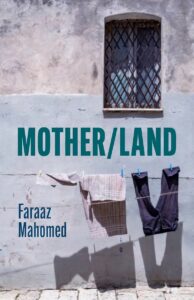
Mother/Land by Faraaz Mahomed is available from Catalyst Press.

Faraaz Mahomed and Damon Galgut
Faraaz Mahomed is a researcher in the field of mental health and human rights, based between New York and his native South Africa. His short stories and travel writing have appeared in Granta, Boston Review, The Georgia Review, the Sunday Times, and other publications. In 2016, he won the Commonwealth Short Story Prize for the African region with his story “The Pigeon”
Damon Galgut was born in Pretoria in 1963. He has published 8 novels and a collection of short stories. He has been shortlisted for the Booker Prize three times and won it in 2021 for his latest novel, The Promise.