Listen: I am not ungrateful. I have always known I am the luckiest girl on earth. I was born in America, for starters, in the belly of the empire instead of its jaws—and I was even born at all. Right after she had me, my mother started having fertility problems, which means I am her only baby, only hope. (I feel the pressure like a life jacket sucked around my ribs. Sometimes I wish she could kill and reincarnate me again, just for a second try to get things right.)
It helps, of course, that I was born in a century when women can read, earn money, take pills for depression, and feasibly become just as powerful and evil as men, if we are motivated enough. If I had been born just a century earlier, I would be illiterate, married with kids by eighteen. A century later and the world will be choked up with greenhouse gas. But I get to attend college for the main purposes of reading books and kissing girls. Women used to get burned at the stake for that shit! My timing couldn’t have been better.
Most of my good fortune is thanks to my parents. They, too, were lucky, graduating from college at just the right time to win the lottery of immigration, finding well-paying IT jobs abroad. They were part of a sea of brown people rolling the dice in America—and they nearly lost it all. When I was eight months old, my dad had a conference in New York. Due to flight delays, he didn’t reach the Twin Towers on time. That day, both buildings went down in flames, blown up by another, unrelated group of suicidal brown people. My dad should’ve died, but he didn’t. (Later, my friend Kavya jokes that some people have plot armor: convenient unkillability because the story can’t happen without them.) So I know a thing or two about beating the odds.
I am thinking a lot about these things—luck and providence, parents and dying, the year I start college. It is my idiot year, my plague year, my pizza-crust year of odd ends and beginnings, and I remember it only more clearly as time passes. It is a year that asks questions, to quote my favorite novel. I am still waiting on some of those answers.
On move-in day, my parents and I fly across the country and then drive to Stanford University. It looks less like a school than a high-end resort. We crane our necks at the rows of palm trees lining the roads. They are towering and vaguely fascist. Somewhere, I read that palm trees are not actually native to Palo Alto. They were transplanted hundreds of miles just for the aesthetics, like me. Mom takes selfies outside the mission-style church, and Dad tries to pick fruit off the ample bushes. I wish they’d cool it with the immigrant behavior.
Reading my mind, Mom smiles. Didn’t I tell you, Rishi? she says. When I first came to America, I lived in Palo Alto. On weekends, I’d walk around campus and dream I was a student here. And now here I am with you. God is good, no?
God’s a real one, I agree. I’ll do my best to live your dream.
That is a lie, of course. I’ll say it up front: I am not trying to live my mother’s dream. Some days, I’m not sure if I want to live at all. Not in a self-loathing, suicidal sense—I’m not a skinny white girl, I don’t have that luxury. I mean that at age eighteen, I’ve already concluded that most things life has offered me (high school, activism, hard work, electoral politics, my parents’ entire American Dream) are shameless, jaw-dropping scams, and I want no part of them. But I am hopeful I can find a better way to live, a more artful and generous one.
On the flight this morning, I told my parents I was going to become a writer in college, both to temper their expectations and to try it on for size. The only problem is that until very recently—mere months ago, to be exact—I was a legal, honest-to-God child. I haven’t fallen in love or done hard drugs yet, two formative experiences I suspect Real Writers possess. In college, I intend to get my heart broken, literarily and expeditiously. I will be unspooled, rescued, smashed-up, burned-out. All this will happen, and I will come to understand.
Outside my dorm is a balloon archway and a welcome committee of RAs who swoop down to help with my luggage. To make the freshmen feel included, the RAs have memorized all of our names—or so I think, until Jeff, the smiling senior handing me my welcome packet, says with his full chest, Welcome, Roshini!
My heart gives an involuntary jump of recognition. I accept the packet, and my new identity, without question. But then Mom leans in and says, That’s the wrong one. Her name is Rishika.
Oh shit, Jeff says. I mean, my bad. I’m so sorry, Rishika. We’re still learning folks’ names! He switches out the packets. I understand that I haven’t entered a parallel universe, I’ve just been mistaken for another freshman. I am suddenly afraid the real Roshini will jump me. Quickly, I follow my parents into the dorm lounge. The centerpiece is a massive world map with pushpinned photos marking every freshman’s hometowns. My smiling face hangs like a ball sack from the Floridian Peninsula. I look away.
What is there to say about my hometown? In Okeechobee, I often felt, to borrow my mother’s expression, like a big fish in a small pond, except the pond was actually a swamp and full of racist alligators. Truly, the kindest thing I can say about Okeechobee is that it instilled in me a desire for revenge. (I suspect revenge drives any gay person who grew up in suburbia.) In Florida, those with social currency had spray tans and football boyfriends, far from the intellectual pedigrees and inherited companies that distinguish the Stanford elites. If high school was Little League, college is the motherfucking ball game.
My double is located across the communal bathroom. Mom says, People will be coming this way all the time, so it will be easy for you to make friends.
Mom is very excited about the prospect of me befriending Stanford students—hearty kids with strong SATs from whom I will gain, perhaps by osmosis, a sense of drive, or a STEM degree. On the plane, when I told her I was just Here For The Plot, she hissed. You can write all your storygories later, Rishi, she said with a demeaning double-rhymed flourish. Right now, you worry about finding some ambition. And a job.
We open the door, and that’s when I first see Georgia Becker. Fate, via a Stanford algorithm, has assigned her as my random roommate. Her parents are bespectacled epidemiologists at the CDC, both Stanford alumni themselves. My dad, like me, distrusts most white people, but I think he likes that they are doctors. The grownups gravitate together to chat, leaving me with Georgia.
You’ve got to teach me to do my eyebrows like yours, Georgia says. She has orange hair, horse-big teeth, and a camp-counselor enthusiasm that is momentarily endearing but I fear will get gra-ing. I promise her I will. I don’t want to give her any reason to kill me in my sleep.
The welcome packet includes introductory placards for us to fill out and hang on the door. According to Georgia’s, she is from Bangor, Maine, an environmental engineering major, and a Taurus. The last section is a conversation starter: Ask me about ! Georgia’s list is lengthy: Infrastructure. Trains. Vegan tacos. The great state of Maine. Nature. The Green New Deal. Women’s soccer. White allyship. Sustainability. I have an inkling that we might have been matched as roommates because of our shared interest in, or perhaps fear of, death by climate change.
Georgia wants me to fill out my placard, too, but I have no idea what to write about myself that might catch someone’s eye en route to the communal bathroom. Ultimately, I keep it short but sweet. I like stories of all forms—novels, movies, confessions at 2 a.m., I write. Should I have said books instead of novels? Too late, I used a Sharpie. I add Bubble tea addict to humanize myself. Then I let Georgia hang the placard before I can agonize further.
The Beckers offer to help us unpack—since we’ve already got the lay of the land, Georgia says heartily. She helps the dads lug things up and down the stairs. I am always impressed by girls who can hold their own with grown men. Meanwhile, Mom and I get into a fight. It turns out Mom packed a handful of Hindu god figurines from our shrine at home, and she wants me to display them on my desk, beside my brand-new birth control pills. Expecting my resistance, she’s waited until the last minute to spring them on me.
You know I’m not religious, I say.
Do it for Amma, she insists. Mom always refers to herself in third person when guilting me. Pattu, I had them blessed by a priest.
People will think I’m a Hindu nationalist, I say. I won’t make any friends.
If you don’t make friends, it’s because of your attitude, Mom says. As a compromise, I agree to keep only one figurine on my desk.
You can even choose which, Mom says generously.
Which one’s this? I say, pointing to the one that appears to have breasts. Mom says it is Annapurna, goddess of food. Could be worse, I think. I could display Annapurna in a feminist way. Maybe girls will ask me about her when they come to the room to hook up.
I want her, I say.
Suspicion crosses Mom’s face. You only chose her because she’s a girl, ha, Rishi?
That’s not true, I lie. Are you telling me I can only worship men? Luckily, Georgia returns, interrupting us. It is time for the parent send-off. We file downstairs into the cavernous lounge. It’s my first time seeing the entire dorm population in one place. It’s bizarre to think that once the parents disperse, we’ll be on our own, like the ensemble cast of some island-survivor show. I scan the room, trying to predict who will go feral first.
My parents are eyeing the crowd, too. I know who they are looking for: brown people. According to the admissions brochure, 20.5 percent of the freshman population is Asian. There are a hundred of us in my wing, so it stands to reason that twenty and a half of us are Asian. I try to count us off in my head. I try not to picture what the “half ” is.
You should go talk to her, Mom says, waving at a tall Indian girl near the pool table. She’s wearing horn-rimmed glasses, a bold choice. I ditched my own glasses in favor of contacts after some jerk boy called me Mia Khalifa in the seventh grade.
The Indian girl catches my eye and smiles. Irrationally, my insides clench. In a movie, she’d be Roshini, my preordained nemesis, my foil, and one of us would have no choice but to kill the other in a climactic duel at the end of the year.
Do you know her, Rishi? Georgia says brightly, startling me. I forgot she was here.
Nope, I say. A silence spreads between us, and I predict correctly that Georgia will break it first.
Well, I don’t know anybody either. Except you, of course. She grins. Should we sit? I think the presentation’s starting.
We find seats and watch the RAs deliver a combination information session / standup set about the impending next stage of our lives. Your freshmen are in safe hands, they declare. We won’t let them do hard drugs . . . alone! The parents laugh at all their jokes, an easy audience. One RA announces there is a counselor for students struggling with homesickness. Mom touches her heart, and I am startled to see tears in her eyes. Maybe she secretly hopes I’ll be one of the students who needs counseling. To her, it would be proof that I love her so much. She’s the person who taught me to love like that. Wretchedly, pathologically, so deeply that it hurts.
After the presentation, markers are passed out so parents can write parting notes for their children on the whiteboard. I mingle with my new hallmates while Mom writes. There is a pretty half-Asian boy named Kevin who lives on my floor. (Found you, I think.) So, what sorts of things are you interested in? I ask. Irritatingly, the placards are starting to make sense now.
You want to know what I did to get into Stanford? Kevin says. Before I can respond (how can I respond?), Kevin answers his own question. I discovered an asteroid, he says. It’s named after me. I’m going to continue my research in the astrophysics department.
Wow, I say. Of course, later on, Georgia and I will laugh about Kevin, along with every other defenseless man in the universe. (There are a million asteroids floating in space, she’ll say. He should shut up until he finds a planet. And I’ll laugh—I bet he can’t even find a woman’s clit. And so on . . . )
What about you? says Kevin.
I know the answer he’s looking for. I used to be a well-known youth climate activist. A D-lister, to be clear—not like that Swedish girl you’re probably thinking of, whom I met only once at a conference, amid her security team. Last month, she sailed to America on a low-emissions boat to save us from ourselves; I, meanwhile, took a plane to college for the purpose, as I’ve said, of slutting it up. Still, I have a hefty online following, since I spent high school marching, organizing, and writing op-eds until it became apparent that nothing kids like me did could ever stop corporations and it was practically child abuse for adults to stand by and let us try.
I think I just got lucky, I say, though I know that women aren’t supposed to say that. I look for my parents, who are getting ready to leave.
When the parting moment comes, it is quick and tearful. I want to shake off my parents quickly, pretend I gave birth to myself—college is about me, not them. Predictably, Mom weeps, and Dad tries to take it like a man, but soon he is crying too. I do my best to stay dry-eyed, but after everyone leaves, I race to the whiteboard to see the note Mom left for me.
Dear Rishi, she wrote. We are so excited for you to experience all that college has to offer. I know things were not always easy at home, but we hope you can find strength in where you came from. Love, Amma and Appa.
She’s written our names in Tamil for privacy, perhaps overestimating my bilingualism, but I can’t help it, I start to weep. Of course I do! I’m not hard-hearted.
*
That night is our first dinner as a dorm. Standing there with my dinner tray, I feel a primal, pubescent anxiety. Where should I sit? My high school cafeteria had long, narrow tables that enforced a rigid hierarchy of who could sit where, but this dining hall is delightfully anarchic, the strangely shaped tables as yet unclaimed. Is this a universe in which I could be popular, even loved? To my relief, Georgia sticks with me; we find seats at a big circular table, where everyone goes around and introduces themselves in a dizzying spin of proper nouns. We are required to wear name tags, which helps. There is Pietro Lopez, a charming twink—there is no better descriptor for him—and his roommate, Imraan Ali, who uses they/them pronouns, which makes them the first queer brown person I’ve ever met, besides myself. I am instantly impressed by Imraan, how liquidly they move, how generously they laugh at everyone’s jokes.
Next to Imraan is Esme Bloom, a funky artist from Brooklyn. My evil twin, Roshini Pandya, turns out to be a computer scientist. We look nothing alike, but I sit far from her, forestalling further mix-ups. Then Jordan Harris, a Black studies major, who looks weirdly familiar to everyone until Roshini clocks him as that year’s Teen Jeopardy! champion. Despite Jordan’s endearing embarrassment, we egg Pietro on to pull up the YouTube clip of Jordan’s winning clue. (The answer is War and Peace.) Then Georgia Becker, who jokes that it is shit luck to have to follow a Jeopardy! champion, and finally me.
I’m a writer, I tell the group. In my diary, for now. But hopefully more substantively someday.
Everyone thinks that is really funny. I check my phone. I already have three missed calls from my mother.
The main conversation crumbles into smaller ones. I end up talking with Georgia, plus our next-door neighbors Imraan and Pietro. I can’t take my eyes off them. I haven’t had many queer friends before. (I know Georgia is queer because she’s hung Pride parade pictures on her wall—either that or she is a really aggressive ally, which we all know is the same thing.) Nobody was out in Okeechobee, of course. But either by coincidence or animal magnetism, there are four of us in conversation.
So, says Imraan, with mock formality. Where are you all from? We talk about our hometowns viciously. I tell them that Okeechobee is going underwater, slowly but surely, and maybe that is good riddance. I learn that Imraan’s family taxi business in Queens was hate-crimed once. Pietro had his sexual awakening after sleeping with his SAT tutor in Albuquerque. What I learn about hanging out with queer kids: Nothing you could possibly want to say is off-limits. In Okeechobee, I was used to biting my tongue. You can’t compete with Southern white people by being funnier than them. But Imraan, Pietro, Georgia, and I have this spiky, mean humor in common. We reveal the sorts of things that other people would gasp
at, but because it is between just us girls, we can laugh.
At the dessert station, I run into the girl with porn-star glasses whom Mom waved at. Her assumption rankles me, that I would befriend any girl just because she’s Indian, but the immigrant mind works in mysterious ways.
I’m Kavya, the girl says. Her name tag displays her full name: Kavya Varma. She is taller than I thought was genetically possible for a brown girl, which, combined with her close-cut hair, makes her boyish, alien. And you’re Rishika?
Immediately, I notice that Kavya Varma is actually from India, unlike me. I haven’t met any real Indians my age, unless you count my annoying cousins in Chennai who constantly mock my American accent. (Once I got my ass beat for retorting, At least I have a sit-down toilet.) Kavya’s accent is crisp and cosmopolitan. She is an international student, probably really wealthy. Mom resents families like hers, loaded up in the motherland. She thinks they are lazier than immigrants.
My friends call me Rishi, I say, then regret it. What if she thinks we are friends?
I’ve followed you on Twitter for years, Kavya says unabashedly.
I saw the viral video of the die-ins. It was incredibly inspiring.
Kavya is referring to the biggest moment of my life, if you’re going by viewer count—when, at sixteen, my peers and I symbolized the climate crisis by lying, like corpses, in prominent locations: senators’ offices, the Capitol lawn, even the president’s Florida golf estate. This happens very occasionally—that I’m recognized from the internet—and I’m unsure how to respond. I don’t think the die-ins were inspiring. I would feel different if they had worked. Mostly, I feel embarrassed for pulling my teenage stunts in public, righteous as they seemed, instead of doing drugs or shoplifting like everyone else at my school.
To change the subject, I ask Kavya, Have you met my roommate? I point out Georgia across the room, who is pouring salsa on a second load of vegan nachos. I feel a rush of affection for girls like her who eat their fill.
No, Kavya says, but she’s envious; her own roommate deferred admission last-minute and now she is living alone. She is studying physics, which is already an isolating subject. And now I’m getting depressing, Kavya says. Anyway, how do you like it here so far? She answers her own question. Personally, I find everyone here is really interesting. Like, I hadn’t met a climate activist before.
I can tell Kavya wants to befriend me. The flattery, the self-deprecation; these are tricks I know intimately. But when I look at Kavya’s wide, expressive gaze, I feel uneasy. I have the irrational thought that she was sent to Stanford specifically to haunt me. Did Mom put her up to it?
Luckily, Georgia appears at my side. We have to finish unpacking, I say. But it was great to meet you! Kavya offers me her number, but I pretend not to hear.
Do you think that girl seemed gay? I ask Georgia as we head upstairs. It’s the hair, right?
Georgia considers, then says she didn’t look long enough to be sure.
Inside the room, we empty the last of our suitcases. Our double has become cozy; we have cloaked its standard-issue furniture with rugs and posters. As a finishing touch, Georgia puts a big glass jar on her desk. It is going to contain all the waste she produces this quarter. Her goal is to quit single-use plastics. Georgia doesn’t believe the burden of climate justice falls on individual consumers, but it feels, to her, like a test of discipline. A practice of alignment with herself. My heart softens when she says this.
What about you? she asks. Do you have a goal you’re working on?
I show her my new journals, tell her, Right now, I just want to take notes and observe everything.
I feel pretentious, but I explain how all my literary icons, like Virginia Woolf and Alison Bechdel, wrote journals that they referenced later, excavating the ways they’d changed. I want to do this too: leave breadcrumbs for myself, just in case in college I become somebody with something to say and I need to find my way back to myself.
You take your plans very seriously, says Georgia.
So do you. I look at the jar, but Georgia doesn’t seem to be judging. She puts on Spotify and rolls a joint. Her music taste is folksier than mine, but I like it. It reminds me of who I could be if I had a better relationship with my mother. Then Georgia looks back at me.
Sorry, I should’ve asked, she says. Where are my manners? Do you want some?
Why not, I say. My parents are gone.
No parents! Georgia cheers. Are you a smoker?
I tried once, but I didn’t feel anything, I say, and Georgia says, I can teach you now, if you want. Oh, God. I’m being a bad influence, aren’t I? You’re going to tell Jeff.
Fuck Jeff, I say, and Georgia laughs. She instructs me to hold the smoke in my lungs; I cough horrendously, and she thumps my back. We smoke in silence for a while, and finally Georgia says, I think we are destined to become best friends.
*
The ensuing days of orientation are like an unwieldy exposition dump. There are campus tours and stressful icebreakers where we recite fun facts. The forced bonding proves highly effective: I begin making friends at an unprecedented rate of one or two per day. Georgia keeps our door open to maximize our chances of meeting new people, but mostly we talk to each other. I thought she was just being kind when she said we would be best friends, until I realize what we have in common: the ability to talk for hours on end. There are no awkward silences. She keeps me on my toes.
That weekend we have sex education. They shepherd the entire freshman class into an auditorium, all these supposed future movers and shakers of the world. Following that logic, you could radically alter the course of history with a single bomb if you dropped it right here. It reminds me of the old rhetorical question, would you kill baby Hitler in the cradle? Surely this room contains enough future war criminals that it would be the right thing to wipe us all out now—who cares if you take a spare novelist or environmental engineer out too? Looking at Georgia, I feel certain she’d agree to make the sacrifice.
My belief in the freshmen’s collective greatness diminishes throughout the program. They play videos in which upstanding young men decline to fuck drunken women, and to be inclusive, even drunken men and nonbinary people. The boys watch the videos, but I watch them, their eye rolls, their boredom. I’d bet a vital organ that some of them are already rapists. If not, they will be soon. Especially the ones condemned to celibacy by the pursuit of computer science—I bet they’re just chomping at the bit. (I have a diminished view of men. I can afford to because I’m queer; I would probably kill myself if I weren’t.)
The sex educator onstage has a PhD in adolescent sexuality. She tells us we are embarking on exciting journeys with pleasure. As long as we are consensual about it, our desires are valid. We’re animals, we all crave being touched, she says. We’ve all got skin hunger.
I picture ravenous tongues sprouting from my palms. I’m not alone: Others start snickering at the image. The sex educator holds her ground. I know it’s a funny concept, skin hunger. But lean back, wrap your arms around yourselves. Feed yourselves! Doesn’t it feel good?
Next to me, Pietro crosses his arms over his chest mockingly, like he is preparing to lie in state. I don’t want to think about my hungry skin, so I look at every girl in my row and try to guess who is still a virgin. I know Georgia is, and probably Kavya too. I lost my own virginity swiftly and summarily this summer at Climate Rising, a summit for young activists in DC. It’s a story I savor each night before bed, when I catalog past events and convince myself I am interesting.
The boy I chose for the task—I wasn’t smooth enough for girls—was Trevor Yates, a climate activist with a British accent. He, too, was internet-famous—the son of a fossil-fuel executive whose video promising to donate his inheritance went viral, apparently prompting death threats. Our first conversation was at a fundraising gala at the Natural History Museum. I was convinced he was faking his British accent, so I tried to trip him up, making him read aloud words like “Anthropocene” and “emu,” but he never slipped, and that’s what put it in my mind to fuck him.
I had never seduced anyone before Trevor Yates. In retrospect, I was a little heavy-handed. Quite literally, I started with a firm handshake. Your hands are so big! I remarked, unaware that was the oldest trick in the book. After a lobbying session, I invited him up to my sponsored hotel room to watch that night’s presidential debate. As we climbed the stairs in silence, I feared that we were, indeed, going to watch the debate. I didn’t like any of the candidates. But when I opened my laptop, Trevor spoke up. What do you want, Rishi? He said it in his British accent, so I didn’t immediately register the question.
Don’t make me say it, I said, because I actually was too shy to say it.
I didn’t know what would happen next. I was out of moves. But I needn’t have worried: As the hype music for the Democratic Party blared, Trevor touched my breast, and I climbed on top of him. Thus began my first-ever kiss. I thought, I made Trevor kiss me. He is kissing me now! It was my first time feeling that way: like I was writing my own story in real time. It was this new sense of power, rather than Trevor’s inexpert maneuverings, that made my body thrum like wire.
All that happened over the summer. Trevor has since returned for his junior year at Brown, so we no longer interact outside of the internet and, I guess, our imaginations. That is fine with me. Another girl might wait to lose it to somebody she loved, but I’m realistic; I’ll take what I can get.
Midway through the program, my hallmate Esme Bloom taps my shoulder. It takes me a moment to identify her because she is too cool to wear her name tag. With her patched-up jeans, Esme strikes me as the kind of anti-popular white girl who has everything you need to fit in—nice teeth, brand-name clothes, and skinniness, which trumps all else—but somehow does not. (I mistrust girls like that, because if you’re white and marginal, there’s a good chance something’s wrong with you, just like if you see a white guy imprisoned for a crime, you know he actually did it.) Esme whispers in my ear, Wanna get out of here and smoke?
I don’t—yes. I change my answer midway. Who am I to turn down a chance to do drugs? Esme grins, and I follow her out of the auditorium, right in the middle of the presentation. White girls are amazing like that. It never would’ve occurred to me to just get up and leave.
Esme passes the joint back and forth with me in the lazy afternoon heat. She smokes like a man—not with ladylike puffs but voraciously, like she’s slurping up a juice box.
So. Rishi. Sex, says Esme. I like the worldly way she says my name. Consent is key, I say. Or so I’ve heard.
Esme sees me struggling with the lighter and sparks up for me, singeing her thumb in the process. I rub my ChapStick on it before it occurs to me that she might care about germs. She sticks her greasy finger in her mouth.
Are you having sex with anyone here yet? she asks. People are having sex already?
Esme rolls her eyes. My roommate, Celia, sexiled me last night. Her boyfriend’s a sophomore here. It was brutal, I wandered campus for hours. But now I know where all the dining halls are located.
My limbs loosen as she speaks. I am still new to the sensation of being high, but I like it. I feel bolder. I ask Esme if she’s had sex with anyone, and she says she had a sometimes-boyfriend in high school in New York.
What about you, who have you had sex with? Esme asks. I am thrilled by her forwardness, flattered by her assumption that I have, indeed, had sex. Girls in Okeechobee never talked about sex, at least not openly.
I hooked up with a British guy this summer, I say. For the record, I chose him in a subversive way. He mostly just pleasured me. In fact, the whole thing could be viewed as colonial reparations.
Esme laughs. We are failing the Bechdel test, but I don’t care.
Already college is off to a swimming start.
Really, I hate men though, I say. I’m not having sex with anyone here. Yet.
I’m looking to branch outward, Esme says. To girls, I mean. I’m bi. You know the vibes, I’m assuming?
How did she find me, echolocation? I wish I had a handkerchief or something inconspicuous to signal my allegiance, because it feels silly to say aloud.
I have reason to believe I might be a lesbian, I say, constructing the sentence to maximize plausible deniability.
And the British guy?
Esme is challenging me. This is banter; I know it. She’s taken an interest in me, and I can’t squander it. I hesitate only briefly before telling Esme that my first time with Trevor counted as lesbian sex, because I only cared about the pleasure of the woman, and that woman was me.
Now Esme really laughs, maybe harder than she would if she were sober. The California sun is perfect, makes everything cinematic. You’re hilarious, Rishi, she says. You should start a podcast or something.
I save this, and the rest of my conversation with Esme, in a little pocket in my mind. I will debrief with Georgia later; clear evidence of someone flirting with me is my favorite subject to analyze.
*
The first day of school is sunny and clear. I wake up early to perfect my outfit. My first class is the one I’m most excited about: Asian American Autofiction. It’s taught by Easha Parwani, a young Indian American novelist I’m obsessed with, the reason I applied to Stanford in the first place. Easha wrote an eponymous novel about Leela, a millennial brown woman who, as far as I can tell, does nothing but mope and sleep with white men, but it is cool and literary, so Leela was a bestseller. Hers is the only class that required an application to enroll, but because she is Easha, I don’t mind.
When I get to Asian American Autofiction, the room is so crowded, I worry I’m in the wrong place. I luck out and get a seat in the back among some serious-looking poetry students. Late-comers are still trickling in, searching for openings in the chairs. But everyone goes silent when Easha Parwani stands up. I have never seen people shut up out of respect for an Indian woman before. In college, it seems, wonders never cease.
Thank you, she says, for making precious time to attend our first session of Asian American Autofiction. I regret that I will have to ask the majority of you to leave. This class was application-based, she adds briskly. Will those of you who were accepted please raise your hands?
I put my hand in the air and am shocked that nobody around me does the same. Only eight people in total have gotten in, I realize. And one of them, smiling widely as she tries to meet my eye, is Kavya Varma. I didn’t know she was a writer, let alone among the top eight of our kind.
Excellent, says Easha. The eight of you will come to the front. Make room for them, she adds; the students who arrived early seem reluctant to relinquish their seats. I can accept two more of you now . . .
She surveys the pack of students in front of her. The tension grows unbearable, and Easha seems content to let it mount until some girl points to her friend and blurts, We’re seniors! This is our last chance to take your class.
Okay, then. You’re in, says Easha. There is a collective sagging in the air, but nobody dares complain. I will be offering this class in the future! she calls after the retreating losers. Please reapply!
I adjust to my new seat up front. Kavya sits next to me, choosing her place only after I’ve sat down; I feel her gaze raking over me like a brown-eyed X-ray.
Easha’s lecture begins with the difference between autofiction and memoir. She says the fictional premise gives authors the freedom to reimagine their lives, consider alternate endings, turn everything up to the max. Through autofiction, Easha says, we can build our lives anew. Please, feel free to push back.
Kavya is the first to raise her hand. Isn’t there a risk of the author changing facts to make themselves look good? Especially if there’s no commitment to the truth?
Kavya’s question would never occur to me. I don’t often consider whether people look “good.” Interesting, enviable, yes, but even I know, in this world, it is impossible to keep your hands clean.
Easha shrugs, and a shiver passes through me. I can see that her ears are punched full of holes but currently bare of jewelry. My mother considers it the height of incivility to go out without earrings.
I don’t know, Kavya, says Easha. What would you write if you knew you could get away with it?
My heartbeat quickens when she says that.
What about the risk of being self-indulgent? says a senior named Michael Truong. Like navel-gazey?
I raise my hand. I think there are probably worse crimes on earth, I say. It seems to me like many people are assuming the perspective of the reader, what they would hypothetically want. But this is a class for writers. Now we play for the other team. Should we maybe wonder what’s good for us? I don’t mean to sound combative, but the words slide out sharp. Kavya’s eyebrows raise, and Easha’s eyes flick toward mine. Like two candle wicks touching, I feel myself ignite.
Interesting perspective, she says. The assumption of a hostile reader is certainly a unique preoccupation for marginalized writers. What do we owe them? What do we owe ourselves?
The syllabus is handed out: During the term, we will each write two pieces for workshop by the class, plus have a one-on-one meeting with Easha. I hang back after class, hoping to thank Easha, but she teleports away. I need to write something to impress her. I need to live my life.
*
The opportunity to live presents itself remarkably quickly, for that weekend is the first frat party of the year. Seemingly overnight, all our brand-new consent education flies out the window. Bodies are touched and skin hunger satisfied in ways I’ve never seen. Parties are preambles for hookups, I learn, and everybody wants to get laid. That night, I download a dating app to scope out options. It is the curse of my generation, I know, to see all my potential sexual partners on my screen. But fuck it—I like online shopping.
The first woman to pop up on my feed is none other than Kavya Varma. She has Superliked me—a bold move, even if it’s ironic. Her profile is mostly hiking shots. Masc lesbian (endangered species, I know.) Let’s go to a bookshop :), she’s written. I quickly swipe left. Then, as if she’s watching, Mom calls—again.
Mom called me eleven times that morning while I was sleeping. Eleven! I figured someone died at the very least—so far, she’s only called once or twice a day. But when I pick up now, Mom says she just wanted to hear my voice. She had a dream in which I wasn’t eating well and my teeth were falling out of my mouth.
Irrationally, when she says that, my gums start to ache. I tell her about that day’s classes, playing up the fact I have an Indian professor. Then Dad joins and I have to start over from the beginning. He asks if it is too late to add a CS class. Send a picture of your coat, Mom orders before I hang up. I will see if it is warm enough. It will be winter before you know.
And that is that. My parents disappear with a tap of a button, and I am back on the app. I decide that I really want to drink tonight.
How often does your family call you? I ask Georgia that evening as we dress for the party. I do the makeup, and she rolls the joints; in this manner, we are self-sustainable.
I don’t know. I feel like I call them more, says Georgia. Like twice this week, I think. And my brother, Jasper, likes to act like I don’t exist, but he’s a teenage boy, so whatever. How about you?
My mom and I talk every day, I say, embarrassed.
That’s very sweet, Georgia says. Can you do my lips? I suck at that.
Pucker up, I say, leaning in with my lip gloss. Georgia giggles. Are we about to kiss?
Darling, we’ve only just met, I say.
By this point, we are higher than the military budget. I look into my mirror and like what I see. I have plenty to work with: thick lashes, strong brows, and pouty lips, so-called ethnic features that make me feel undeservedly accomplished because some women have to pay for them. Due to my ethnic ambiguity, men of all races catcall me, and maybe this should get my feminist card revoked, but I’m not as offended as I pretend to be. Beauty is a social construct, beauty should be abolished, I know this. But also, when the climate apocalypse comes and I need a man for protection, I’ll easily bag one. Which means, in a primordial sense, my body is a resounding success.
We roll out to the party like a glittery tidal wave: me, Georgia, Pietro, and Imraan. I hoped Esme Bloom would come too, but she doesn’t. Imraan is still waiting on their fake ID from their cousin in Pakistan, so Georgia scours Snapchat for alcohol opportunities.
It appears that Jason Ryan has tequila shots, she announces, so we traipse across the dorm into the room of a popular lacrosse player. Inadvertently, our entry shatters the glass ceiling, since Georgia and I are the only girls there. Jason’s athlete friends greet us affably, and we help ourselves to their tequila because they are too drunk to care. It smells like nail polish remover; I gag.
Do you have chasers? Imraan inquires. I can’t drink this stuff straight.
Naw, man. That’s pussy shit, says Jason Ryan. Georgia and I stare at Imraan, awaiting their response to not one but two gender-based slights within five words, but they shrug and bend to inspect Jason’s drinks. Let’s just go, they say. It is only when we are in line outside the frat house that Imraan reveals that they have slipped the rest of Jason’s tequila under their shirt. We all cheer. Then a familiar voice calls out, Rishi? Girl, is that you?
I turn and see my old friend Clara Green waving at me. CLARA! I yell. I absolutely adore Clara Green. We’ve been Twitter mutuals for two years after meeting at a climate march in DC. I organized the Florida delegation, and Clara led Colorado’s. All summer, we DMed about our upcoming college lives. Even though we’ve only met once, I feel a blood loyalty to climate teens like Clara. We share a world-weary sense of humor, like veterans of the same war.
I introduce Clara to my friends. Georgia’s eyes get really big. Sorry if this is prying, she says. But are you Marcy Green’s daughter? Clara nods modestly. I figure she is used to fielding such questions. Clara’s entire family works in politics, and her mother ran a high-profile but unsuccessful campaign for Senate last year. If elected, Marcy Green would’ve been the first Black woman to represent the state.
__________________________________
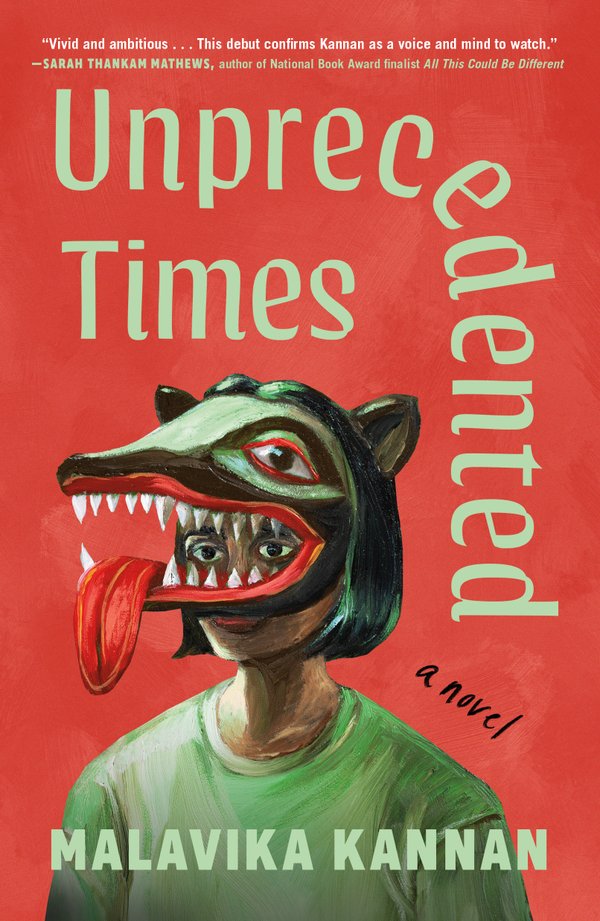
From Unprecedented Times: a novel by Malavika Kannan. Published by Henry Holt and Company. Copyright © 2026 by Malavika Kannan. All rights reserved.