1998
They are running again. Deep into the seam of the Wisconsin woods, through the gaps in the spruces and pines. Along the golden jog of the creek. They fly past the yowling of dogs, the hiss of fat catching fire under the grates of a grill, leaving behind clattering pill bottles, upturned furniture, napkins crumpled like fallen doves among pillars of glass, a yeasty belch of fury in the air. The yellow farmhouse becomes a thumb smudge in the background. And still, they go deeper.
Vivi, the elder at ten, holds her sister’s sweat-wicked hand so tightly that Calla, eight and indignant, cries out in protest. Vivi catches sight of Calla’s pastel-crayon-grimed fingertips, the marmalade streaked under the downward curve of her mouth. Her chest is tight with adrenaline, but she forces a release of muscle.
“Here, Button,” she says, handing Calla a stick. “Draw me a dragon.” When things become what they do, the sisters take to the woods.
In the dirt, they render worlds more beautiful and sensible than their own. Dragons expelled from castles; mermaids saving sailors from shipwrecks. Their mother, May, was the one who’d given them all those myths of justice. She hadn’t wanted to live in their reality, so she taught them to build stepping-stones made of stories. She revealed to them the art of waking dreams. Then she left to climb alone.
Calla stares at the stick, then throws it away from her. “No. I won’t.” Vivi sees a shiny, new hardness in her sister’s eyes. The gauze of childhood, lifted from a wound. She remembers how, just moments before, in the kitchen their mother once loved, their father had slapped Calla across the face. Don’t sass me, girl. It was an unconvincing slap, hesitant in its conviction, but it was also the first time Tuấn had turned against his youngest and most beloved.
Calla had stood in the mottled light, her hand cushioning her cheek, breathing fast. Vivi saw the churn of wills; their father, on his fourth beer of the evening, regretful yet clinging to his last thread of authority, and Calla, prideful and betrayed, ready to antagonize. Vivi had known enough to pull Calla away before portent could become disaster.
The woods of Deer Creek would always lure Calla in, her dark siren. Wind hissing through her parted lips, the clench of her teeth as she runs. She loves running. And maybe she’d let herself be pulled away because, in some corner of her young heart, she understands the mechanics of power. Even in the fairy tales, heroes must be cunning. They must wait for the monsters to sleep.
Now it’s dusk. Tuấn’s handprint on Calla’s skin is as pink as the disappearing horizon. Vivi thinks she would like to mix that color for herself. She’d start with a base of titanium white, warmed with Holland yellow. Then, a flick of carmine, deepened with an undertone of her favorite shade, phthalo blue. Yes, almost right. The tender pink of consequence.
Calla catches her gaze. “What are you looking at?” “I have an idea. Let’s play hide-and-seek. Trốn tìm.” “His game.” Calla quavers with disgust.
Months ago during a winter power outage, with nothing more to do than poke the fire, Tuấn told them about how he used to play with his younger brother Kiê`u in Long Xuyên. He rarely spoke of Kiê`u, but that night, the memories rivered from him. Tuấn talked about how he and his brother folded themselves into impossible wads of skin and bone to escape the other’s notice. The hiding had served them well during the war, another one of his forbidden topics. Tuấn buried the memories of singing bullets and refugee boats toppling with bodies, along with those of their mother, who’d left without a trace when Vivi was seven and Calla was five. Vanishings and violence, curses that kept on giving.
Before the sisters could ask where Kiê`u had gone, the lights flickered back on in the farmhouse. Tuấn would not speak about his brother again, but Vivi imagines her uncle sometimes, a patient man with her father’s blue-black eyes, still huddled behind the trees, waiting to be found. But he’s dead now. Most of their family are.
“Trốn tìm will be ours,” says Vivi. “Better than regular hide-and-seek.
A bigger adventure.”
Doubt hopscotches across Calla’s face, then sinks under the skin. In its place emerges a hope so tender and fragile that Vivi could almost reach out to stroke it.
“How do we play?”
They set the rules together. The seeker counts to fifty while the hider scurries to their chosen spot. They can hide anywhere in the woods, but once they find a spot, they are not allowed to move. No matter how long it takes, the hider can’t reveal herself, under that most grievous penalty of sibling humiliation.
Vivi scoots behind a stone shaped like a curled-up jungle cat, not far from where Calla squeezes her eyes shut, counting. Calla skips a few numbers, but Vivi doesn’t correct her. She presses her nails into the dirt and waits.
Then Calla begins hunting, footsteps approaching and receding, tracing orbits around the trees. By the ticking of her wristwatch, Vivi tracks five minutes, then ten. There’s a shuffling of leaves, Calla’s hum of annoyance.
At last, Calla’s head pops from behind the stone. Eleven minutes precisely. “Found you. My turn.”
As Vivi counts, eyes shut, she practices honing her other senses. Once, she’d read about sightless animals that relied on vibrations to navigate the world around them. An alternate sense expanding to fill in the gap of the missing one. She remembers her art teacher talking about Claude Monet’s diminished sight, how perception can muddy and sharpen all at once. Art, the teacher had said, can come from loss.
Twenty-seven, twenty-eight. Her fist curls and uncurls with the count, a throbbing organ.
On a parallel rail of thought, Vivi is imagining her father’s right hand, crushed in an accident at the lumber mill just a year before their mother left. Vivi was six when the accident happened. She’d only just begun to sleep through the night, but her father’s hand brought the nightmares back. She spies the hand when he’s sleeping, resting on his chest in a heap of skin and bone.
Now he does everything with his left hand. Reaching for his belt, slamming doors, holding the telephone receiver as he calls about the food stamps that never arrive on time. Driving like a maniac under the yawning country roads. Smacking Vivi for some infraction she would never remember afterward.
“Fifty,” she finishes.
Calla is not behind the crouching-cat rock. She is not among the ghost trunks of quaking aspen or the snowberry shrubs with their larval clusters of fruit. Vivi wanders on and on in the woods, her sneakers slipping in muck, a wet sickness running up her neck. Fifteen minutes, and still no Calla. A warbler trills from a branch, a squirrel scrabbles over mulch. Dread scoops a hollow inside Vivi’s stomach.
She hears her mother’s last words, the ones spoken before she left them in the night. Keep close to your sister. She’s all you have. A tuck of the hair, a soft close of the door. Vivi had nodded drowsily, not understanding what she was promising or how that promise would root inside her for the rest of her life. Because that’s the way of oaths. They are binding.
Ink now bleeds from the clouds, shadowing the last of the day. Vivi fiddles with the silver antler ring in her pocket, one of the mementos left behind by May. She hasn’t told Calla about the ring, but Calla will find out. The secrets never manage to grow between them.
“Calla?” she calls. “You can come out now. This is a stupid game.” She imagines Calla falling into the creek, bitten-down fingertips slipping beneath the surface. Wiggling a farewell. Vivi races toward that thin vein of the woods. Her feet stir the leaves and shuffling night creatures. But the creek’s surface is glass, reflecting a swarm of midges, the black cathedral of trees.
Vivi wants her mother, even as she feels her anger leaping out in unexpected places, then disappearing just as quickly. What would May do in this situation? Vivi doesn’t know anymore. With each passing year, the memory of her mother frays into another woodland story, draped from the boughs like moss. How to hate something that no longer exists?
Vivi makes her decision. She will go back to the farmhouse and find Tuấn. She’ll pull him into their hidden world, allow him to slice it open with his impotent rage, his unceasing blame. She has no choice. She is the protector and she has failed.
But then she hears a muffled giggle. She looks up and there Calla sits on a low branch, feet dangling in hand-me-down sneakers. She’d drawn a series of hearts on the outer sole and colored them in with a red Sharpie. Each as precise as a stamp.
Vivi blinks into this version of reality, one where Calla is not in danger at all, where they can be kids playing in a safe pocket of nature. How close the two realities were, how much slippage between their borders.
“Why didn’t you come out when I called?”
“That’s not how you play Seekers.” Calla hops down nimbly, spits a hunk of black hair out of her mouth.
“When did you learn to climb?”
Calla gives her a secretive smile. “Let’s play again.”
Later, it would come to Vivi, the way a sudden thunderstorm descends on a body, all white-hot flashes and skin-sluicing chill, that she had been the one to teach Calla to run. Before their minds and imaginations were fully formed, they’d learned together all the ways to hide from the world, and each other.
__________________________________
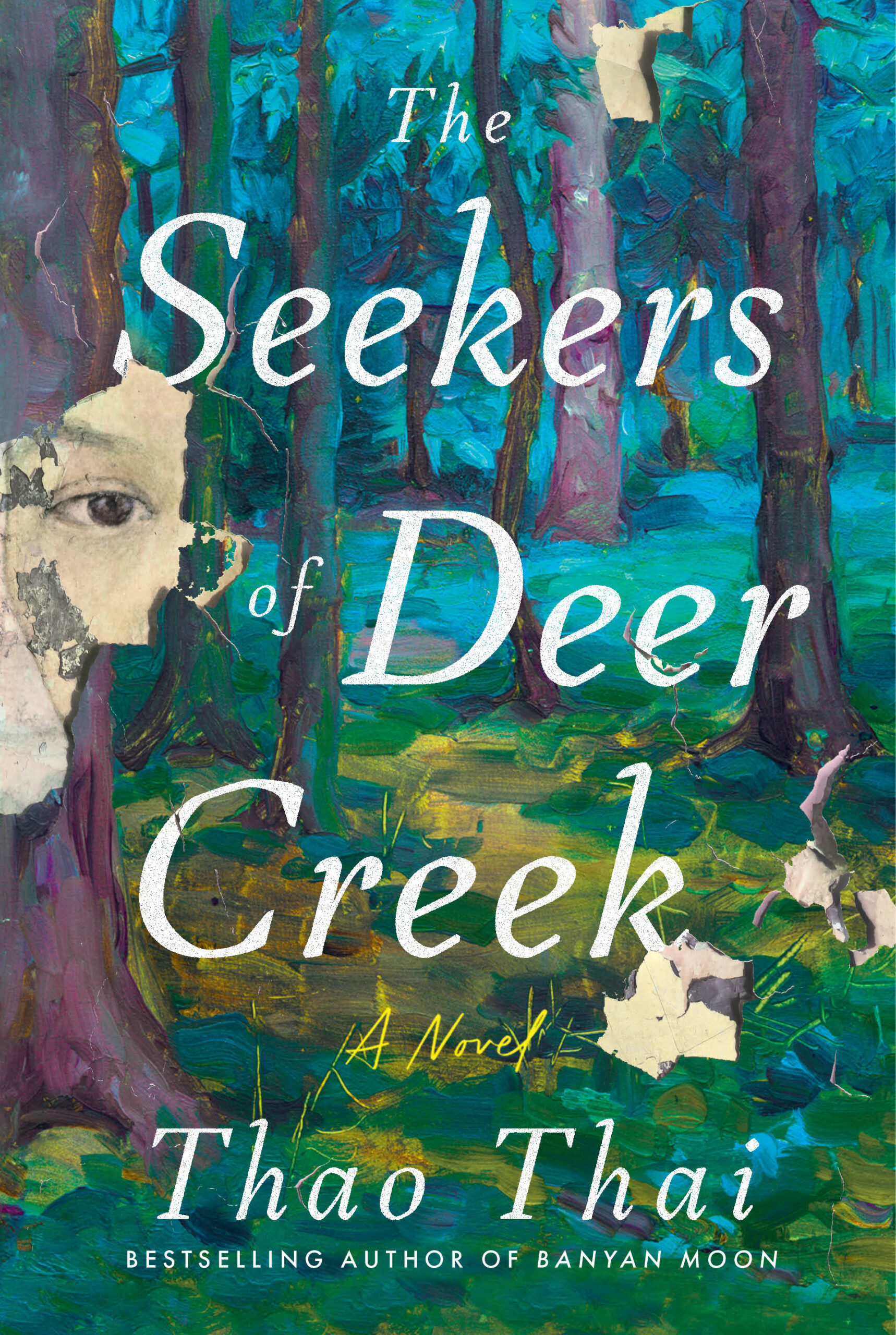
From The Seeker of Deer Creek by Thao Thai. Copyright © 2026 by Thao Thai. Reprinted by permission of Mariner Books, an imprint of HarperCollins Publishers.